


Kyoto Ine Funaya, Amanohashidate & Miyama Thatched Village Day Tour | Depart from Osaka
- Visit Ine Funaya and Ine Funaya Roadside Station in one day to experience the charm of Japan's most beautiful maritime village
- Explore Amanohashidate, one of Japan's three most scenic spots, and climb up to overlook the 'Flying Dragon' view or stroll through the pine forest and white sandbar
- Visit the Miyama Thatched Village in Kyoto to experience the atmosphere of traditional thatched-roof folk houses and slow village life
- Miyama milk and local ice cream are must-try delicacies in the Thatched Village, and taking photos in front of the vintage red mailbox is recognized by travelers as the best check-in spot
- Full Chinese-speaking driver/guide service, no transfers needed from Osaka, easy and direct access to three hidden gems
Package Options


Sightseeing Tours
| Tour Type | Shared tour |
| Transportation method | Transfer from meeting point |
| Minimum participant requirement | 4 travelers |
| Tour types | Guided tour |
| Meal arrangement | Arrange yourself |
| Family-friendly | Free for children under 2 (no seat) |
| Seasonal | Autumn Maple |
| Sightseeing type | Natural sights, Temples & shrines, Bus tour |
| Transport | Bus tour |
Product Info
This tour features the most iconic hidden gems in northern Kyoto: Ine Funaya, Ine Funaya Roadside Station, Amanohashidate, and the Miyama Thatched Village. In one day, you will visit a rare Japanese maritime village, one of Japan's three most scenic spots, and a traditional thatched-roof settlement. Known as the 'Venice of Japan,' the Ine boathouses are built along the bay, with the ground floor used for boats and the second floor for living, preserving the authentic lifestyle of a fishing village. The blue sea, mountains, and boathouses create a unique coastal landscape. At the Ine Funaya Roadside Station, you can enjoy a panoramic view of the bay and experience the slow, peaceful daily life of Ine Town. Next, head to Amanohashidate, one of Japan's three most scenic spots, where a 3.6-kilometer sandbar stretches across Aso Bay and Miyazu Bay. You can take the cable car to the View Land observatory to overlook the 'Flying Dragon' view or take a leisurely stroll through the pine forest and white sand. Finally, visit the Miyama Thatched Village, known as the 'Kyoto Shirakawa-go,' where rows of thatched houses and mountain scenery feel like stepping back into the Edo period. You can take photos in front of the vintage red mailbox and enjoy local Miyama milk or ice cream. Experience the original landscape of Japan, covering the sea, mountains, and traditional villages, all in one trip.
- Children aged 0-2 who do not occupy a seat are free of charge (please note when booking to avoid overcrowding). Please inform us upon booking. Children aged 3 and above are charged the same as adults.
- Each person is entitled to one piece of luggage for free, with no size limit. Please note this when booking (the driver/guide reserves the right to refuse boarding if the vehicle becomes crowded due to unnoted luggage, and no refund will be provided). If you have extra luggage, a fee of 2000 JPY per piece will apply.
- Reference vehicle types: 5-8 seater: Toyota Alphard or equivalent; 9-14 seater: Toyota Hiace or equivalent; 18-22 seater: Minibus; 22+ seater: Large bus. The above vehicles are for reference only; actual vehicles will be adjusted based on the number of participants on the day.
- Driver/guide service (1-13 people: small group with driver-guide; 14-45 people: bus tour, actual arrangement will be adjusted based on the number of participants on the day).
- Arrival times for each itinerary may vary due to unpredictable factors such as traffic, weather, holidays, or crowds. According to Japanese law, the maximum working time for drivers is 10 hours. To ensure driver safety and driving stability, the itinerary may be adjusted based on actual conditions, including reducing time at attractions, changing the order of visits, or canceling certain attractions. We sincerely hope for your understanding and support regarding adjustments made to ensure safety.
We deeply apologize for any inconvenience caused by itinerary changes due to the above or other force majeure factors. Please understand our position, as no refunds can be provided in such cases. This decision is based on considerations for the safety of both the driver and passengers, and to ensure the smooth operation of the group's overall itinerary. - We are committed to providing you with a high-quality travel experience, but in special circumstances, we may need to flexibly adjust the itinerary based on actual conditions. Thank you for your understanding and cooperation.

Head to the Ine Boat House Station on the high ground. From the observation deck, you can enjoy a panoramic view of the Ine Boat House and Ine Bay. You can take a short break, take photos, and, if the time permits, make some simple purchases of local seafood and souvenirs at the specialty shop.

Taking a sightseeing boat tour to enjoy close-up views of the Ine boat houses and Ine Bay from the sea is a classic way to experience the local fishing village atmosphere. ※Optional participation, at your own expense; tours may be suspended due to weather conditions. Please be aware of eagles while on the boat and avoid feeding the seagulls.

【Ine Boat Houses】, known as the "Venice of Japan," is one of Japan's most beautiful villages. More than 230 unique boat houses are scattered along a 5-kilometer stretch of Ine Bay, with the first floor for boats and the second floor for living, showcasing a lifestyle where people coexist with the sea. The azure sea and verdant mountains complement each other, creating a tranquil and rustic atmosphere that perfectly embodies the beauty of a traditional Japanese fishing village.
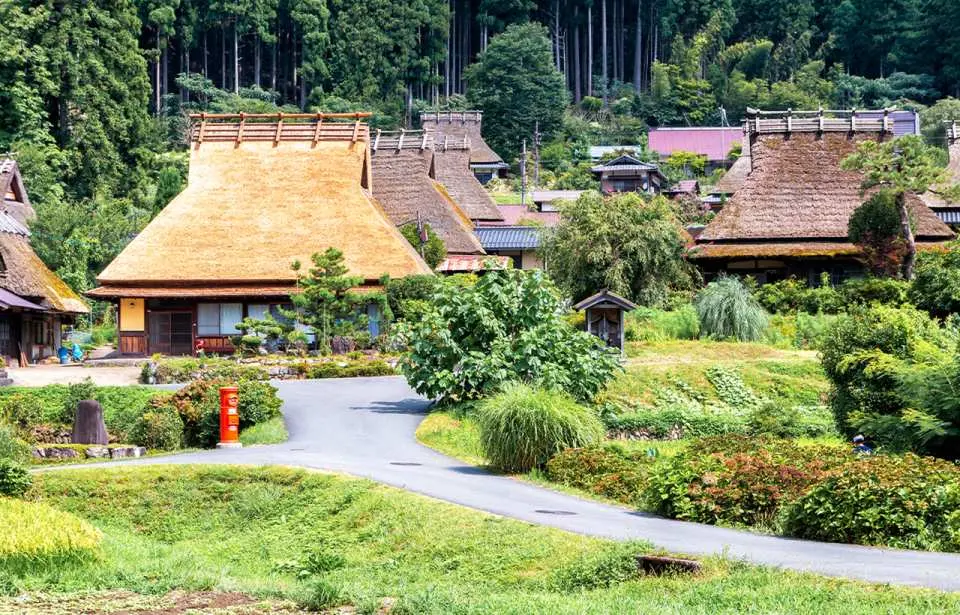
The main feature is a thatched cottage at the front, with rows of rooftops behind it creating a beautiful scene. The bright red old-fashioned mailbox at the entrance is a landmark of the village. The "Thousand Trees" and "Snowflakes" on the rooftops demonstrate the wisdom of the ancients in preventing snow and reinforcing structures.

Amanohashidate, along with Matsushima and Miyajima, is known as one of Japan's three most scenic spots. It stretches for about 3.6 kilometers and features approximately 8,000 pine trees on a sandbar, flanked by white sand, creating a magnificent view. From the View Land observation deck on Mount Bunju, you can overlook the spectacular view of Hiryukan, which resembles a dragon ascending to the sky, and admire the natural beauty where the Sea of Japan and Miyazu Bay meet.

Jieunsa Temple's Manjushri Hall enshrines Manjushri Bodhisattva, the god of wisdom, and is a place to pray for academic success. The temple's most distinctive feature is its fan-shaped fortune slips, symbolizing gradual improvement. Nearby, a spiral bridge connects the sky bridge to the mainland; large ships rotate 90 degrees to pass.

The sandbar on both sides of Amanohashidate is covered with fine white sand, perfect for strolling through the pine forest and enjoying the natural scenery. The Amanohashidate Shrine in the middle section is a place to pray for good luck in love, and the famous spring "Iso-Shimizu" is listed as one of Japan's 100 Famous Waters. It opens as a beach in summer with complete facilities, and the pine forest acts as a natural parasol.
Purchase Notice
【Travel Conditions】
Departure place and destination: Osaka and Kyoto
Trip duration: Day trip
Utilizing transportation: Bus
Using the transportation bus company: Ichisei Trading Co., Ltd.
Meal conditions: 0 breakfasts, 0 lunches, 0 dinners
Accommodation facilities: None
Minimum group size: 2
Team Leader: 1
【Travel Planning/Implementation】
Operating Company Name: Shuzenji Takitei Co., Ltd.
Address: Shuzenji 722, Shizuoka Prefecture I▖ City
License number: Shizuoka Prefecture Governor Registration Tourism No. 2-723
Reminders
A minimum of 2 traveler(s) are required for the tour to depart. If the number of participants does not reach the minimum requirement, the tour will be canceled. An email regarding tour cancellation will be sent 4 day(s) before the departure date
In the event of inclement weather such as typhoons or snowstorms, a decision on whether to cancel the tour will be made 1 day(s) before departure (local time 18:00). Notifications will then be sent via email
Travelers with the following conditions or other health issues that could be worsened by excessive stimulation should not participate in this activity: High blood pressure, Heart disease, Acrophobia, Asthma, Pregnant women, Epilepsy
Please arrive at the designated location 15 minute(s) before the scheduled departure time, as the tour will depart on time
This is a fixed-route shared tour. Customers participating in this tour are requested to adhere to the designated time limits at each attraction and follow the driver/guide's instructions. For a more flexible itinerary, please refer to our private charter car tour services.
If you leave the group midway through the trip, the transaction will be considered invalid, and no refund will be given. Furthermore, you will be solely responsible for any personal injury or property damage resulting from this.
No refunds will be given for any absences or cancellations due to personal issues, lateness, or other reasons. Please take note.
Arrival times for each itinerary may vary depending on traffic conditions, weather, holidays, and crowds. We apologize for any delays or cancellations caused by the aforementioned factors or other unforeseen circumstances, and no refunds will be provided on such grounds.
When there are fewer passengers, a small vehicle with a driver/guide providing simple explanations will be used. Please be aware that this is a shared ride service, and other guests will be traveling with you. Stops are not allowed outside of designated attractions.
The transportation and tourist attractions in this itinerary will be kept as faithful as possible to the original plan. However, in the event of special circumstances such as traffic congestion, inclement weather, large tourist crowds, or other force majeure events, the company reserves the right to make changes to the itinerary to ensure the safety of travelers and the smoothness of the trip.
According to Japanese law, the maximum working hours for drivers are 10 hours. To ensure driver safety and the stability of the itinerary, adjustments may be made based on actual circumstances, including reducing sightseeing time at attractions or canceling certain attractions. We apologize for any inconvenience. Refunds cannot be issued without prior notice. We sincerely hope for your understanding and support.
FAQ
1. What is Amanohashidate known for, and what makes its scenery unique?
Amanohashidate is renowned as one of Japan's Three Scenic Spots. It is famous for its long, pine-covered sandbar that appears to create a bridge across the bay. When viewed from a specific observatory (like the View Land Observatory) in the "matanozoki" (bending over and looking through your legs) pose, it resembles a dragon soaring into the sky. Its unique formation of land, sea, and trees makes it a breathtaking natural wonder.
2. What activities can visitors enjoy at Amanohashidate View Land Observatory?
At Amanohashidate View Land Observatory, visitors can primarily enjoy panoramic views of the "bridge to heaven" formation. The observatory offers various viewing platforms, including specific spots for the unique "matanozoki" pose. There are also smaller attractions such as a Ferris wheel and go-karts, adding recreational elements to the scenic experience. It's an ideal spot for photography and appreciating the natural landscape.
3. What are the unique characteristics and appeal of the traditional boathouses at Ine Funaya?
Ine Funaya is famous for its "funaya," traditional wooden boathouses that line the tranquil bay, giving it the nickname "Japan's Venice." These unique two-story structures have garages for boats on the ground floor, directly facing the water, and living quarters upstairs. Their appeal lies in offering a glimpse into a traditional maritime lifestyle, where daily life is intimately connected with the sea, creating a picturesque and serene coastal village landscape.
4. What types of activities can visitors participate in while at Ine Funaya?
Visitors to Ine Funaya can enjoy various activities focused on its unique setting. You can take a boat tour around the bay to see the funaya from the water, often with opportunities to feed local seagulls. Strolling along the shoreline allows for close-up views of the boathouses and the tranquil atmosphere. Some cafes and restaurants offer bay views, perfect for relaxing. It's generally not permitted to swim directly in the bay due to it being a working fishing village.
5. What makes Miyama Gassho Village a special destination, especially during autumn?
Miyama Gassho Village is a special destination due to its preservation of traditional thatched-roof "kayabuki" homes, offering a rare glimpse into rural Japanese architecture and culture. During autumn, the surrounding natural landscape bursts with vibrant fall colors, creating a picturesque backdrop for the historic village. The tranquil, rustic charm and sense of stepping back in time make it a highly valuable cultural experience, distinct from urban Kyoto.
6. What is the "water release" event at Miyama Thatched Village, and when does it occur?
The "water release" event at Miyama Thatched Village (also known as Miyama Kayabuki no Sato) is a special annual autumn spectacle. It involves local villagers conducting a fire drill where water cannons are used to spray the thatched roofs, demonstrating traditional fire prevention methods. This event typically occurs once a year in early December, creating a dreamlike scene of mist and rainbows against the backdrop of the historic village. It's a unique cultural experience.
7. Can tourists experience the interior of Kayabuki homes at Miyama Gassho Village?
Yes, tourists can often experience the interior of some Kayabuki homes at Miyama Gassho Village. While not all are open, a few traditional houses have been converted into museums or guesthouses, offering visitors a chance to see the unique architecture, traditional tools, and lifestyle of the past. It provides a deeper understanding of the craftsmanship involved in building and maintaining these iconic thatched-roof structures.
8. What unique cultural and natural experiences do Amanohashidate, Ine Funaya, and Miyama Gassho Village collectively offer?
Collectively, these three destinations offer a rich blend of Japan's natural beauty and deep cultural heritage. Amanohashidate presents a breathtaking natural wonder with its unique sandbar. Ine Funaya showcases a distinctive maritime culture through its traditional boathouses and serene bay life. Miyama Gassho Village preserves a timeless rural landscape with its iconic thatched-roof homes and agricultural traditions. Together, they provide a comprehensive journey through Kansai's picturesque countryside, blending scenic vistas with historical insights.


