
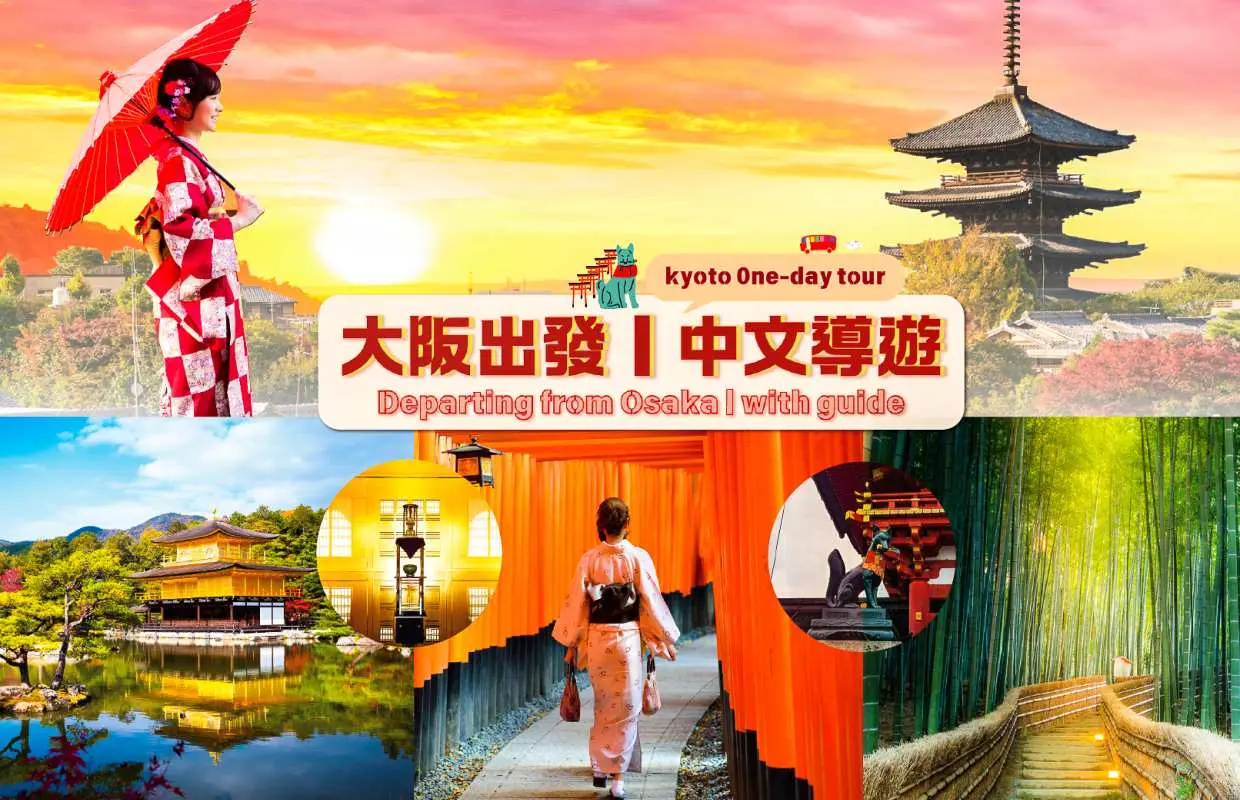


Kyoto, Japan | Arashiyama, Kiyomizu-dera Temple, Kinkaku-ji, Fushimi Inari Taisha Shrine | Classic Kyoto Day Trip | Departing from Osaka
- Exclusive Chinese customer service, providing exclusive Chinese maps of scenic spots
- The Golden Classic Route: Explore Kyoto's four most popular must-see attractions in one day
- Enjoy a fulfilling and wonderful journey by bus from Osaka with a professional Chinese-speaking tour guide, eliminating transportation worries.
Package Options


Sightseeing Tours
| Tour Type | Shared tour |
| Transportation method | Transfer from meeting point |
| Minimum participant requirement | 8 travelers |
| Tour types | Guided tour |
| Sightseeing type | Temples & shrines, Bus tour |
| Transport | Charter car, Walking |
Product Info
The content of this product is provided by machine translation and may not reflect the actual information, please take this into consideration before booking.
- Itinerary Introduction -
"A Stroll Through the Ancient Capital, a Classic Kyoto Day Trip - The Golden Pavilion Shines, the Thousand Torii Gates, and the Bamboo Grove" departing from Osaka.
• Arashiyama and Bamboo Grove: Famous for Togetsukyo Bridge and the bamboo grove path. The bamboo grove path stretches for about 400 meters, feeling like entering a fairyland, tranquil and healing.
Highlights: Cherry blossoms in spring, maple leaves in autumn, beautiful in all four seasons (filming location for the movie House of Flying Daggers).
• Kinkaku-ji(Rokuon-ji): A representative landmark of Kyoto, the three-story golden pavilion is reflected in the Mirror Pond, creating a picturesque scene.
Highlight: Regardless of the season, the reflections on the lake and the scenery of the Golden Pavilion are absolutely stunning.
• Fushimi Inari Shrine: Famous for its thousands of torii gates, the red torii gates stretch for several kilometers, forming a spectacular tunnel-like landscape.
Highlights: One of Kyoto's most iconic shrines, symbolizing commercial prosperity and good fortune, perfect for taking photos and paying respects.
Kiyomizu-dera Temple: A World Heritage Site, it features the Kiyomizu Stage and offers panoramic views of Kyoto. The scenery is especially breathtaking during the spring cherry blossom and autumn foliage seasons.
Highlight: The "Otowa Waterfall" inside the temple is said to bring blessings for studies, love, and health, and is very popular with tourists.
*The itinerary will include admission tickets to Kinkaku-ji during January and February.
-Important Notice During Japan's Golden Week-
·period
April 29 (Wednesday) to May 6 (Wednesday)
• The announcement states that severe traffic congestion occurs every year during Golden Week. To ensure a smooth trip, visits to Fushimi Inari Shrine will be cancelled during the aforementioned period, and the originally allocated time will be redistributed to other attractions for a more convenient visit.
Fushimi Inari Taisha Shrine enshrines Inari Okami, the deity who protects the harvest, business prosperity, and family safety. The fox is considered Inari Okami's messenger, conveying people's wishes. A closer look at the fox statues at the shrine reveals they carry ears of rice, keys, jade, or scrolls in their mouths, symbolizing abundance, wealth, and wisdom.


The shrine contains approximately 10,000 torii gates, donated by devotees from all over the country as a token of their prayers and gratitude. The pronunciation of "torii" in Japanese is similar to "pass," thus symbolizing the fulfillment of wishes and the attainment of desires.


Kiyomizu-dera Temple is one of Kyoto's seventeen UNESCO World Heritage Sites and one of the oldest surviving wooden structures in the world. The entire complex was constructed without using a single nail!


Niōmon is the main gate of Kiyomizu-dera Temple, a magnificent and imposing gatehouse. On either side of the gate stand statues of Vajrapani (spirit guardians), symbolizing the exorcism of evil spirits and the protection of believers.


Kiyomizu-dera's three-story pagoda stands approximately 30 meters tall, making it the largest of its kind in Japan! Its magnificent form has been a symbol of Kiyomizu-dera since ancient times, and it's a must-see for tourists when viewed against the backdrop of cherry blossoms.


The Shariden (relic hall) of Kinkaku-ji) is its biggest highlight, resplendent in gold and reflected in the water like a painting. The first floor is in the style of an imperial palace, the second in the style of a samurai, and the third is a Buddhist building, symbolizing the unification and supreme power of the shogunate's samurai regime.


The uppermost level of Kinkaku-ji, "Kikusho" (meaning "ultimate"), adopts the architectural style of Zen Buddhism, with a black lacquered floor and gold leaf covering the ceiling and walls. At the center is a Buddha's relics (relics of the Buddha) for people to worship.


Arashiyama's central landmark is Togetsukyo Bridge, which symbolizes the beauty of Arashiyama. "Togetsukyo Bridge" means "the bridge over which the moon crosses," and its name originates from the Heian period, when this place was a famous spot for cherry blossoms and autumn leaves.


The "Arashiyama Bamboo Forest Path" features thousands of lush green bamboos arranged in straight rows. A gentle breeze rustles the bamboo leaves, making a stroll here both dreamy and therapeutic.


Purchase Notice
【Travel Conditions】
Departure and destination: Osaka and Kyoto. Number of days: Round trip. Transportation: Chartered bus. Meals included: Breakfast 0, Lunch 0, Dinner 0. Accommodation: None. Minimum number of people: 8. Tour leader: 0. Tour guide: 1.
【Travel Planning/Implementation】
Operating Company: YOUTUOUR Co., Ltd. Address: 3rd Floor, Yashima Hakata Ekimae Building, 3-8-20, Hakata-ku, Fukuoka City, Fukuoka Prefecture License Number: Tourism Bureau Registration No. 2099 Travel Agent Association: Japan Travel Agents Association (JATA) Member
Reminders
A minimum of 8 traveler(s) are required for the tour to depart. If the number of participants does not reach the minimum requirement, the tour will be canceled. An email regarding tour cancellation will be sent 5 day(s) before the departure date
In the event of inclement weather such as typhoons or snowstorms, a decision on whether to cancel the tour will be made 1 day(s) before departure (local time 17:00). Notifications will then be sent via email
Please arrive at the designated location 15 minute(s) before the scheduled departure time, as the tour will depart on time
Please arrive at the meeting point 5 minutes before departure time. The tour guide will leave the meeting point and return to the bus 5 minutes before departure time. If you are late for the meeting time, we regret that we will not contact you to ensure on-time departure, as other passengers are waiting. No refunds or changes will be made for late arrivals or absences at the meeting time.
We apologize that guests arriving or departing on the same day cannot join the tour.
Each adult can bring one child under 3 years old for free, excluding a seat. Please make your request when booking.
For your safety while traveling, please purchase overseas traveler insurance.
Please note that child seats are not provided on this tour.
The specific itinerary and schedule may be adjusted depending on the weather, traffic, and flowering conditions on the day. Please understand that the actual arrangements made by the tour guide shall prevail.
To provide higher quality service, a dedicated tour guide will be assigned to each bus, regardless of its size.
Smoking is prohibited on the bus throughout the journey. Please clean up all your trash after the trip.
Please keep your valuables safe. When the trip is over, please double-check that you have not forgotten any of your personal belongings.
Depending on the number of people booking for the day, different sizes and types of buses may be available.
As Japanese law stipulates that vehicles cannot be used for more than 10 hours, the tour guide will adjust the itinerary time for each attraction based on the actual situation of the day. Thank you for your understanding!
Each passenger may bring a maximum of one piece of luggage free of charge, and please be sure to note it in the "Special Requests" section when placing your order. If you bring extra luggage at the last minute, due to limited space in the vehicle, it may not be possible to arrange for its placement, and this may affect driving safety and the rights of other passengers. We cannot guarantee that we can assist in handling such cases.
This tour offers unreserved seating; seats are not assigned. To avoid disputes during the journey, please ensure you have a reserved seat from departure until the end of the trip. Passengers who wish to select front-row seats should board the train early to do so. Thank you for your understanding and cooperation!
This is a group tour, and early departure or leaving the group midway is not permitted. If a traveler chooses to leave the group midway, it will be considered a voluntary abandonment of the unfinished itinerary, and no refund will be given. Furthermore, any accidents or losses incurred after a traveler leaves the group will be the sole responsibility of the traveler. Your understanding and cooperation are appreciated.
Once your itinerary is confirmed, the system will send your tour voucher via email. Please check your inbox. If you haven't received it, please check your spam/junk mail folder first. If you still cannot find it, please contact customer service as soon as possible to avoid affecting your trip. We will be happy to assist you.
Severe traffic congestion is a common occurrence during Japan's Golden Week holiday. To ensure a smooth trip, we will not be visiting Fushimi Inari Shrine during this period, and the originally allocated time will be redistributed to other attractions for a more efficient visit.
FAQ
Yes, entering the main path of Arashiyama Bamboo Grove is generally free for visitors. You can stroll through the towering bamboo forest and enjoy its serene atmosphere without an admission fee. However, some adjacent temples or specific gardens within the wider Arashiyama area, such as Tenryu-ji Temple or Okochi Sanso Villa, have their own separate entrance fees if you choose to visit them.
Walking through the main path of Arashiyama Bamboo Grove typically takes about 30 to 60 minutes, depending on your pace and how often you stop for photos or to simply immerse yourself in the tranquil surroundings. The core section is relatively short, but many visitors choose to explore nearby areas like the Tenryu-ji Temple garden or the Hozugawa River for a more extended experience.
The primary highlight of Arashiyama Bamboo Grove is the breathtaking sight of towering bamboo stalks forming a dense, natural canopy. Visitors can experience a unique tranquility as they walk along the path, enveloped by the rustling sounds of the bamboo leaves and the dappled sunlight. It's an iconic spot for photography, offering a serene escape and a distinct natural beauty that contrasts with Kyoto's temple and shrine architecture.
The best time to visit Arashiyama Bamboo Grove for a more peaceful experience is early morning, right after it opens, or late afternoon before sunset, to avoid the largest crowds. Seasonally, spring and autumn offer pleasant weather, with cherry blossoms nearby in spring and vibrant foliage in autumn. Winter can also be magical with light dusting of snow, while summer provides lush greenery but can be hot and humid.
The walking experience at Fushimi Inari Shrine is unique, centered around thousands of vibrant vermilion torii gates that form tunnels leading up Mount Inari. Visitors can walk through these iconic gates, which are donations from individuals and companies. The path can be an extensive uphill hike to the summit, taking a few hours, or a shorter loop through the main gate areas, offering picturesque views and smaller shrines along the way.
Kiyomizu-dera Temple is renowned for its large wooden stage that juts out from the main hall, offering panoramic views of Kyoto. The main hall itself houses a statue of Kannon, the goddess of mercy. Other highlights include the Otowa Waterfall, where visitors can drink from three streams believed to grant wishes, and the Jishu Shrine for matchmaking. The temple grounds are also beautiful during cherry blossom and autumn foliage seasons.
Kinkaku-ji, also known as the Golden Pavilion, is a Zen Buddhist temple in northern Kyoto. Its significance lies in its stunning architecture, with the top two floors completely covered in gold leaf, reflecting beautifully on the surrounding pond, Kyōkochi (Mirror Pond). Originally a villa for a shogun, it was converted into a temple after his death. It symbolizes the Kitayama culture of its era and is a UNESCO World Heritage site, admired for its exquisite garden design and historical value.
Traveling between Kyoto's major attractions like Arashiyama and Kiyomizu-dera can be done using a combination of trains and buses. For instance, you could take a JR train from Arashiyama to Kyoto Station, then transfer to a bus for Kiyomizu-dera. However, for a seamless experience without planning multiple transfers or navigating public transport, joining an organized day tour often includes comfortable bus transportation directly between these popular sites, eliminating the hassle of self-planning and allowing more time for sightseeing.
Get Help


