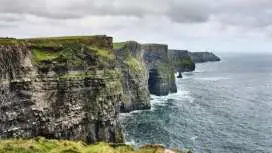


Cork
- Suitable For
- Market Finds, Historic Sites, Architecture
- Featured Activities
- English Market, Blarney Castle, Shandon Bells
Best Time to Visit May, June, July, and August


Ireland is a central plain surrounded by beautiful mountains, with quicksand beaches and sub-temperate bays nourished by warm currents. The natural scenery and cultural heritage here attract countless tourists. The best tourist season is from October to April, when the temperature is suitable and suitable for enjoying the warm sunshine. Must-see attractions include the Guinness Distillery Museum and Aviva Stadium, among others.
Best Time to Visit May, June, July, and August
Best Time to Visit May, June, July, and August
Best Time to Visit May, June, July, and September
Best Time to Visit May, June, July, and August
Day 1
Dublin Airport, City Centre
Trinity College & Book of Kells
Grafton Street stroll & shopping
Day 2
Dublin City Centre, The Liberties
Dublin Castle & Christ Church Cathedral
Dublin: Book of Kells, Dublin Castle and Christ Church Tour|IrelandGuinness Storehouse
Music & dance dinner show
Day 3
Wicklow, Dublin City Centre
Powerscourt Gardens
Glendalough monastery & lakes
Tour return to Dublin
Henry Street shopping
Day 4
Dublin, Galway City
Train to Galway
Latin Quarter & Spanish Arch stroll
Latin Quarter seafood dinner
Day 5
The Burren, Cliffs of Moher, Galway
The Burren & Dunguaire Castle
Aran Island and Cliffs of Moher tour with cruiseCliffs of Moher scenic walk
Tour return to Galway
Shop Street stroll & shopping
Day 6
Galway, Dublin Airport
Eyre Square stroll
Direct bus to Dublin Airport
Cliffs of Moher, Burren, and Galway day trip from Dublin
Global Multi-Country SIM Card | Global Orange Internet + Calling eSIM
I used this eSIM card in Croatia, Montenegro, Slovenia, Hungary, and Austria. The reception was excellent 90% of the time, and the phone function was very convenient. The reception was only slightly poor in mountainous areas or when traveling on trains in remote regions. I initially chose the global SIM card because I was going to Montenegro. If the countries you're visiting are all within the eSIM card's coverage area, you can buy the eSIM card.
Anonymous user
Friends

Europe eSIM | 42 Countries | Unlimited Data
Internet access is OK in Hungary, Croatia, Slovenia, and Italy.
Anonymous user
Family

Europe eSIM: High-Speed Daily Data / Total Data
By completing a simple setup before leaving Japan, I was able to use the internet without any problems during my trip. This time, I visited Munich in Germany and Barcelona, Madrid, Toledo, and Malaga in Spain for about a week, and I was able to use it without any issues in all of them! Basically, I only used it to look at maps and do some research on Instagram, but it was very fast and comfortable. The price was also reasonable, and I would really recommend it to anyone planning a trip to Europe ;)
Anonymous user
Solo traveler

[Up to 50% Off | Purchase and Use Immediately]Europe Multi-Country 5G eSIM | Supports All AI Apps and TikTok | Daily Plan / Total Data Plan / Unlimited Data
The process was simple and quick, but it was disappointing that I couldn't change the date. It's convenient because it can be used in several European countries.
Anonymous user
Friends

Europe 5G eSIM | 38 or 41 Destinations | 1–30 Days
This trip through multiple European countries: the automatic network switching between Germany, France, and Italy was incredibly smooth! No need to reset anything, Google Maps navigation and photo transfers were fast and easy. Great value for money, I'll definitely buy it again next time I travel abroad!
Anonymous user
Solo traveler
Data source: Meteostat・Last updated: 2025-09
Spring (March–May): Average 6.6–11.6°C, cool and humid climate with occasional showers. Common activities: Coastal walks, visiting castles, enjoying the countryside. Recommended clothing: Light waterproof jacket, sweater, long trousers.
Summer (June–August): Average 12.4–14.6°C, mild climate, sunny with less rainfall. Common activities: Hiking, cycling, seaside activities. Recommended clothing: Light breathable clothing, sun protection clothing, rain gear.
Autumn (September–November): Average 10.4–8.1°C, cool climate, slightly increased rainfall. Common activities: Autumn sightseeing, visiting museums, enjoying local cuisine. Recommended clothing: Warm jacket, long-sleeved clothing, comfortable trousers.
Winter (December–February): Average 3.9–7.1°C, cold and humid climate, occasional rain or snow. Common activities: Indoor activities, visiting art galleries, enjoying warm pubs. Recommended clothing: Warm coat, scarf, hat, gloves, waterproof boots.
Annual average temperature: approx. 9.6°C / Annual rainfall: approx. 33 mm / Summer humidity: 65%–75% / Rainiest month: March
| Month | January | February | March | April | May | June | July | August | September | October | November | December |
|---|---|---|---|---|---|---|---|---|---|---|---|---|
| Temperature | 3.9°C | 7.1°C | 6.6°C | 8.3°C | 11.6°C | 12.4°C | 13.8°C | 14.6°C | 12.2°C | 10.4°C | 8.1°C | 6.6°C |
| Rainfall (mm) | 2.5 | 4.4 | 4.3 | 3.3 | 3.2 | 1.4 | 1.9 | 2.4 | 2.2 | 2.8 | 2.8 | 2.3 |
| Date | 11/21Saturday | 11/22Sunday | 11/23Monday | 11/24Tuesday | 11/25Wednesday | 11/26Thursday | 11/27Friday |
|---|---|---|---|---|---|---|---|
| Weather |  Mist |  Light drizzle |  Patchy rain nearby |  Light rain |  Partly Cloudy |  Overcast | Light drizzle |
| High | 10.5°C | 8.9°C | 9.9°C | 9.8°C | 6.8°C | 8.7°C | 9.9°C |
| Low | 4.1°C | 7.5°C | 6.6°C | 4.6°C | 1.8°C | 1.7°C | 4.7°C |