


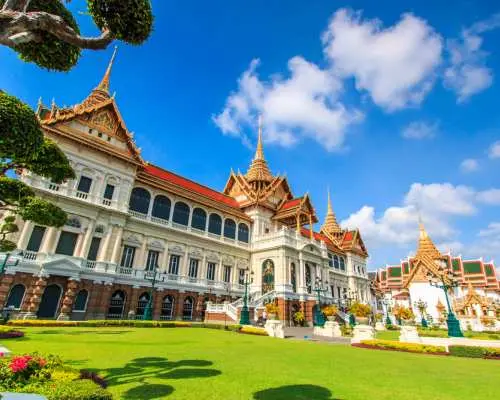

Downtown Bangkok Private Day Tour
- Explore vibrant Bangkok at your own pace with a private car service and personal driver. Take in iconic landmarks like the Grand Palace and Wat Arun.
Package Options


Product Info
- Highlights -
・See Bangkok’s top attractions like Wat Pho (Temple of Reclining Buddha) etc.
・Build your own itinerary, see only what you want to, just inform and we'll design the tour for you!
・Sit back and relax as your driver takes you from stop to stop
・Choose the vehicle size that suits your needs (Number of passengers)
- What You Can Expect -
Discover the beauty of Bangkok at your own leisure. Your private car service and driver will take you sightseeing across Bangkok. See points of interest like the Grand Palace, boasting intricate architecture.
Stop at Wat Arun, also known as the Temple of Dawn, which looks spectacular lit up at night. Let your driver take you from point A to B; no need to worry about directions. Choose a small, medium or large size vehicle to suit your needs. Get to know Bangkok with this 10 hours private car service.
- Important Info -
・Depart time: Your selection (Just confirm the starting time and meeting point before the service date)
・Duration: 10 hours
・Meeting Points:
- Bangkok Hotel lobby (Where guests are staying)
- Suvarnabhumi Airport Information Counter [near Exit Gate 3 on the Arrivals level (2nd floor)]
- Don Mueang International Airport International Arrival (Gate 5, Terminal 1) or Domestic Arrival (Gate 11, Terminal 2)
** A grace period of 20 mins will apply for hotel pick-up **
-Vehicle Types-
- Deluxe Sedan (Toyota Camry or equivalent) for 1-2 passengers with no more than 2-3 pieces of 24–28-inch luggage.
- Family MPV (Toyota Innova or equivalent) for 3-4 passengers with no more than 3-4 pieces of 24–28-inch luggage.
- VIP Van (Toyota Commuter or equivalent) for 5-10 passengers with no more than 5-6 pieces of 24–28-inch luggage. (Up to 10 passengers if no luggage)
• Please consider the number of passengers and luggage before booking, in order to choose the most suitable vehicle. Also, note that the seating area will be reduced according to the number of luggage
-Additional Info -
・An additional fee of THB 500 Baht for Sedan/MPV and 800 Baht for VIP Van. if you wish to begin or end your tour at Don Mueang International Airport and Suvarnabhumi Airport (BKK) ; fees to be paid on-site, directly to the driver.
・Please notify the supplier of the attractions you wish to visit in the 'Notes' section while booking, so the driver can design & arrange the route for you
・For travelers who wish to be picked-up or dropped-off at Suvarnabhumi Airport (BKK) or Don Mueang International Airport (DMK):
- Please provide your flight number and details (arrival or departure time) in the 'Notes' section when pressing the booking
・The following surcharges will apply for overtime, to be paid directly to the driver: ・Also surcharge of THB100 will apply to start the service on these following these areas as follows: Phranakorn / Charoennakorn / Thonburi / Samsen / Ladprao / Chatuchak / Laksi / Don Muang (to be paid directly to the driver)
Bangkok Pick up - Drop off zone

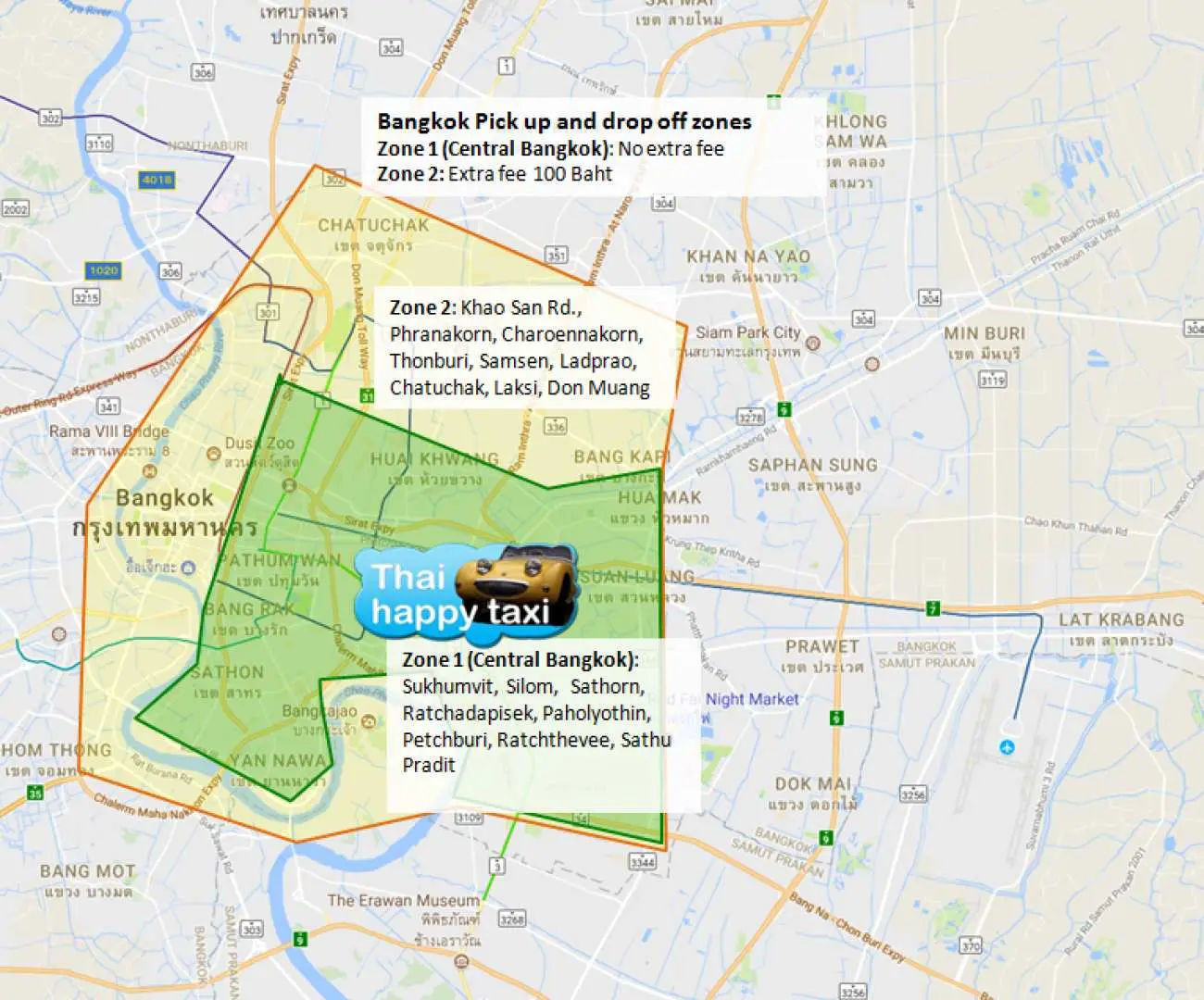
Additional cost price Pick up - Drop off Pick-up at certain areas requires additional fees.


Type of vehicle : Deluxe Sedan - Suitable up to 2 passengers (brand or color of the car might be subject to change depending from the availability)


Type of vehicle : Family MPV - Suitable for 4 passengers (brand or color of the car might be subject to change depending from the availability)


Type of vehicle : VIP Van - Suitable up to 10 passengers (brand or color of the car might be subject to change depending from the availability)


Luggage Information


Important Info
Reminders
Please discuss the itinerary with your driver in advance. You can still change your itinerary within 3 days after your booking. Please note that once your booking is confirmed, no changes can be made
Status may be reported to the local agency in order to check your itinerary
The pick-up location for international flight travelers is changed to international arrival gate 5, please refer to the notice released by the supplier for more information
If your trip requires extra stops outside of the normal route, we will inform the amount and send invoice for credit card payment. Please check your message and make a payment before the trip.
Cancellation Policy
- Cancellations 3 day(s) (inclusive) before the selected date are allowed. Unused orders can be canceled for free
- Cancellation is not allowed between 0–2 days from the selected date. Orders cannot be canceled or modified, and refunds will not be granted.
- Due to time zone differences, the confirmed cancellation date is based on the supplier’s local time. Please allow 2–5 business days to process your cancellation request, after which the cancellation fee will be charged according to the product’s cancellation policy. Once the cancellation is confirmed, you will receive your refund within 14 working days.
FAQ
The Grand Palace is a historical symbol of Thailand's monarchy, serving as the official residence of the Kings of Siam (and later Thailand) since 1782. It embodies traditional Thai architecture and craftsmanship, housing the revered Wat Phra Kaeo (Temple of the Emerald Buddha), which is considered the most sacred Buddhist temple in Thailand. Its intricate design and spiritual importance make it a cornerstone of Thai cultural identity.
Visitors to the Grand Palace can expect a rich immersive experience into Thai history and art. The complex features several impressive buildings, halls, and temples, showcasing exquisite golden spires, intricate mosaics, and detailed murals. It offers a glimpse into royal traditions and religious practices, providing numerous photo opportunities amidst stunning architecture and landscaped gardens. It's a place of reverence, so a respectful demeanor and appropriate attire are essential.
Within the Grand Palace complex, visitors can explore several key areas. The most prominent is Wat Phra Kaeo, the Temple of the Emerald Buddha, which houses a highly revered Buddha statue. Other areas include the Royal Reception Halls, the Coronation Hall, and the Royal Pantheon, each with unique historical and architectural significance. While some areas are open for viewing, others, like the current royal residence, are not accessible to the public.
Tipping for a private driver in Bangkok is a common practice and greatly appreciated for good service. While there's no strict rule, a general guideline is to offer a gratuity that reflects the quality of service, duration of the trip, and your satisfaction. For a full-day tour, a tip equivalent to a few hundred Thai Baht is customary, demonstrating appreciation for their professionalism, local knowledge, and comfortable journey.
A private car service significantly enhances a day tour by providing unmatched convenience and flexibility. You can navigate Bangkok's bustling traffic comfortably and efficiently, reaching landmarks like the Grand Palace and Wat Arun directly without the hassle of public transportation or searching for taxis. It allows for a personalized itinerary, maximizing time at each site and offering a comfortable retreat between locations, complete with air-conditioning.
Visitors can conveniently arrange entry to the Grand Palace and other attractions by booking a comprehensive private Bangkok tour. Reputable platforms like KKday offer such tours, where entry requirements for major sites are often seamlessly integrated into the package. This ensures a smooth and hassle-free experience, allowing you to focus on exploration while a professional guide and private driver manage logistics, often saving time with pre-arranged access.
Wat Arun, known as the Temple of Dawn, is famous for its towering central prang (Khmer-style tower) adorned with intricate mosaic patterns made from colorful porcelain and seashells. This design gives it a shimmering appearance, especially at sunrise or sunset. Visitors can appreciate the detailed craftsmanship up close and enjoy scenic viewpoints of the Chao Phraya River from its surrounding smaller prangs, offering excellent photography opportunities.
When visiting sacred sites like the Grand Palace, a strict dress code must be observed out of respect. Visitors must dress modestly, covering shoulders and knees. This means no sleeveless tops, shorts, mini-skirts, or ripped jeans are permitted. Comfortable, respectful attire such as long pants, long skirts, or dresses, and shirts with sleeves are appropriate. Footwear should also be respectful, though specific shoe requirements are typically less stringent.
Get Help


