


Beijing Great Wall (Juyongguan) & Longqing Gorge Day Tour (Korean-speaking guide, admission & cruise included)
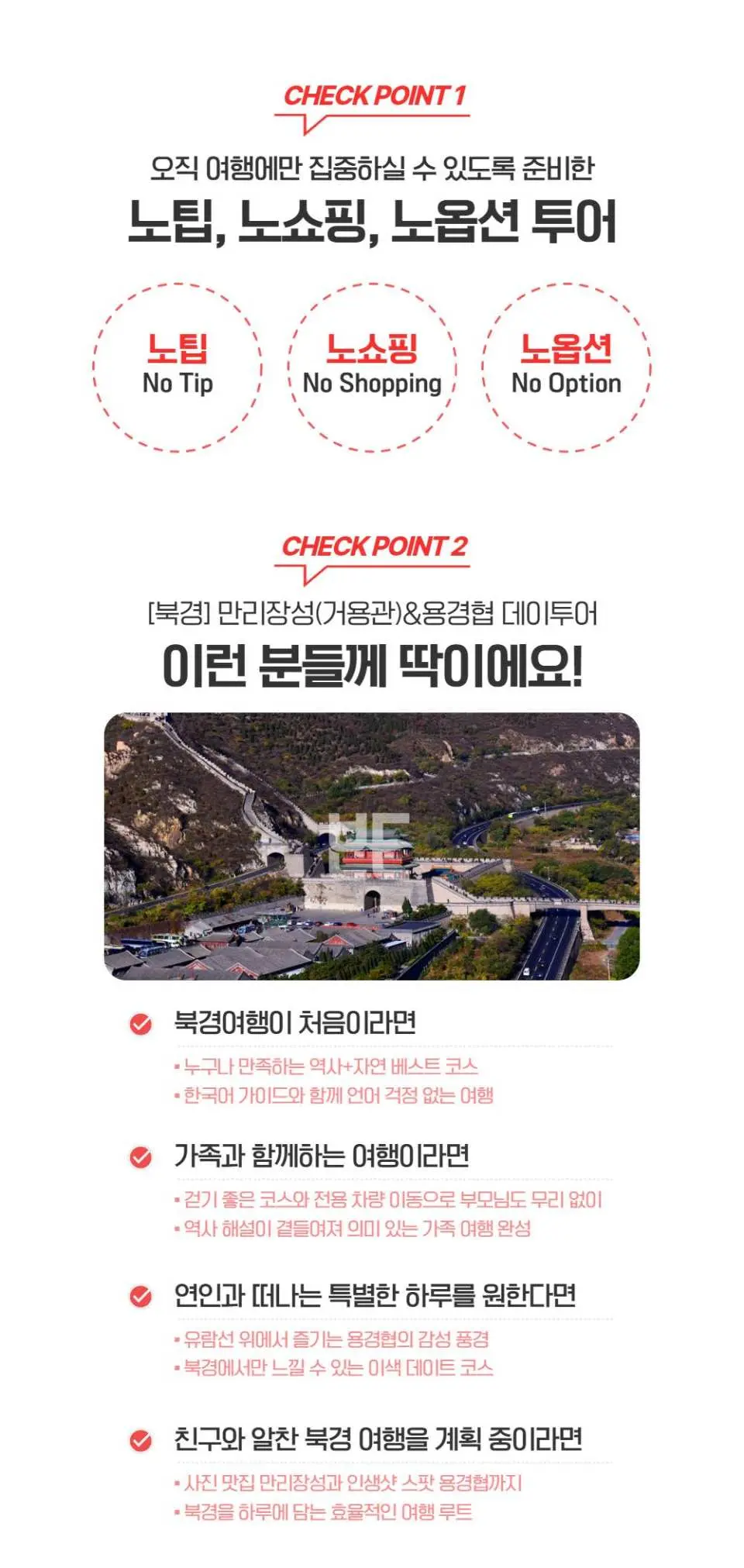
- Visit Juyongguan, one of the most famous ancient military fortresses on the Great Wall.
- Enjoy a cruise at Longqing Gorge, a man-made lake created by damming a valley, often referred to as the 'Little Guilin'.
- Travel comfortably with a private vehicle and a Korean-speaking guide.
Product Info
Experience the grandeur of Juyongguan Great Wall, steeped in China's long history, and
the serene beauty of Longqing Gorge, where water flows between cliffs.
A day in Beijing to encounter both nature and history.




Purchase Notice
- This product is a join-in tour, and the minimum number of participants for departure is 4.
- If the minimum number of 4 participants is not met, the tour may be cancelled.
- Adult rates apply for children 120cm or taller, and child rates apply for children between 100cm and 120cm. (Infants under 100cm are free.)
- If the height limit for infants or children is exceeded on the day of the tour after the reservation is completed, the difference will be charged.
- As this is a joint tour, please be sure to arrive on time for the meeting.
- If you are late for the meeting time without prior notice, the tour will depart without further notification, and in such cases, refunds and cancellations are not possible.
- The vehicle size is assigned based on the number of passengers on the tour day.
- We recommend purchasing travel insurance before participating in the tour.
- Cancellation/refund requests are accepted only if received during business hours (Monday to Friday 10:00–18:00 / excluding Saturdays, Sundays, and public holidays). Requests received outside of business hours will be processed on the next business day.
- Please make reservation cancellation and refund requests during business hours and receive confirmation of the cancellation.
Reminders
A minimum of 4 traveler(s) are required for the tour to depart. If the number of participants does not reach the minimum requirement, the tour will be canceled. An email regarding tour cancellation will be sent 3 day(s) before the departure date
FAQ
1. How can travelers conveniently reach the Juyongguan Great Wall from Beijing?
The Juyongguan Great Wall is located north of Beijing. The most convenient way for travelers to visit is often through an organized day tour that includes private transportation. Such tours typically provide a comfortable vehicle service directly from Beijing, eliminating the complexities of public transport transfers and ensuring a smooth journey to and from the site. This allows visitors to enjoy the scenic drive without navigation concerns.
2. What differentiates the Juyongguan section of the Great Wall from other popular sections like Badaling or Mutianyu?
Juyongguan stands out as a formidable military pass, unlike sections primarily built for defense along mountain ridges. It's known for its well-preserved fortress architecture, including watchtowers and gates. Historically, it was a crucial strategic point guarding Beijing. Compared to Badaling, Juyongguan is generally less crowded, offering a more tranquil experience. While Mutianyu is famous for its cable cars and slides, Juyongguan provides a more immersive historical fortress experience, often allowing for closer exploration of its military structures.
3. What is the historical background and strategic importance of the Juyongguan Great Wall?
Juyongguan, or Juyong Pass, has a history spanning over a thousand years, dating back to the Northern and Southern Dynasties. It was one of the three great passes of the Great Wall, along with Jiayuguan and Shanhaiguan. Its strategic importance lay in its natural mountainous terrain, making it a critical choke point defending Beijing from invasions from the north. The pass has witnessed numerous battles and played a pivotal role in protecting the capital through various dynasties, including the Ming Dynasty, making it a symbol of ancient Chinese military prowess.
4. Besides its historical value, what other activities or sights can visitors enjoy at Juyongguan Great Wall?
Beyond appreciating its historical fortifications, visitors to Juyongguan Great Wall can enjoy climbing sections of the wall for panoramic views of the surrounding valleys and mountains. The site also features the Cloud Platform, an impressive marble archway with intricate carvings, and the Great Wall Museum, which offers deeper insights into the wall's history and construction. Walking along the restored sections provides an excellent opportunity for photography and experiencing the grandeur of this ancient marvel.
5. What kind of natural scenery and leisure activities does Longjing Gorge offer as part of the tour?
Longjing Gorge, also known as Yonggyeong Gorge or 'Little Guilin,' offers stunning natural scenery characterized by lush green mountains, clear waters, and unique rock formations. The primary leisure activity is a relaxing boat cruise along the artificial lake, which allows visitors to admire the picturesque landscape and towering cliffs up close. The serene environment provides a peaceful contrast to the historical intensity of the Great Wall, making it an ideal spot for photography and enjoying nature's tranquility.
6. Are there specific architectural features at Juyongguan Great Wall that highlight its military role?
Absolutely. Juyongguan is renowned for its elaborate military architecture. Key features include multiple strong watchtowers, massive fortress gates, and interlocking defensive walls that adapt to the mountainous terrain. The Cloud Platform (Yuntai) within the pass originally served as the base for a pagoda and features exquisite Buddhist carvings, demonstrating a blend of military and cultural significance. These structures collectively showcase the sophisticated engineering and strategic thinking behind the Ming Dynasty's defense system.
7. What advantages does a tour with a private vehicle and a Korean guide offer for visiting Juyongguan Great Wall?
A tour providing a private vehicle ensures comfort and efficiency, allowing visitors to travel directly to Juyongguan Great Wall and Longjing Gorge without the stress of navigating public transport. The convenience of door-to-door service enhances the overall travel experience. Furthermore, a Korean guide offers invaluable insights into the history and culture of the sites in your preferred language, enriching the visit with expert commentary and making the complex historical context more accessible and engaging.
8. What local legends or significant historical events are associated with the Juyongguan Great Wall?
Juyongguan is rich with historical narratives. One notable event is its role during the Mongol invasions, particularly during the Yuan Dynasty when it became a crucial passage. Later, during the Ming Dynasty, it was heavily fortified and witnessed significant battles, repelling various northern nomadic tribes. While specific local legends can vary, the entire Great Wall system, including Juyongguan, is steeped in tales of emperors, soldiers, and the immense human effort involved in its construction, reflecting centuries of history and conflict.


