


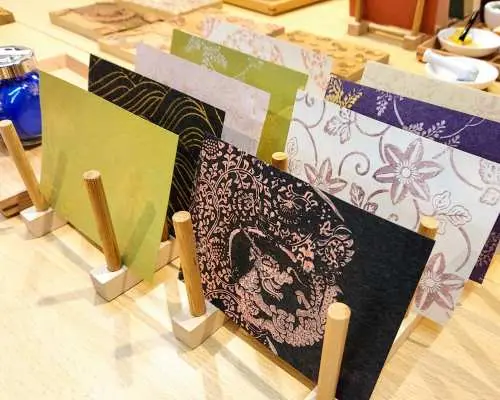


Kyoto, Japan|Kyo Karakami|Mini woodblock printing experience・Hand-printed postcards
- By purchasing this tour through KKday, you will use Kyo Karakami's mini experience kit "KARAKAMI KIT" to personally print the Tang paper patterns on postcards.
- Recommended to friends who want to easily experience hand-made rubbings. Suitable for creating with family and friends and enjoying the fun of hand-made!
- The hand-made experience provides English service and the finished product can be taken home on the same day.
Product Info
The content of this product is provided by machine translation and may not reflect the actual information, please take this into consideration before booking.
- Itinerary -
In this experience, you will use Kyo Karakami's mini experience kit "KARAKAMI KIT" to personally print the patterns on the postcards. Recommended for friends who want to easily experience hand-made rubbings. Suitable for creating with family and friends and enjoying the fun of hand-made!
- Project Introduction -
1. [「Kyo Karakami」Mini Woodblock Printing Experience・Hand-printed Postcards]
- In this experience, you will use Kyo Karakami's mini experience kit "KARAKAMI KIT" to personally print the patterns on the postcards.
- Experience content:
- 9 traditional Tang paper patterns to choose from
- 2 types of pigments, you can mix your own color
- 14 postcard colors available
- You can create about 5 to 7 unique postcards
2. [Experience making rubbings on Tang paper and making your own red seal book]
- Using Japanese paper (Torinoko Japanese paper), we hand-print traditional Karakami patterns and make them into goshuincho.
- Experience content:
- Make a copy of a piece of Tang paper and bind it into a Goshuin book
- More than 20 kinds of Torinoko paper colors to choose from
- Change 3 different wood panels every month to create a unique design
- Finished products can be taken back on the same day - Goshuin Book Size: Approx. W12cm x H18cm
3. [Kyoto Karakami Studio Visit & Traditional Tang Paper Rubbing Experience]
- Explore the Kyo Karakami workshop with a history of over 100 years, learn about the craft of making Karakami paper, and experience rubbing Karakami paper yourself.
- Experience content:
- Traditional wood blocks with a history of more than 100 years (approximately W47 × H28cm)
- Change 3 different wood panels every month to create a unique design
- 3 pieces of Tang paper, you can freely mix and match 20 kinds of Toriko paper colors
- 2 types of pigments, you can mix your own color
- You can choose to take it back as a finished product, or process it into a decorative panel (additional cost)
4.【Hand-made rubbing experience & 3D lighting production】
- The lampshade is made of translucent reinforced Japanese-style rubbing paper to create a three-dimensional light and shadow beauty.
- Experience content:
- The finished product can be taken back on the same day, convenient to carry
- Comes with lamp holder & LED bulb
- Lighting size: Approx. W19cm × D19cm × H29cm
5.【Hand-made rubbing experience & unique decorative panel production】
- Experience content:
- Use Torinoko Japanese paper to print 2 sheets of Kara paper (optional 3 types of wood and 2 types of pigments)
- One of them will be mounted as a decorative panel, and the other one can be used freely
- Finished products can be taken back on the same day
- Panel size: W27.5cm × H27.5cm × D2.1cm
6. [Machiya Culture - "Kyoto Karakarmi Exploration Tour"]
- Experience content:
- Learn about the history and traditional craftsmanship of Kyo Karakami
- Visit a large Kyomachiya house decorated with actual Karakura paper
- Experience rubbing Tang paper with your own hands and feel the charm of Tang paper up close
9 traditional Tang paper patterns to choose from


Suitable for creating with family and friends and enjoying the fun of hand-made


Important Info
Reminders
Preschool children must be accompanied by a parent or guardian
How to Redeem Your Voucher
How to Use Your Voucher
- Please present the e-voucher on-site
Experience Location
Location Name: Kyo Karakami Experience Workshop and Kara Maru Store
Address: 460 Senshoji-cho, Shimokyo-ku, Kyoto CityCancellation Policy
- Cancellations 3 day(s) (inclusive) before the selected date are allowed. Unused orders can be canceled for free
- Cancellation is not allowed between 0–2 days from the selected date. Orders cannot be canceled or modified, and refunds will not be granted.
- Due to time zone differences, the confirmed cancellation date is based on the supplier’s local time. Please allow 2–5 business days to process your cancellation request, after which the cancellation fee will be charged according to the product’s cancellation policy. Once the cancellation is confirmed, you will receive your refund within 14 working days.
FAQ
The traditional Kyo Karakami process involves several steps: selecting washi paper, carving intricate patterns onto woodblocks, and then hand-printing. Pigments are applied to the woodblock, which is carefully pressed onto the paper. This technique often uses mica to create a subtle shimmer, enhancing the pattern's elegance. The process requires precision and skilled craftsmanship.
Key techniques in Kyo Karakami include 'karazuri' (blind embossing) for texture, 'kirazuri' (mica printing) for a shimmering effect, and the precise alignment of hand-carved woodblocks. The use of natural pigments and traditional washi paper, combined with careful hand-rubbing, ensures the unique delicate finish characteristic of Karakami.
'Kyo Karakami' refers to a traditional Japanese decorative paper craft originating in Kyoto. 'Kyo' means Kyoto, and 'Karakami' traditionally referred to paper with patterns imported from China, later evolving into a unique Japanese style. It is distinguished by its repetitive patterns printed onto high-quality paper, often using mica.
Kyo Karakami holds deep cultural significance as a refined art form reflecting Kyoto's aesthetic sensibilities. Historically used for fusuma (sliding doors), room dividers, and poetry cards, it embodies understated beauty and seasonal motifs. It symbolizes the city's rich artisanal heritage and its connection to traditional Japanese interior design.
Essential materials include high-quality Japanese washi paper, hand-carved woodblocks (often from cherry wood), and natural pigments or mica powder. Key tools involve brayers for applying ink to blocks, and a baren (hand pad) for transferring the pattern evenly onto the paper with firm, controlled pressure.
Yes, visitors can engage in a hands-on Kyo Karakami mini woodblock printing experience. Using a special kit, participants personally print traditional patterns onto postcards. This allows for an easy and enjoyable way to learn about the craft, suitable for individuals or groups. English service is often provided for clearer instruction.
Kyo Karakami designs frequently feature traditional Japanese motifs inspired by nature, such as cherry blossoms, bamboo, flowing water, clouds, geometric patterns, or auspicious symbols like cranes. These patterns are often repetitive and reflect the changing seasons or convey good fortune and longevity, adding a unique aesthetic to the paper.
Participants in a Kyo Karakami mini woodblock printing experience can expect to use a 'KARAKAMI KIT' to hand-print intricate patterns onto postcards. The process is designed to be accessible and fun, making it ideal for families or friends to create together. Finished postcards can be taken home immediately as unique, handmade souvenirs.
Get Help


