




Package Options


Product Info
Purchase Notice
Reminders
Please refer to your voucher for final information regarding meeting points, pick-up locations, and pick-up time
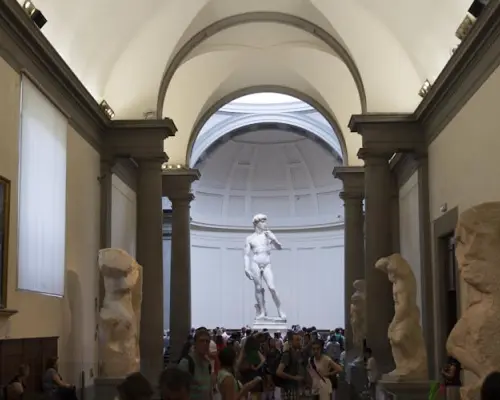
Meeting point description: Please note this is a combo tour. Meeting point 1: "Accademia" Meet Towns of Italy guide in front of civic number 58. Meeting point 2: "Uffizi" Meet Towns of ITaly guide in Via de' Lamberti 1. Please arrive 15 minutes before scheduled time.(Accademia Gallery, Via Ricasoli, Florence, Metropolitan City of Florence, Italy)
Know in advance:Please note: the Vasari Corridor is currently undergoing a major reconstruction, but it's still absolutely worth it to discover it from the outside
There's a compulsory security check that may cause some delays at the entrance of the museums
Your booking includes the official Uffizi Gallery entrance ticket, seamlessly integrated with semi-private touring service. Individual ticket costs (inclusive of the mandatory reservation fee): standard adult ticket: €35.00, reduced ticket: €8.00 (available for EU citizens aged 18–25 with a valid ID), super reduced ticket: €5.00 (available for minors under 18, visitors with disabilities, and other qualifying categories)
FAQ
1. Can Michelangelo's David at the Accademia Gallery be seen without an admission ticket?
No, Michelangelo's David is housed within the Accademia Gallery, and a valid admission ticket is required to enter the gallery and view the statue. The Accademia Gallery has a collection of Renaissance art, with David as its undisputed centerpiece, making it a paid attraction for all visitors who wish to experience this iconic masterpiece up close.
2. What are the main differences between the Uffizi Gallery and the Accademia Gallery for visitors?
The Uffizi Gallery focuses on a vast collection of Renaissance paintings, featuring masterpieces by Botticelli, Leonardo da Vinci, and Michelangelo, spread across numerous rooms. The Accademia Gallery, while also housing some paintings, is primarily famous for Michelangelo's David and a collection dedicated to his works and Florentine sculpture. The Uffizi is significantly larger, requiring more time to explore comprehensively.
3. Beyond Michelangelo's David, what other famous artworks can be found at the Accademia Gallery?
The Accademia Gallery features several unfinished 'Prisoners' (Prigioni) sculptures by Michelangelo, which offer insight into his carving process. It also displays a collection of musical instruments from the Cherubini Conservatory and a significant collection of Florentine Gothic and Renaissance paintings, including works by Giambologna, Andrea del Sarto, and Botticelli's 'Madonna of the Sea'.
4. Which gallery, the Uffizi or Accademia, is recommended for first-time visitors to Florence interested in Renaissance art?
For first-time visitors keen on a broad overview of Renaissance painting, the Uffizi Gallery is generally recommended due to its extensive collection of masterpieces from various periods. If your primary interest is Michelangelo's monumental David and understanding Florentine sculpture, then the Accademia Gallery should be your priority. Many visitors choose to experience both for a complete understanding of Florence's art.
5. What are the options for skip-the-line access to both the Uffizi and Accademia Galleries?
To secure skip-the-line access for both the Uffizi and Accademia Galleries, it is highly recommended to book tickets in advance. This can be done through various online platforms. Booking through KKday allows you to secure your entry time slots conveniently, providing peace of mind and saving valuable time by bypassing long queues, ensuring a smoother visit to these popular attractions.
6. What should visitors know about the collection and layout of the Uffizi Gallery?
The Uffizi Gallery is arranged thematically and chronologically across two main floors. Its collection showcases pivotal works of the Italian Renaissance, including Botticelli's 'The Birth of Venus' and 'Primavera', Leonardo da Vinci's 'Annunciation', and works by Raphael and Titian. Visitors should be prepared for a substantial amount of walking and consider using a map to navigate its extensive corridors and numerous rooms effectively.
7. How long should one plan for a comprehensive visit to the Uffizi Gallery and Accademia Gallery?
For a comprehensive visit to the Uffizi Gallery, visitors should plan for at least 3 to 4 hours due to its vast collection. The Accademia Gallery, while smaller, typically requires about 1.5 to 2 hours, primarily to fully appreciate Michelangelo's David and the surrounding works. These estimates allow for unhurried viewing and absorbing the art without feeling rushed, offering a richer cultural experience.
8. Are there any specific rules or etiquette visitors should observe when viewing Michelangelo's David at the Accademia Gallery?
When viewing Michelangelo's David, visitors should maintain a respectful distance from the statue and avoid touching it. Photography is generally permitted without flash, but specific rules may apply to certain areas or temporary exhibitions, so always check signage. Visitors are also encouraged to keep voices low and refrain from eating or drinking inside the gallery to preserve the artworks.


