


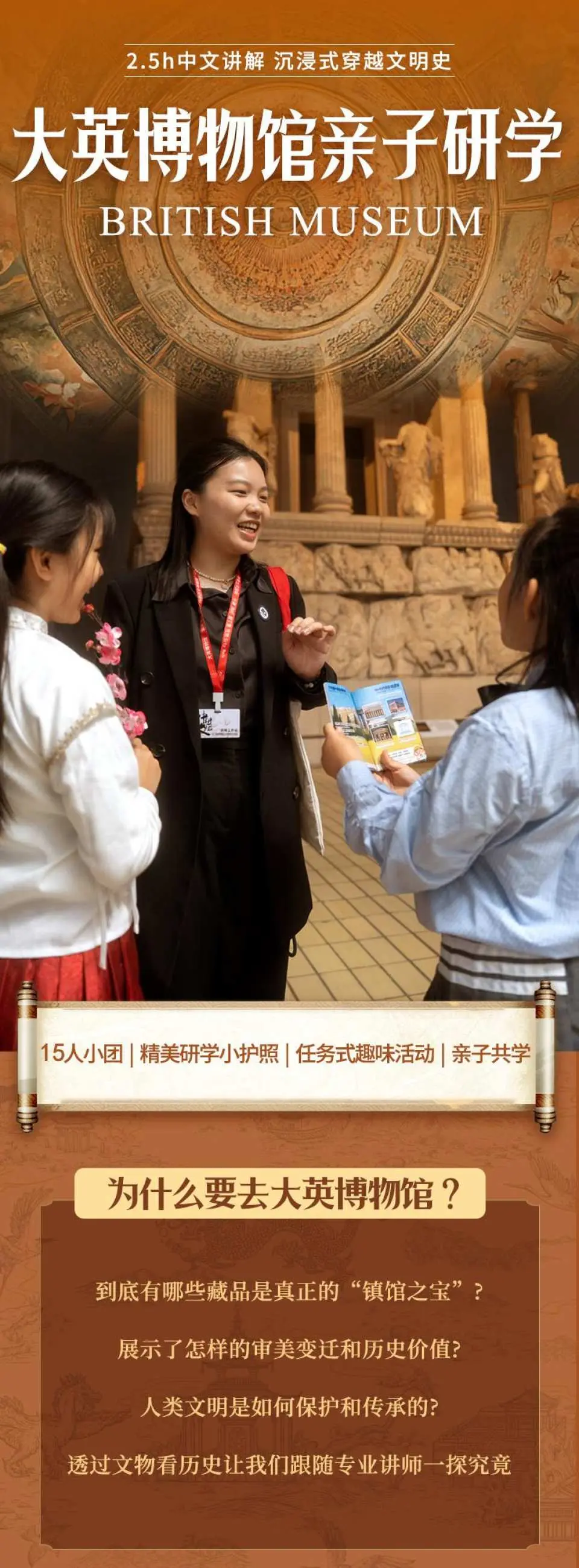
British Museum, London - Family-friendly guided tour in Chinese (small group of 15 people) | Includes admission, headphones, study guide, and China Pavilion audio pack
- Tasks such as [Ancient Egyptian Mythology], [Amazing Ancient Greek Architecture], and [Searching for the Chinese Dragon] can inspire children's desire to explore, while parents can become "teammates" and unlock the truth of civilization through clues from cultural relics.
- From the Rosetta Stone to the Parthenon sculptures, the conflicts and stories behind these artifacts help children understand "how civilization changes the world."
- Each group is limited to 4-5 families, a small group of 15 people. The instructor guides the parents and children to learn together throughout the tour, rejecting "photo-taking tours" and making the museum an anchor point for family memories.
Package Options


Product Info
The content of this product is provided by machine translation and may not reflect the actual information, please take this into consideration before booking.
- 24/7 online service: We handle ticket reservations, and you'll receive an invoice a day in advance via group chat; our service is available around the clock, giving you peace of mind.
- A superior user experience: Includes a complimentary audio guide package featuring key artifacts from the China Pavilion; group purchase options available/free rescheduling/early refund supported.
- Youjian Museum: A professional team from British museums, with over ten years of experience, providing Chinese-language guided tours to over 500,000 visitors.


Purchase Notice
[Important Notice]
The China Pavilion will be closed from June 1st to 5th, 2026.
The instructors will flexibly adjust the route and appropriately increase the number of explanations in other exhibition halls, without shortening the overall duration.
【Product Description】
Recommended for families with children aged 6-11.
Group booking: Minimum order of 2 people, minimum group of 4 people, maximum of 15 people per group (excluding children aged 5 and under).
Group booking: Maximum 15 people per group. Please inform us of the number of travelers after placing your order; additional charges will apply for exceeding this number.
Minors must be accompanied by at least one adult.
[Collection Information]
Meeting point: The Great Court of the British Museum, left side, next to the stone lion statue.
Navigation address: Great Russell Street, London WC1B 3DG
Museums are usually crowded during holidays, so it's recommended to arrive 30 minutes early to avoid delays.
Please show your ticket on your mobile phone upon entry and follow the pre-booked ticket channel to enter; there is no need to wait in long lines.
Reminders
A minimum of 4 traveler(s) are required for the tour to depart. If the number of participants does not reach the minimum requirement, the tour will be canceled. An email regarding tour cancellation will be sent 1 day(s) before the departure date
FAQ
A visit to the British Museum highlights iconic artifacts such as the Rosetta Stone, which was key to deciphering ancient Egyptian hieroglyphs, and the Parthenon sculptures, masterpieces of ancient Greek art. Other essential collections include the Egyptian mummies, the Sutton Hoo treasures, and significant pieces from Chinese history. A guided tour often focuses on the stories and historical context behind these world-renowned exhibits.
The parent-child guided tour at the British Museum offers a unique, in-depth experience for families. It features a small group setting, led by a lecturer who engages children through interactive tasks and storytelling. Artifacts like the Rosetta Stone and Parthenon sculptures are explored with narratives about their history and impact. The tour aims to foster a deeper understanding of civilizations, turning the museum visit into a memorable family learning journey, often supplemented with a study manual and a Chinese Hall audio pack.
For an in-depth exploration of the British Museum, especially when participating in a guided tour designed for comprehensive engagement, it is recommended to allocate approximately 3 to 4 hours. This duration allows sufficient time to focus on key exhibits, participate in interactive learning activities, and absorb the rich historical narratives presented without feeling rushed, ensuring a meaningful and educational experience.
The British Museum is easily accessible via several London Underground (Tube) stations. The closest stations include Russell Square (Piccadilly Line), Tottenham Court Road (Central and Northern Lines), Holborn (Central and Piccadilly Lines), and Goodge Street (Northern Line). Each is within a short walking distance of the museum. Additionally, numerous bus routes serve the area, with stops conveniently located around the museum's vicinity.
Yes, many British Museum guided tour packages, particularly specialized experiences like the parent-child study tour, typically include admission tickets. This simplifies the entry process for visitors, ensuring a smooth start to their museum exploration. The package also often includes audio headphones to enhance the guided commentary, allowing for a focused and immersive learning experience.
A family-focused visit to the British Museum stands out for its exceptional educational value due to its unparalleled collection covering global civilizations. Unlike attractions primarily focused on entertainment or specific historical periods, the British Museum offers a broad, multicultural learning experience. A guided tour, especially one designed for parent-child interaction with study manuals and engaging tasks, facilitates a deeper understanding of history and cultural impact, making it ideal for families seeking comprehensive educational enrichment.
During a British Museum parent-child study tour, children are engaged through various interactive and hands-on activities designed to stimulate their curiosity. These include missions like exploring Ancient Egyptian myths, discovering the brilliance of ancient Greek architecture, or embarking on a 'hunt for Chinese dragons' within the collections. A dedicated study manual guides both children and parents through these tasks, transforming passive viewing into an active, co-learning adventure that makes history tangible and exciting.
The British Museum guided tour helps visitors understand global civilization by weaving narratives around its vast collections. It goes beyond mere display, using the stories behind artifacts like the Rosetta Stone and Parthenon sculptures to illustrate historical conflicts, cultural exchanges, and the evolution of human societies. This storytelling approach helps visitors grasp how diverse civilizations emerged, interacted, and ultimately shaped the world we live in, fostering a comprehensive understanding of human history and cultural development.
Get Help


