


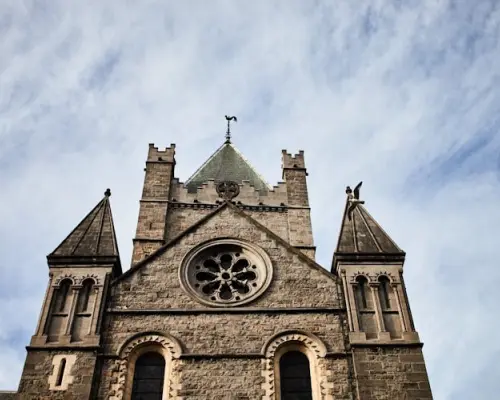

Historic highlights of Dublin with Trinity College private walking tour
- Book a guided walking tour to the highlights of Dublin. Learn the local history of the capital city while visiting landmarks including Trinity College, the House of Parliament, Temple Bar and O'Connell Street.
Package Options


Product Info
Purchase Notice
Reminders
Please refer to your voucher for final information regarding meeting points, pick-up locations, and pick-up time
Meeting point description: Meet your guide outside of Dublinia Museum (under the bridge). Please arrive 10 minutes before the start time of the tour.(Christ Church Cathedral, Christchurch Place, Wood Quay, Dublin 8, Ireland)
Tour times may change based on ticket availability. You do not need to do anything at this time. The local operator will be in touch if this affects your booking
Please note: external guides are not allowed in Trinity College so you will be parting ways with your guide at the entrance where you will join a small guided tour the visit to the Trinity College Campus, Old Library and the Book of Kells
All books from the Long Room have been removed as part of the historic Old Library Redevelopment Project, except the first four bays as you enter the space. In the meanwhile your visitor experience will include a digital journey through the Old Library’s precious collections
FAQ
Trinity College Dublin is renowned globally for its academic excellence, particularly in arts and humanities. It is most famous for housing the iconic Book of Kells, an ancient illuminated manuscript, within its magnificent Old Library. The college also boasts a rich history of producing prominent alumni, including Nobel laureates and literary figures, making it a significant cultural and intellectual landmark.
Trinity College Dublin was founded in 1592 by Queen Elizabeth I, making it Ireland's oldest university. Modeled after the collegiate universities of Oxford and Cambridge, it initially served as a Protestant institution aimed at strengthening English rule. Over centuries, it evolved to become a co-educational, multi-denominational university, playing a pivotal role in Irish intellectual and cultural development.
Trinity College Dublin attracts visitors with its stunning Georgian architecture, tranquil cobblestone courtyards, and profound historical significance. The primary draw is the Old Library, which contains the world-famous Book of Kells. Its central location in Dublin makes it an easily accessible and essential stop for those seeking a blend of cultural, historical, and architectural experiences.
Walking the main grounds and courtyards of Trinity College Dublin is generally free of charge, allowing visitors to appreciate its historic campus. However, there is a separate admission fee required to enter the Old Library and view the Book of Kells exhibition. Many visitors choose a guided tour, which often includes timed entry to this popular attraction.
A private walking tour exploring Dublin's historic highlights often covers several significant landmarks. These commonly include the prestigious Trinity College, the stately House of Parliament (Leinster House), the vibrant Temple Bar cultural quarter, and the historic O'Connell Street, renowned for its monuments and pivotal role in Irish history.
O'Connell Street is Dublin's principal thoroughfare and holds immense historical significance. It has been the stage for many pivotal events in Irish history, most notably the 1916 Easter Rising. The street is lined with prominent monuments dedicated to national figures like Daniel O'Connell, Charles Stewart Parnell, and features the striking Spire of Dublin, symbolizing modern Ireland.
A private walking tour offers an intimate and personalized exploration of Dublin's rich historical narrative. You can expect a dedicated guide to share in-depth stories, historical anecdotes, and contextual information about each landmark. This tailored approach allows for a deeper understanding and the flexibility to engage with specific interests, providing a more immersive experience than a standard group tour.
Beyond Trinity College, a Dublin city walking tour typically delves into various facets of Irish history. Guides often cover the city's Georgian architecture and its social context, Dublin's pivotal role in Ireland's struggle for independence, the impact of significant cultural and literary movements, and insights into the daily life and traditions of Dubliners through the centuries, offering a comprehensive historical perspective.
Get Help


