

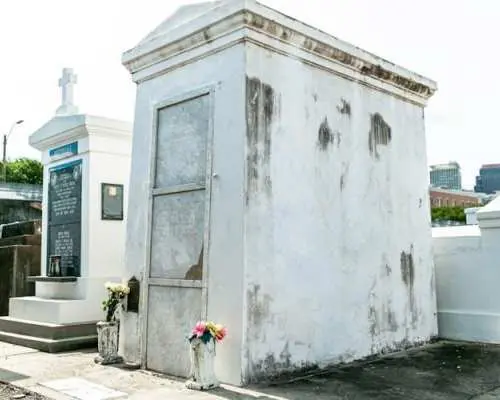


New Orleans St. Louis Cemetery tickets and guided tour
- Visit the burial site of New Orleans' most famous and historical figures.
Package Options
Product Info
Purchase Notice
Reminders
Please refer to your voucher for final information regarding meeting points, pick-up locations, and pick-up time
Meeting point description: Please arrive 15 minutes before the starting time.(501 Basin Street, New Orleans, LA, USA)
How to Redeem Your Voucher
How to Use Your Voucher
- Please present the e-voucher on-site
Validity Period
- The voucher must be used on the selected date and within operating hours; Invalid after expiration
FAQ
1. What is the historical significance of St. Louis Cemetery 1 in New Orleans?
St. Louis Cemetery 1 is New Orleans' oldest active cemetery, established in 1789. It is historically significant as the final resting place for many prominent figures who shaped the city's unique culture and history, including the legendary Voodoo Queen Marie Laveau and renowned chess champion Paul Morphy. Its distinctive above-ground tombs reflect the city's French and Spanish heritage and adaptation to its challenging terrain.
2. Are visitors required to join a guided tour to enter St. Louis Cemetery No. 1?
Yes, visitors are required to be accompanied by a licensed tour guide to enter St. Louis Cemetery No. 1. This regulation is strictly enforced to protect the fragile historic tombs from vandalism and wear, and to ensure that visitors learn about the cemetery's rich history and cultural importance in a respectful and informed manner. Independent entry is not permitted.
3. What makes visiting St. Louis Cemetery No. 1 a unique experience in New Orleans?
Visiting St. Louis Cemetery No. 1 offers a unique window into New Orleans' distinct cultural heritage and burial traditions. The dense arrangement of elaborate above-ground tombs creates a fascinating 'city of the dead,' showcasing diverse architectural styles and a blend of French, Spanish, and Creole influences. Guided tours enhance the experience by sharing compelling narratives of the interred and the city's past, providing a profound cultural immersion unlike any other.
4. Who are some of the notable historical figures buried in St. Louis Cemetery 1?
St. Louis Cemetery 1 is the final resting place for several significant historical figures of New Orleans. Most famously, it houses the tomb of Marie Laveau, the legendary Voodoo Queen, which remains a popular site for visitors. Other notable figures include Paul Morphy, a world-renowned chess champion, and Etienne de Boré, who was the first mayor of New Orleans and pioneered sugar granulation. Their stories are integral to the city's rich history.
5. How do St. Louis Cemetery 1 tours differ from other cemetery experiences in New Orleans?
St. Louis Cemetery 1 tours stand apart due to the cemetery's age, its requirement for a licensed guide, and the density of its historical figures. Unlike some other cemeteries, St. Louis Cemetery 1 offers a structured, historically accurate interpretation of its unique above-ground burial practices, intricate family crypts, and the fascinating, often dramatic, narratives of its notable residents. This provides a deeply contextualized cultural journey focused on preservation and storytelling.
6. Is Nicolas Cage's pyramid tomb located within St. Louis Cemetery 1?
No, Nicolas Cage's distinctive pyramid-shaped tomb is not located within St. Louis Cemetery 1. His tomb can be found in St. Louis Cemetery No. 3, which is another significant historic cemetery in New Orleans. St. Louis Cemetery 1 is primarily known for its older, more traditional family tombs and its strict requirement for guided tours for entry.
7. What is the process for booking a guided tour for St. Louis Cemetery 1?
You can easily book a guided tour for St. Louis Cemetery 1 through KKday, which provides a convenient and reliable reservation process. Booking in advance is highly recommended, especially during peak travel seasons, to secure your spot. Utilizing KKday ensures you have access to a licensed, knowledgeable guide who can offer comprehensive historical and cultural context, greatly enriching your understanding of this significant landmark and simplifying your travel planning.
8. What specific types of architecture and burial practices can be observed at St. Louis Cemetery 1?
At St. Louis Cemetery 1, visitors can observe distinct above-ground burial vaults, a necessity due to New Orleans' high water table. The architecture ranges from simple brick 'oven' vaults to elaborate family crypts fashioned from marble and stucco, often adorned with intricate ironwork reflecting French and Spanish influences. A key burial practice involves the 're-use' of tombs, where remains are interred in charnel houses after a period, making space for new interments within family crypts.


