


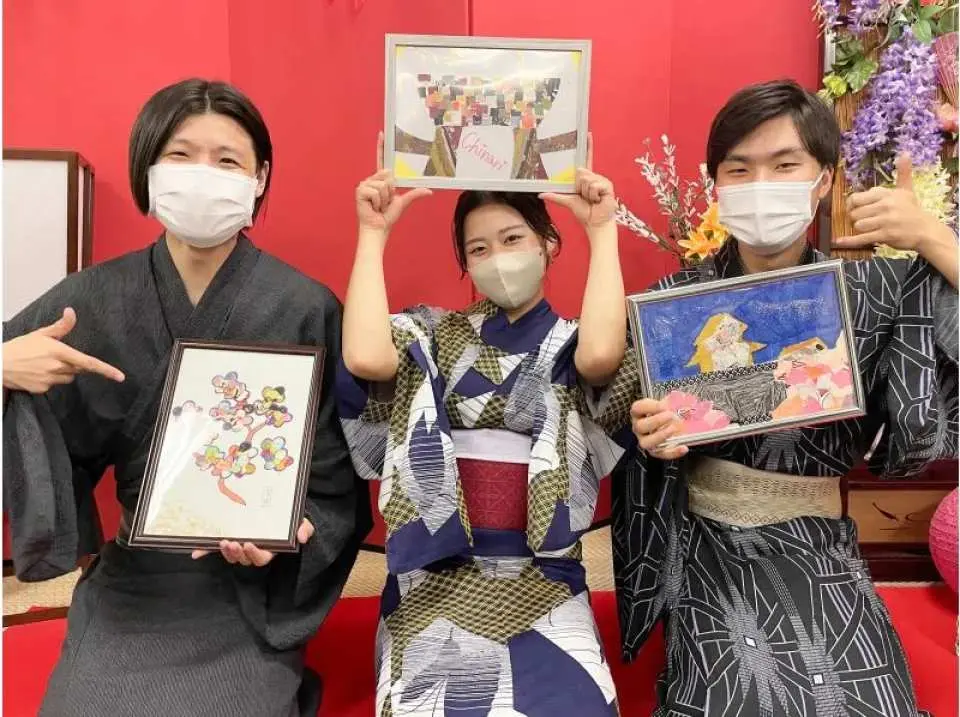
[Ishikawa/Kanazawa] Make kimono scrap art! You can take home your one-of-a-kind finished product right there!
Sudden rain makes it impossible to enjoy outdoor sightseeing or leisure activities.
Even in those cases, the experience is entirely indoors, so the weather won't affect your plans!
Same-day reservations are also possible if there are openings, so if your plans have changed due to rain, please feel free to contact us.
[You're in Kanazawa, so it would be a waste not to go and have fun!]
After a busy day, I finally made it to Kanazawa, which I was looking forward to. But it was raining...
In times like these, why not try an indoor experience that everyone from small children to adults can enjoy together!!
Making kimono scrap art is a great way to exercise your brain and have fun freely.
[You can change the stencil to any shape you like, so you can make your own original design!]
If you can't find a shape you like, you can make your own pattern. So you can make your own original piece.
Package Options
Product Info
What You Can Expect
1 Day
- ① First, we will help you put on the kimono and style your hair. We do not have kimonos for small children, so small children will only be able to participate in the experience.
- ②After dressing, you will create a one-of-a-kind piece of kimono art using scraps of kimono.
- ③Decide the frame color
- ④Choose the frame color and place your artwork in it
- You can frame your completed work and take it home with you. *The required time is only a guide.



Purchase Notice
Clothes that you don't mind getting dirty, towels, water (if needed)
[About rental items]
Scissors, glue
[Plan basic information]
Minimum number of participants: 2 people. Reservations: 2-20 people.
Travel time
Within 1 hour / Approximately 60 minutes
The required time is only an estimate.
The event is held on irregular holidays, so please contact us in advance.
Meeting time: Please arrive 5 minutes before your reservation time.
Reservation deadline: 11:59 on the day of the event. *If you would like to make a reservation on the day, please contact us by phone.
Includes/Excludes
- All materials used in the experience
Reminders
This will be an experience using scissors and glue. Our staff will be there to support you, but please be careful if you are bringing children.
How to Redeem Your Voucher
How to Use Your Voucher
- Please present the e-voucher on-site
Meeting Point
Location Name: Kimono Salon Cross 2F
Address: 2F SAISEI Building, 1-16-13 Nagatsuchibe, Kanazawa City, Ishikawa PrefectureCancellation Policy
- Cancellations 2 day(s) (inclusive) before the selected date are allowed. Unused orders can be canceled for free
- For cancellations made 1 to 1 days prior to selected date, a cancellation fee of 50% will apply
- Cancellation is not allowed between 0–0 days from the selected date. Orders cannot be canceled or modified, and refunds will not be granted.
- Due to time zone differences, the confirmed cancellation date is based on the supplier’s local time. Please allow 2–5 business days to process your cancellation request, after which the cancellation fee will be charged according to the product’s cancellation policy. Once your refund request is confirmed, KKday will initiate the refund to your original payment method within 15 days. The actual refund timing depends on your card-issuing bank’s policy.
FAQ
1. What are the recommended methods for transporting finished Kimono Scrap Art from the Kanazawa studio?
When transporting your finished Kimono Scrap Art from the studio in Kanazawa, you generally have a few methods. For immediate travel, carrying it as a personal item or safely packing it into your luggage is common. If you prefer not to carry it yourself, professional shipping services are an option, especially for international destinations, ensuring specialized handling and appropriate packaging. Always prioritize protecting the artwork from impact and moisture regardless of the chosen method.
2. How can I best ensure the safety of my unique Kimono Scrap Art piece during domestic or international travel?
To ensure the safety of your Kimono Scrap Art during travel, proper packing is crucial. Use sturdy, rigid packaging that is appropriately sized for your artwork to prevent shifting. Wrap the piece in acid-free tissue paper, then cushion it generously with bubble wrap or soft foam. For checked luggage, consider placing the artwork in the center of your suitcase, surrounded by clothes for extra padding. If shipping, ensure the service provides adequate insurance and tracks packages.
3. What materials or techniques are effective for packaging Kimono Scrap Art to prevent damage in luggage or as a carry-on?
Effective packaging for Kimono Scrap Art involves several layers of protection. Start by wrapping the artwork in acid-free tissue paper to prevent surface damage. Next, use bubble wrap, securing it with tape to create a protective cushion. Place the wrapped artwork inside a sturdy, hard-sided box or container that fits snugly to minimize movement. For carry-on, choose a bag that provides good structural support. If placing in checked luggage, surround the box with soft clothing.
4. Are there specific considerations for handling the finished Kimono Scrap Art to maintain its integrity after the workshop?
Yes, to maintain the integrity of your finished Kimono Scrap Art, handle it carefully by its edges and avoid touching the artwork surface directly. Protect it from direct sunlight, extreme temperatures, and high humidity, which can cause materials to warp or colors to fade. Avoid bending or applying pressure to the artwork. When not in transit, store it in a stable environment, ideally framed or carefully laid flat to preserve its shape and details.
5. What factors influence the overall expense of shipping Kimono Scrap Art internationally?
Several factors influence the overall expense of shipping Kimono Scrap Art internationally. These typically include the package's weight and dimensions, the destination country, the chosen shipping speed (e.g., standard versus express), and the declared value for customs and insurance purposes. Additional services like professional packing, tracking, and customs brokerage can also impact the final cost. It's advisable to compare different couriers and their services.
6. What different shipping options are generally available for finished Kimono Scrap Art, and what are their typical characteristics?
For shipping finished Kimono Scrap Art, common options include postal services, private couriers (such as FedEx or DHL), and specialized art shipping companies. Postal services are often more economical for smaller, less urgent shipments but may offer less robust tracking or insurance. Private couriers typically provide faster delivery, detailed tracking, and more comprehensive insurance options, though at a higher expense. Specialized art shippers offer bespoke crating and white-glove service for maximum protection and convenience.
7. Does the size or complexity of my custom Kimono Scrap Art design impact its ease of transportation or required safety measures?
Yes, both the size and complexity of your custom Kimono Scrap Art design can impact its ease of transportation and the safety measures required. Larger pieces may necessitate specialized packaging or larger luggage, potentially increasing handling challenges. More intricate designs with delicate embellishments might require extra cushioning and a rigid, custom-fitted container to protect fragile elements from bending or breaking. Simpler, more compact designs are generally easier to transport.
8. What should I keep in mind when taking my Kimono Scrap Art to and from the KIMONO SALON CROSS studio in Kanazawa?
When taking your Kimono Scrap Art to and from the KIMONO SALON CROSS studio in Kanazawa, remember to handle it gently. The studio will likely provide a basic carrying bag, but if you plan further travel, ensure you have a sturdy bag or box to protect it from jostling. Kanazawa often experiences rain, so protecting your artwork from moisture, perhaps with a waterproof cover or bag, is a wise precaution for its short journey.
Get Help


