



Package Options


Product Info
Purchase Notice
Reminders
Please refer to your voucher for final information regarding meeting points, pick-up locations, and pick-up time
Meeting point description: On the square of the church, you'll see a tandem with a "rent-a-bike" sign. The local partner's office is located inside the courtyard, that's where the tours start. Please arrive at the meeting point 15 minutes before the tour start time.(Poststraße 11, 10178 Berlin, Germany)
Know in advance:Prices are per group
You’ll cover approximately 15 km during the tour
The route plan may vary
In case of very bad weather, you or the local partner can cancel the tour at any time free of charge, based on a severe weather warning from the German weather service
Rain ponchos are provided in case of bad weather
Children's bikes, child seats and trailer bikes are available
Remember to bring:Comfortable clothes and shoes, water
FAQ
The construction of the Berlin Wall began very abruptly. On the night of August 12-13, 1961, East German soldiers and workers erected barbed wire fences and barriers, effectively sealing off West Berlin. Within days, these temporary measures were reinforced with concrete blocks, establishing the physical barrier that would divide the city for decades. This rapid construction was a swift response to the mass exodus of East Germans to the West.
The primary purpose of the Berlin Wall, officially called the 'Anti-Fascist Protection Rampart' by East Germany, was to prevent its citizens from defecting to West Berlin and, by extension, to West Germany. The mass emigration was causing a severe labor and economic crisis in East Germany. The Wall was built to halt this 'brain drain' and stabilize the socialist state, creating an impenetrable physical and ideological barrier between East and West.
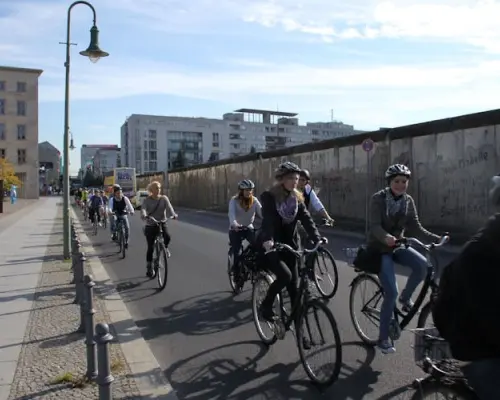
A private bike tour focused on the Berlin Wall often visits key sites such as the East Side Gallery, a long preserved section adorned with murals; the Berlin Wall Memorial on Bernauer Strasse, offering insights into escape attempts and the Wall's structure; Checkpoint Charlie, the most famous border crossing point; and remnants of the Wall's watchtowers. These locations provide a comprehensive understanding of the Wall's history and impact.
A Berlin Wall and Third Reich private bike tour delves into Germany's darkest historical periods. It offers insights into the rise and fall of Nazism, visiting sites like the former Gestapo Headquarters (now the Topography of Terror), Hitler's Bunker location, and the Memorial to the Murdered Jews of Europe. Simultaneously, it explores the Cold War era, focusing on the division of Berlin by the Wall, escape stories, and the ideological conflict between East and West.
A typical private bike tour exploring the historical sites of the Berlin Wall and the Third Reich usually lasts approximately 4 to 5 hours. This duration allows for a comprehensive cycling route, covering significant landmarks and providing ample time for the guide to share detailed historical context and anecdotes at each stop. The pace is generally relaxed to accommodate historical discussions and photo opportunities.
Participants should have a basic to intermediate level of cycling proficiency for a Berlin historical bike tour. The routes generally follow flat urban paths and dedicated bike lanes, making it accessible for most casual riders. While the tour covers several kilometers, it includes frequent stops for historical explanations and sightseeing, so strenuous endurance is not typically required. Familiarity with city cycling is beneficial.
The flooding of the Berlin U-Bahn during the Battle of Berlin in April 1945 was deliberately ordered by Hitler's regime. Soviet forces were advancing, and German defenders detonated explosives under the Landwehr Canal, flooding subway tunnels where both German soldiers and civilians were sheltering. The intention was to impede the Soviet advance, but it resulted in a significant loss of life for those trapped within the tunnels.
For a private bike tour in Berlin, participants should always wear a helmet, follow the guide's instructions, and adhere to local traffic laws. Berlin has many bike paths, but awareness of pedestrians and other cyclists is crucial. Hydration is important, especially on longer tours. It is also advisable to check the weather beforehand and dress appropriately, as tours typically proceed rain or shine.
Get Help


