
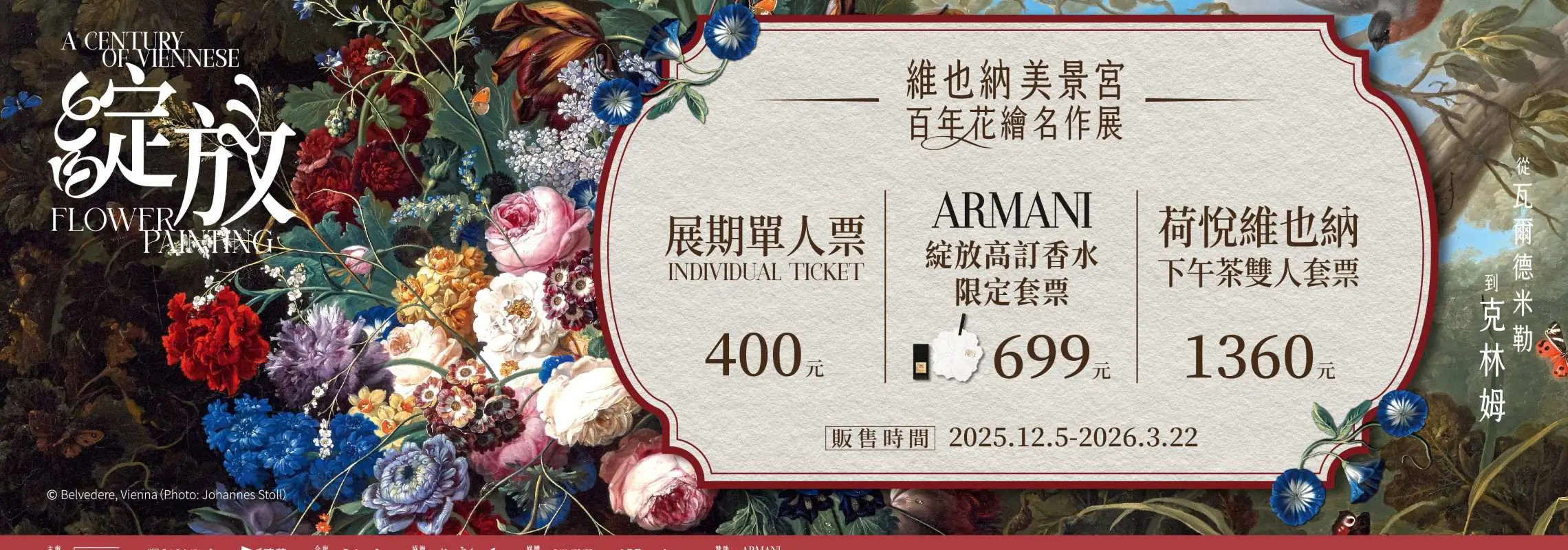
Vienna's Belvedere Palace Centennial Flower Painting Exhibition - From Waldmüller to Klimt
- Klimt's original work comes to Taiwan for the first time: the rare original "After the Rain", a masterpiece of Symbolist aesthetics.
- The Belvedere Palace in Vienna presents its first exhibition in Taiwan: 60 masterpieces of floral art from Austrian national treasures.
- Taiwan's first international floral-themed art exhibition: a comprehensive overview of the evolution of floral art in European art history.
- Six classic art periods are featured in the exhibition: from Baroque, Romanticism, Belle Époque, Impressionism, Secessionism to Modernism, offering a comprehensive overview of the splendor of art across centuries.
- Immersive Visual Experience of Klimt Gardens: Projection Technology Recreates Klimt's Vibrant Floral World
- Bonus offer: Order now and receive a free Bolt ride discount of 30% off two trips, with a maximum discount of NT$225 per trip.
Attraction Tickets
| Ticket type | E-ticket (direct entry) |
| Exhibit type | Art exhibits |
| Attraction type | Modern art |
| Tour types | None |
Product Info
The content of this product is provided by machine translation and may not reflect the actual information, please take this into consideration before booking.
- Exhibition Information -
- Exhibition Dates: December 5, 2025 - March 22, 2026
- Exhibition time: 10:00 - 18:00, 17:30. Ticket sales and admission are suspended on the exhibition site. The exhibition is closed on New Year's Eve and the first day of the Lunar New Year. Other necessary closures will be announced separately, and the official website and on-site announcements will be the main ones.
- Exhibition Location: National Museum of History, first and second floor exhibition halls
- Exhibition Address: No. 49, Nanhai Road, Zhongzheng District, Taipei City
Exhibition Introduction
A Taiwan premiere! Austria's Belvedere Palace in Vienna brings treasures from its collection to Taiwan, presenting a feast of floral art spanning two centuries. The exhibition features over 60 masterpieces of floral art, including authentic works by Symbolist masters Gustav Klimt, Egon Schiele, and Josef Lauer, as well as several other significant works making their debut in Taiwan, allowing viewers to experience the splendor and refinement of European art up close. The Belvedere Palace in Vienna is Austria's most iconic national art museum, housing a collection spanning eight centuries of art history. This special exhibition not only marks the Taiwan premiere of national treasures from the Belvedere Palace, but also features an immersive "Klimt's Garden" video experience, inviting viewers to personally experience the magnificent gardens depicted by the master.




Bolt App User Guide


Purchase Notice
- Additional discounts during the event -
- This offer is only available to new users who register in Taiwan for the first time. Accounts that have previously used Bolt outside of Taiwan are not eligible.
- Offers are provided by Bolt's partner fleets. All trips must be made through the Bolt App and vehicles will be dispatched by Bolt's partner fleets.
- This discount code must be redeemed before 23:59 on 2026/03/31. The discount is valid for 14 days from the date of redemption. Both the pick-up and drop-off times must fall within the validity period. It will automatically expire after the expiration date.
- Open the Bolt App, tap the menu in the top left corner [☰], go to the "Promotions" page, tap "Enter Promo Code", enter the promo code in the promo code field, and you can redeem it.
- Both pick-up and drop-off locations must be within Bolt's Taiwan operating area (including Taipei, New Taipei, Keelung, and Taoyuan). Other areas are not applicable.
- The maximum discount is NT$225 per trip, valid for a total of 2 trips. Any amount exceeding this limit must be borne by the passenger. Unused discounts cannot be accumulated or carried over.
- If you have any questions about the trip, please report the problem through the "Help Center" in the Bolt App.
- Bolt and its partner teams reserve the right to amend these Terms and Conditions or terminate the offer at any time without prior notice. Bolt and its partners reserve the final decision-making power regarding any dispute concerning the offer.
- Only one discount code can be used per trip. If a user's account has more than one discount code, the system will prioritize the discount code that complies with the terms and conditions, applies to the user's trip, and has the highest discount value.
Reminders
Please complete your visit within the exhibition period (2025/12/5 - 2026/3/22). No cancellations or refunds will be accepted after the exhibition period. Please be advised.
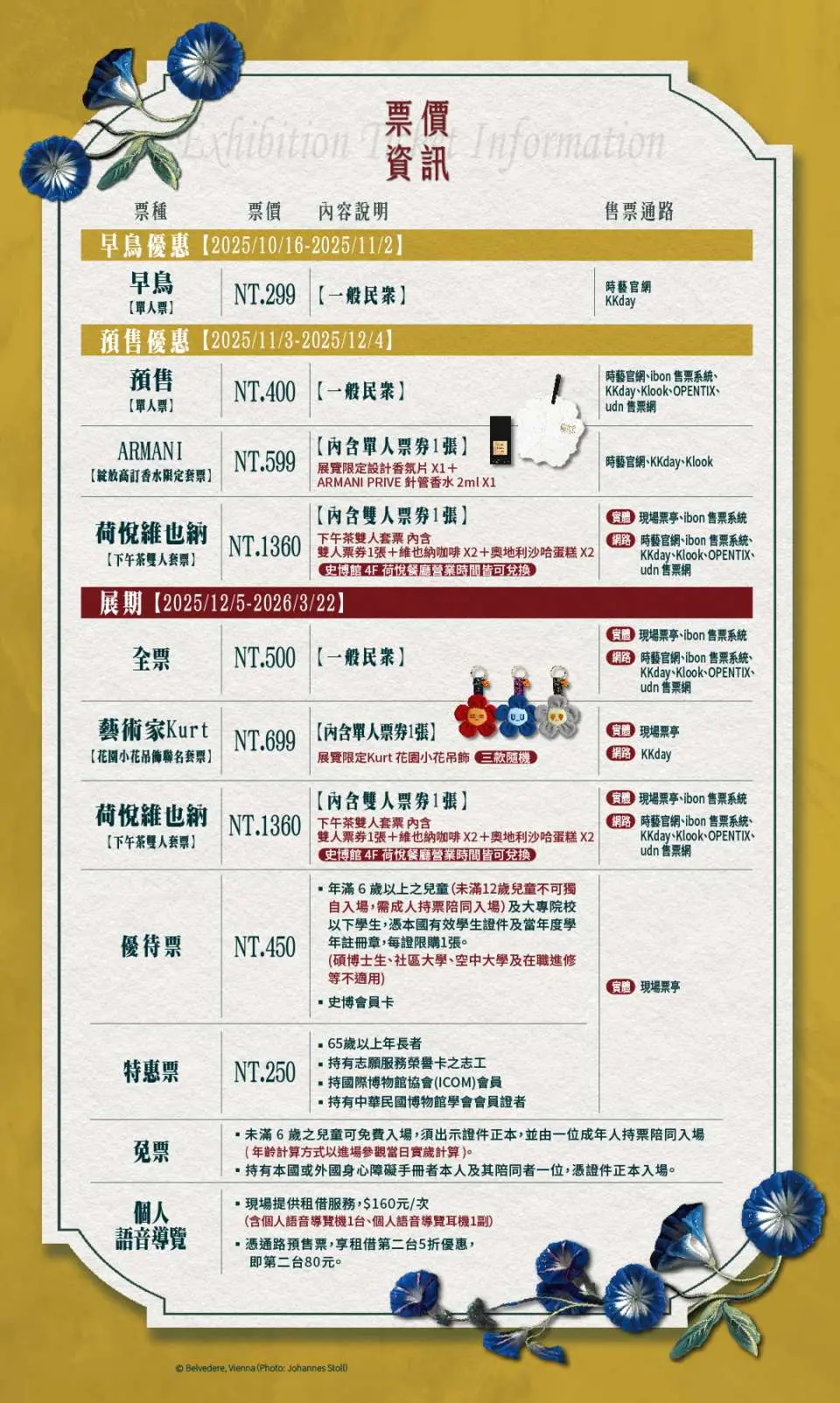
Each ticket is for a designated number of people only. Double tickets are limited to 2 people. Admission is based on the ticket only and cannot be split or reused.
Children under 6 years old are admitted free and must be accompanied by an adult with a ticket. (Applicable ID is required; age is calculated based on actual age on the day of admission.)
The museum is closed on New Year's Eve and New Year's Day. If you plan to visit, please pay attention to the closing dates.
Those who are eligible for preferential tickets, special tickets or free tickets are requested to present relevant supporting documents; various discounts cannot be used at the same time.
If a disabled person needs to be accompanied by a companion, only one person is allowed. The disabled person and the necessary companion must attend together. If the disabled person does not meet the requirements, a supplementary ticket will be required to enter.
If you wish to request a refund, please submit your refund request before the end of the exhibition (March 22, 2026). Refunds will not be processed after the exhibition ends.
Other ticketing regulations or any consumer disputes arising from this ticket shall be handled in accordance with the matters that should and should not be recorded in the standardized contract for arts and cultural exhibition tickets issued by the Ministry of Culture.
Please refer to the on-site announcements or official fan page for any changes to the exhibition's opening hours, content, and regulations. The organizer reserves the right to interpret any matters not covered above.
How to Redeem Your Voucher
How to Use Your Voucher
- Please present your QR code on-site
Experience Location
Location Name: National Museum of Japanese History [First and Second Floor Exhibition Halls]
Address: No. 49, Nanhai Road, Zhongzheng District, Taipei CityMonday 10:00–18:00 (Last Entry Time: 17:30)
Tuesday 10:00–18:00 (Last Entry Time: 17:30)
Wednesday 10:00–18:00 (Last Entry Time: 17:30)
Thursday 10:00–18:00 (Last Entry Time: 17:30)
Friday 10:00–18:00 (Last Entry Time: 17:30)
Saturday 10:00–18:00 (Last Entry Time: 17:30)
Sunday 10:00–18:00 (Last Entry Time: 17:30)
The museum will be closed on New Year's Eve and New Year's Day. Other necessary closures will be announced separately, and will be based on the event's official website and on-site announcements.
FAQ
The exhibition prominently features Gustav Klimt's rare original masterpiece, "After the Rain." This symbolist work is making its first appearance in Taiwan, offering visitors a unique opportunity to experience Klimt's distinctive aesthetic and artistic depth firsthand. It is a key highlight among the presented floral art pieces.
Key highlights include the first-ever display of Gustav Klimt's original "After the Rain" in Taiwan and over 60 masterpieces of floral art from Vienna's Belvedere Palace, many being Austrian national treasures making their debut. The exhibition comprehensively reviews European floral art history across six major periods, culminating in an immersive "Klimt Garden" experience using projection technology.
To fully appreciate the over 60 masterpieces and the immersive "Klimt Garden," visitors should typically allocate approximately 1.5 to 2 hours for the Belvedere Palace Centennial Flower Painting Exhibition. This allows ample time to explore each of the six major art exhibition areas and engage with the diverse range of floral art.
The "Klimt Garden" is an immersive video experience within the Belvedere Palace exhibition. It utilizes advanced projection technology to recreate Klimt's vibrant and colorful floral world, allowing visitors to step into a sensory journey of art and romance. This interactive area offers a unique way to engage with the artist's style and themes beyond traditional paintings.
Yes, the Belvedere Palace Centennial Flower Painting Exhibition is organized into six major art exhibition areas. These sections trace the evolution of floral art through various periods, including Baroque, Romanticism, Belle Époque, Impressionism, Secessionism, and Modernism. Each area offers a distinct perspective on the splendor of two hundred years of European floral art.
The exhibition proudly showcases over 60 masterpieces of floral art from Vienna's Belvedere Palace, many of which are considered Austrian national treasures. These include, but are not limited to, the original "After the Rain" by Gustav Klimt, alongside other significant works making their debut in Taiwan, offering a comprehensive review of European floral art history.
The exhibition comprehensively reviews the evolution of floral art across two centuries of European art history. It showcases diverse styles from six major periods: Baroque, Romanticism, Belle Époque, Impressionism, Secessionism, and Modernism. Visitors can observe how different artists interpreted floral themes through various artistic movements, highlighting the rich history of floral art.
Yes, the Belvedere Palace Centennial Flower Painting Exhibition is highly suitable for art history enthusiasts. It offers a comprehensive review of the evolution of floral art in European art history, covering six major periods from Baroque to Modernism. The exhibition presents a unique opportunity to see rare masterpieces, including a Klimt original, and appreciate two centuries of artistic development.
Get Help


