


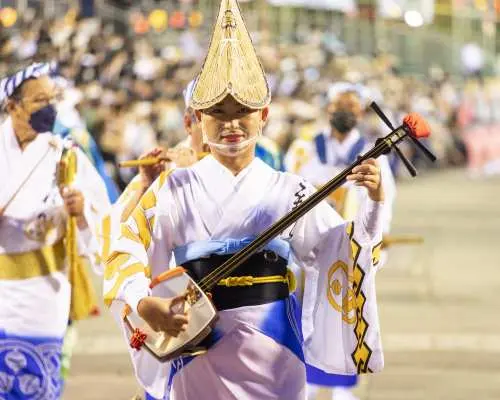
Awa Dance Festival Ticket for Part 2 (20:20~) with Car Transfer from Takamatsu
- Experience Japan's largest dance festival, Awa Odori, part of the Obon festival in Tokushima.
- Depart from Takamatsu Station with a English speaking driver.
Package Options


Sightseeing Tours
| Tour Type | Shared tour |
| Transportation method | Transfer from meeting point |
| Minimum participant requirement | 6 travelers |
| Tour types | None |
| Meal arrangement | Arrange yourself |
| Sightseeing type | Bus tour |
| Transport | Bus tour |
Product Info
Purchase Notice
This is not a private tour, you will enjoy the tour with other guests together.
We might cancel the tour if we do not have at least 6 participants by 1 month before the scheduled departure.
Please note that wheelchair is not accessible.
Reminders
Customer Guidelines:
Please arrive at the meeting location 15 minutes prior to the departure time.
IMPORTANT: The bus will depart according to the schedule and will not wait for late arrivals.
The schedule is subject to change without prior notice.
Due to traffic or other reasons, the duration of visits at each destination may be shortened, and arrival times may be delayed.
Refunds will not be provided if you fail to arrive at the meeting location on time (no show).
In the event of a natural disaster, such as a typhoon, the tour will be canceled, and a full refund will be issued.
Wearing your seatbelt is mandatory while the bus is in motion due to legal regulations.
Please personally take responsibility for your valuables.
Note: These guidelines are provided to ensure a safe and enjoyable experience. Thank you for your cooperation.
Cancellation Policy
- Cancellations 2 day(s) (inclusive) before the selected date are allowed. Unused orders can be canceled for free
- Cancellation is not allowed between 0–1 days from the selected date. Orders cannot be canceled or modified, and refunds will not be granted.
- Due to time zone differences, the confirmed cancellation date is based on the supplier’s local time. Please allow 2–5 business days to process your cancellation request, after which the cancellation fee will be charged according to the product’s cancellation policy. Once your refund request is confirmed, KKday will initiate the refund to your original payment method within 15 days. The actual refund timing depends on your card-issuing bank’s policy.
FAQ
1. What is the history and origin of the Awa Odori Festival?
The Awa Odori Festival's origins can be traced back to 1587 when feudal lord Hachisuka Iemasa celebrated the completion of Tokushima Castle. It evolved from traditional Bon Odori dances, incorporating local festive elements and spontaneous street performances. Over centuries, it transformed into a vibrant and highly anticipated community celebration, becoming one of Japan's most famous dance festivals.
2. What is the cultural and religious significance of the Awa Odori Festival?
The Awa Odori Festival is deeply intertwined with the Obon festival, a Japanese Buddhist tradition honoring ancestral spirits. It serves as a joyful expression of gratitude, welcoming spirits back to the earthly realm. Culturally, it symbolizes Tokushima's identity, fosters strong community bonds, and preserves a rich tradition of performing arts, reflecting the region's heritage.
3. What instruments and chants characterize the Awa Odori Festival's musical performances?
The Awa Odori Festival features lively and rhythmic music played on traditional Japanese instruments. Key instruments include the shamisen (three-stringed lute), taiko drums, shinobue (bamboo flute), and kane (bell). Dancers and spectators often chant phrases such as 'Yattosa, yattosa!' which adds to the infectious energy and celebratory atmosphere of the performances.
4. What is the traditional attire or dress code for dancers at the Awa Odori Festival?
Dancers, organized into groups called 'ren,' wear specific traditional attire. Women typically don colorful yukata (summer kimonos) and distinctive amigasa (braided straw hats) that often cover their faces. Men wear happi coats over yukata or hanten, often paired with tabi (split-toe socks) and geta (wooden clogs), contributing to the festival's iconic visual appeal.
5. Where are the main viewing areas and venues for experiencing the Awa Odori Festival?
The Awa Odori Festival primarily takes place in Tokushima City, with performances across various areas. The main viewing venues include designated paid spectator stands (Enbujo) set up along major streets, offering optimal views of the dance groups. Additionally, there are numerous free street dancing areas (Odori Road) throughout the city center where groups parade, allowing for a more immersive experience.
6. What are the different viewing options for the Awa Odori Festival, including reserved seating?
Visitors to the Awa Odori Festival have several viewing options. You can experience the vibrant atmosphere from free street performances, where various dance groups parade and perform spontaneously. For a guaranteed and comfortable view of the main performances, paid reserved seating areas provide dedicated spots along the primary dance routes and stages, allowing for an excellent vantage point.
7. What are the distinctive dance movements and characteristics of the Awa Odori Festival?
The Awa Odori is renowned for its energetic, free-spirited, and somewhat erratic style, often playfully referred to as the 'fool's dance' (Aho Odori). It features distinct movements for men and women: men typically adopt wide stances with high arm swings, while women perform with graceful, flowing steps, often holding their hands above their heads, creating a dynamic and captivating visual spectacle.
8. How is the Awa Odori Festival connected to the Obon festival in Japan?
The Awa Odori Festival is deeply rooted in the Japanese Obon festival, a significant Buddhist custom observed to honor and welcome the spirits of ancestors. The vibrant dancing and celebrations during Awa Odori are traditionally believed to entertain and guide these spirits, making it a lively and communal event with profound spiritual connections to the ancestral world.
Get Help


