


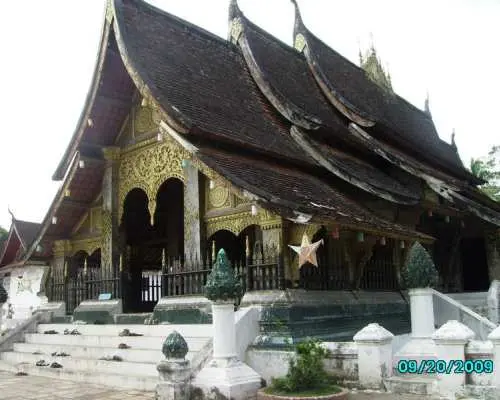

Luang Prabang City Tour (Royal Palace, Phousi, Wat Xieng Thong, Wat Mai) Half-Day Tour
The city itself is a UNESCO World Heritage Site, and Luang Prabang is packed with popular attractions that are sure to leave you with unforgettable memories. A Japanese-speaking guide will efficiently guide you around the city's key attractions over a half-day. Tour must-see spots in Luang Prabang, including the Royal Palace Museum, built in 1909 as the residence of King Sisavangvong and his family, and Wat Visunnarat, also known as Wat Mak Mo (Watermelon Temple) because the chedi within the temple, That Pathum, resembles a watermelon cut in half. This half-day tour is perfect for when you have a little extra time!
Package Options


Product Info
Important Info
Reminders
The tour schedule may be changed or canceled due to weather, traffic conditions, etc.
Please take care of your valuables and luggage yourself.
Cancellation Policy
- Cancellations 4 day(s) (inclusive) before the selected date are allowed. Unused orders can be canceled for free
- Cancellation is not allowed between 0–3 days from the selected date. Orders cannot be canceled or modified, and refunds will not be granted.
- Due to time zone differences, the confirmed cancellation date is based on the supplier’s local time. Please allow 2–5 business days to process your cancellation request, after which the cancellation fee will be charged according to the product’s cancellation policy. Once your refund request is confirmed, KKday will initiate the refund to your original payment method within 15 days. The actual refund timing depends on your card-issuing bank’s policy.
FAQ
1. Is there an entrance fee to visit the Royal Palace Museum and Mount Phousi in Luang Prabang?
Yes, both the Royal Palace Museum (also known as the National Museum) and Mount Phousi typically require an entrance fee for visitors. This fee contributes to the maintenance of these historical and cultural sites. For a convenient and comprehensive experience that includes these sites, consider booking a city tour through KKday, which often bundles admission with guided services, enhancing your visit with expert commentary and seamless logistics.
2. How long does it typically take to ascend Mount Phousi in Luang Prabang?
Ascending Mount Phousi usually takes about 15-30 minutes, depending on your pace and the specific staircase chosen. There are over 300 steps to reach the summit. Visitors often spend additional time at the top to enjoy the panoramic views of Luang Prabang and the Mekong River, especially popular during sunset.
3. What cultural significance does Mount Phousi hold in Luang Prabang?
Mount Phousi holds deep spiritual and cultural significance in Luang Prabang. It is considered a sacred hill, housing several Buddhist shrines and temples, most notably Wat Chom Si at its summit. Pilgrims visit to pay respects, and it offers a symbolic vantage point over the city, embodying its spiritual heart.
4. What is the meaning behind the name 'Mount Phousi' in Luang Prabang?
The name 'Phousi' is derived from the Lao language, where 'Phou' means mountain or hill and 'Si' refers to a sacred or spiritual essence, possibly linked to the Bodhi tree. Therefore, 'Mount Phousi' can be understood as 'Sacred Hill' or 'Mountain of the Sacred Tree,' reflecting its revered status.
5. What exhibits or areas can visitors explore at the Royal Palace Museum in Luang Prabang?
At the Royal Palace Museum, visitors can explore the former royal apartments, reception halls, and the throne room, which are preserved to display royal artifacts, furniture, and personal belongings of the Lao royal family. The museum also features a collection of religious artifacts, including the revered Phra Bang Buddha statue.
6. What makes Wat Xieng Thong a significant temple to visit in Luang Prabang?
Wat Xieng Thong is highly significant as one of Luang Prabang's oldest and most beautiful temples, built in 1560. It is renowned for its classic Luang Prabang temple architecture, including its ornate golden facade, intricate mosaics, and the distinctive 'tree of life' mural. It served as a royal temple and coronation site.
7. What are the notable architectural features of Wat Mai Suwannaphumaham in Luang Prabang?
Wat Mai Suwannaphumaham is notable for its five-tiered roof, a classic Luang Prabang architectural style, and its stunning gilded bas-relief facade depicting scenes from the Phra Lak Phra Lam (Lao version of the Ramayana). Its spacious verandas and elaborately carved wooden columns are also distinctive features.
8. Why is Wat Visunnarat in Luang Prabang also known as the 'Watermelon Temple'?
Wat Visunnarat is affectionately known as 'Wat Mak Mo' or the 'Watermelon Temple' because of the unique shape of its large, dome-like stupa (chedi), That Pathum. Its rounded, hemispherical design remarkably resembles a cut-in-half watermelon, making it a distinctive landmark within the temple complex.


