

JR Sanyo Shinkansen One-way Ticket | Japan
- Access Sanyo Shinkansen, the main transportation route from Osaka to the Chugoku region of Japan, connecting the Kansai and Kyushu areas.
- Reach major cities like Okayama, Hiroshima, and Hakata quickly and conveniently with the Sanyo Shinkansen one-way ticket
- Book your Sanyo Shinkansen one-way ticket through KKday to reserve your seat and pick up your ticket at designated ticket machines. Save the hassle of lining up for ticket on-site
- Choose the best ticket for you based on your travel needs as KKday offers a variety of Sanyo Shinkansen routes
- For more ticketing instructions and purchase information, please refer to the JR Japan Rail Booking site.
- For more details, check out the Japan Shinkansen Travel Guide.
Product Info
The content of this product is provided by machine translation and may not reflect the actual information, please take this into consideration before booking.
— Ticket Introduction —
- This ticket is valid for JR Sanyo Shinkansen from Shin-Osaka Station to Hakata Station, connecting many of Japan's most popular tourist destinations. With a total length of about 555 kilometers, it is the main transportation route from Osaka to various counties in the Chugoku region of Japan, including Okayama, Hiroshima and Yamaguchi.
*Use this ticket to get on and off at JR stations in the Osaka area (Limited to 1 ride)
*The timetable can be found on the JR West official website
— Exchange Method—
- Ticket vending machines (Self-service): Operate and collect tickets through the green ticket vending machines marked with "passport" icons at each station
• Redemption location info
• eMCO redemption important notice
• If the ticket machine is out of service or you do not have an e-passport, please visit the designated stations and redeem the pass at the green ticket booth - JR West Ticket Office (Manual): Present your e-voucher and passport to the JR Ticket Office (Midori-no-madoguchi, also known as the Green Window) to exchange for a physical ticket
• There will be no name and passport verification if you choose to collect from the ticket vending machine; however, if you exchange at the counter, the staff will check the name on the voucher and the passport
• Ticket machines are only available for travelers with an e-passport. If you do not have an e-passport or the passport does not work at the ticket machine, please visit the ticket office for a manual exchange - Collect reserved seat ticket: Please redeem the ticket at the green ticket booth or green ticket machine before using
• How to redeem
• If you've run out of reserved seat quota or haven't redeemed the reserved seat ticket, you can still use the pass to ride unreserved seats
JR Sanyo Shinkansen – Using Sectional Diagram


Sanyo Shinkansen One-Way Ticket: Train/Seat Information
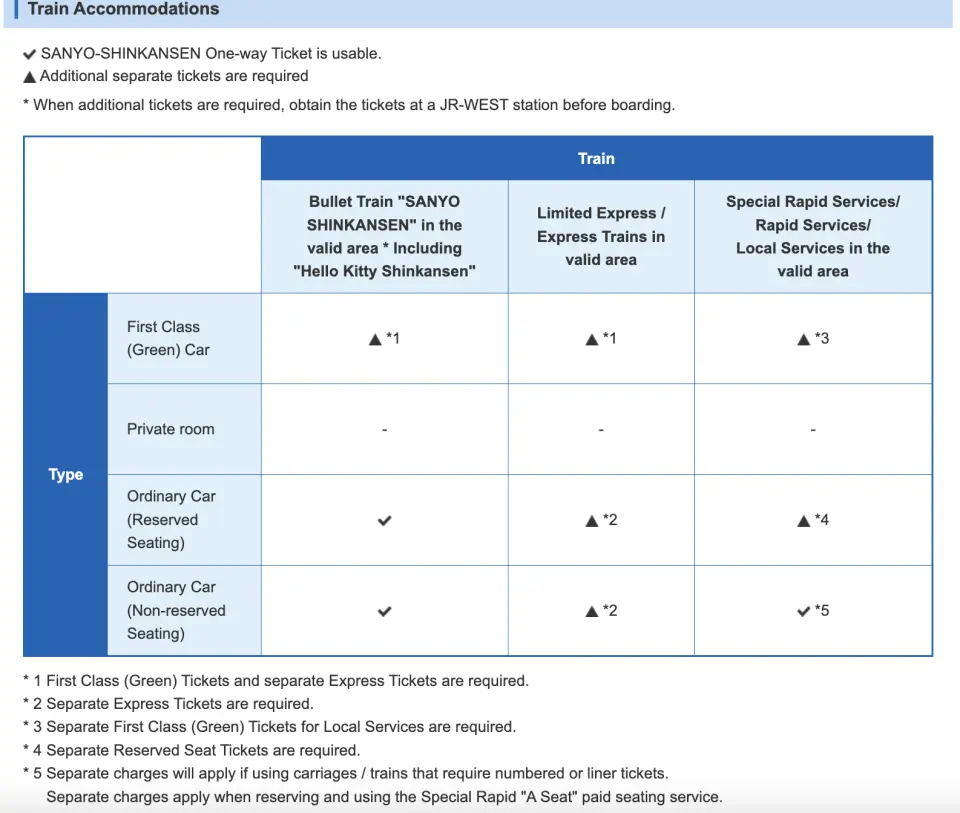

You can get on and off at any JR station in Osaka Prefecture.


Only passports with IC chips are applicable to collect physical tickets at automatic ticket vending machines. The ticket vending machine supports five languages: English, Simplified Chinese, Traditional Chinese, Korean, and Japanese


Purchase Notice
- Please purchase a separate first class car ticket if you need to use the First Class Car (Green Car)
- Please note that if the reserved seat cannot be used due to reasons such as full occupancy, the price difference between the non-reserved seat and the reserved seat cannot be refunded
- If your voucher or physical ticket is lost or stolen, it cannot be reissued
- Please note that the train may be delayed or stopped due to weather conditions
- This ticket can only be used once for a one-way trip during the specified time period. Please do not get off halfway, otherwise, you cannot continue to use the ticket
Eligible Users
Ineligible Nationalities/Regions
- Japan
Notes
- This pass is only eligible for non-Japanese tourists with a tourist visa or short-term stay visa
- This pass is not available for middle to long-term foreign residents holding a Japanese student visa or work visa
Reminders
[Refund Policy] If you still want to refund your ticket after redeeming it, you can go to the green window in the station and pay the handling fee (10% of the purchase price) for refund.
Please note that a single passenger cannot purchase or exchange multiple tickets for the same service section within the same period of use
How to Use
- Guests will receive a booking confirmation email after the booking and payment is completed
- Please present the received QR Code on the exchange e-voucher and non-Japanese passport to the JR ticket vending machines at designated station (green ticket vending machines) or JR Ticket Office (Midori-no-madoguchi, in another name: Green Window) to exchange for a ticket or Reserved Seating
- Exchangeable stations are Kansai Airport, Kyoto Station, Shin-Osaka Station, Osaka Station, Okayama Station, Hiroshima Station, Shin Yamaguchi Station, Shimonoseki Station, Kokura Station, Hakata station
- The ticket vending machine supports five languages: English, Simplified Chinese, Traditional Chinese, Korean, and Japanese - Reserved seat tickets can be issued after exchanging physical tickets. Please refer to this page for how to operate the JR green ticket vending machines
- Inform the service staff of the train you want to take if you swap at the JR Ticket Office (Midori-no-madoguchi)
*Please note that if the reserved seat cannot be used due to reasons such as full occupancy, the price difference between the non-reserved seat and the reserved seat cannot be refunded
How to Use Your Voucher
- Please present your e-voucher and passport on-site
Validity Period
- Valid for use within 90day(s) from the date of issue; Invalid after expiration
FAQ
Yes, the Sanyo Shinkansen is generally covered by the nationwide Japan Rail Pass. This allows travelers to use the Sanyo Shinkansen line as part of their pass validity. Specific regional JR passes, such as the Kansai-Hiroshima Area Pass or Sanyo-San'in Area Pass, also often include unlimited rides on the Sanyo Shinkansen within their designated areas. Always confirm the latest coverage details of your specific pass before travel.
The Sanyo Shinkansen is a vital route connecting major cities in western Japan. It primarily links Shin-Osaka in the Kansai region with Hakata in Fukuoka, Kyushu. Along this route, it conveniently serves key cities such as Okayama, Hiroshima, and Kokura, making it a crucial artery for travel between the Kansai and Kyushu areas.
The Sanyo Shinkansen operates various train types, including Nozomi, Mizuho, Sakura, and Kodama. The fastest services, like Nozomi and Mizuho, can reach speeds of up to 300 km/h (186 mph), making inter-city travel exceptionally quick. Even the slower services offer a significantly faster and smoother journey compared to conventional trains, ensuring efficient transport across the region.
Yes, the Sanyo Shinkansen is an integral part of the Japan Railways (JR) network. It is primarily operated by JR West (West Japan Railway Company), serving as a crucial high-speed rail line in western Japan. Being a JR line ensures seamless connections and integration with other JR services across the country, providing extensive travel options.
The Tokaido Shinkansen connects Tokyo to Shin-Osaka, serving Japan's most populous corridor. The Sanyo Shinkansen then extends from Shin-Osaka westward to Hakata (Fukuoka), linking the Kansai, Chugoku, and Kyushu regions. While they are distinct lines, many Nozomi and Mizuho trains operate through services, effectively connecting Tokyo directly to cities on the Sanyo Shinkansen line without transfers.
You can purchase Sanyo Shinkansen tickets and make seat reservations through several convenient methods. Online platforms like KKday offer a straightforward booking experience, allowing you to reserve your seat in advance and pick up your physical ticket easily at designated ticket machines, which helps avoid long queues at stations. Alternatively, tickets can be bought at JR ticket offices (Midori-no-Madoguchi) or ticket machines at Shinkansen stations across Japan.
Riding the Sanyo Shinkansen offers a fast, comfortable, and reliable travel experience. Trains are known for their punctuality, spacious seating, and smooth operation, even at high speeds. You can expect a clean environment, often with power outlets, and a selection of food and beverages available for purchase onboard. The journey allows for efficient travel while observing diverse Japanese landscapes and scenery.
Several factors determine the price of a Sanyo Shinkansen ticket. Key elements include the travel distance between your origin and destination, the class of seating (e.g., Ordinary Car or the more spacious Green Car), and the type of train service chosen (e.g., Nozomi and Mizuho trains are generally priced higher than Sakura or Kodama trains due to their speed and fewer stops). Additionally, opting for a reserved or unreserved seat can affect the final cost.
Get Help


