


Miyama Snow Lantern Day Trip: Amanohashidate & Ine
- See Miyama Kayabuki-no-Sato's thatched houses lit up by the winter-only Snow Lantern Festival in the evening
- Pound mochi and taste warm red bean mochi soup at Miyama's winter event (provided per event arrangements)
- Ride the cable car to see Amanohashidate, one of Japan's Three Views, as the "Flying Dragon View"
- Cruise Ine Bay past century-old wooden funaya floating on the sea, where sea and sky blend
- Watch the Haruno-ryu dance offering at Chii Hachiman Shrine, on February 3 only, a local tradition
- Travel round trip from Osaka with transport included, so there are no transfers to handle yourself
Package options


Sightseeing Tours
| Tour Type | Shared tour |
| Transportation method | Transfer from meeting point |
| Minimum participant requirement | 1 traveler |
| Meal arrangement | Arrange yourself |
| Sightseeing type | Natural sights, Temples & shrines |
| Transport | Bus tour |
Product Info
Where does the Miyama Snow Lantern day trip go?
An annual winter-only trip from Osaka that covers three popular sights in northern Kyoto in one day.
- By day: see Amanohashidate, one of Japan's Three Views, and visit the traditional Ine Funaya (boathouses).
- In the evening: walk into Miyama Kayabuki-no-Sato for the winter-only snow lantern illumination, where traditional thatched houses and warm lights create a dreamlike night view.
What can you do at Ine and Amanohashidate?
The daytime stops are two seaside sights of northern Kyoto.
- Ine Funaya: about 230 boathouses line the curved shore of Ine Bay, each with a boat garage on the ground floor and living space above. Fishermen still live and work here, and the district is an Important Preservation District for Groups of Traditional Buildings.
- Ine Bay cruise: the boat circles the bay in approx. 25 minutes. Look out over the rows of funaya from the 2nd-floor deck, with seagulls often flying alongside.
- Amanohashidate: a natural sandbar approx. 3.6 km long with pine forest, lying across the sea like a "bridge in the sky".
- View Land: ride the cable car up Mt. Monju for the "Flying Dragon View" (Hiryukan), and bend over to look at it between your legs.
- Free time: walk the scenic area or visit nearby sights such as Chion-ji Temple and Monju-do, a temple for praying for academic success.
What is special about Miyama Kayabuki-no-Sato in winter?
Miyama is one of Japan's three surviving thatched-roof settlements, alongside Shirakawa-go in Gifu and Ouchi-juku in Fukushima, with about 40 thatched houses among about 50 buildings.
- Snow lantern illumination: about 78 snow and flower lanterns, about 200 LED lanterns, about 50 paper lanterns and other lanterns light up the village at night.
- Mochi pounding: try traditional mochi pounding and taste warm red bean mochi soup. Included in the price; actual arrangements depend on the event on site.
- Chii Hachiman Shrine: built in 1017, the center of local faith and a Kyoto Prefecture cultural heritage site, with lit sacred lanterns and snow in winter.
- February 3 only: watch the shrine's Haruno-ryu dance offering.
- Photo spot: frame a thatched house with the rows of thatched roofs behind it, and find the bright red old-style mailbox at the entrance, the village's signature landmark.
- Food stalls: hot food stalls serve mainly grilled and fried food and hot soup, including venison, a Miyama specialty, and more.
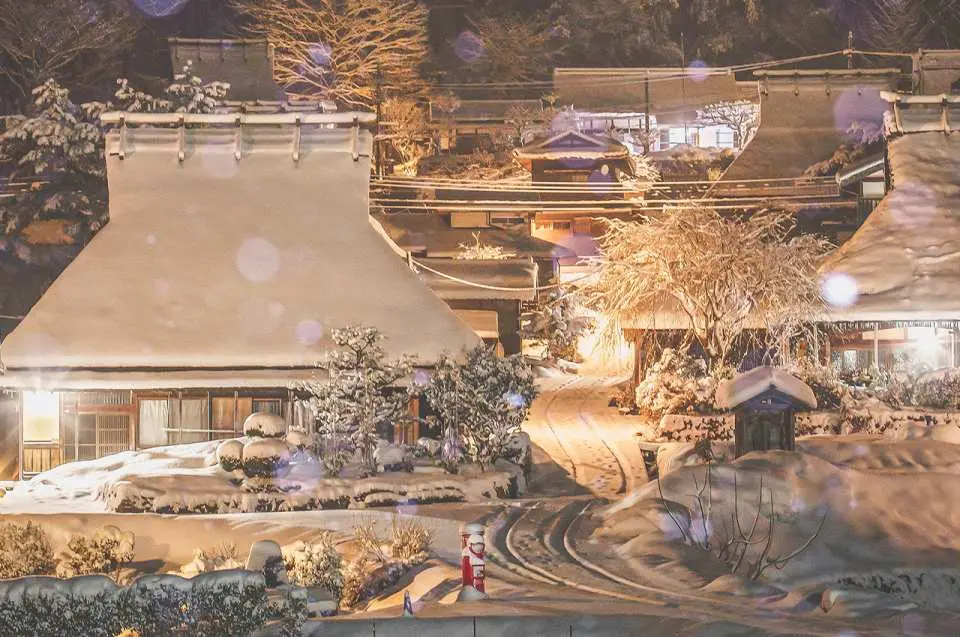
Kyoto's Thatched Village—Miyama Thatched Village Snow Lantern Festival, along with Shirakawa-go in Gifu Prefecture and Ouchi-juku in Fukushima Prefecture, is one of the three remaining thatched house settlements in Japan. The thatched houses in Miyama belong to the Kitayama-style folk house architecture, characterized by a kirizuma-zukuri roof on the upper part and a yosemune-zukuri roof on the lower part, known as irimoya-zukuri.

Amanohashidate, hailed as one of the "Three Views of Japan," is a natural sandbar stretching approximately 3.6 kilometers, lying across the sea like a bridge in the sky. Amanohashidate is particularly enchanting in winter—the white sandbar and pine forests are covered in a thin layer of snow, resembling a silver ribbon floating between the blue sea and the white snow.

Take the cable car to the observation deck and overlook Amanohashidate under a snow-covered landscape. The sea and sky blend seamlessly, and the pine forests are picturesque—a romantic and unique winter spectacle. The cool sea breeze and tranquil atmosphere intertwine, allowing you to forget the hustle and bustle and immerse yourself in the unique serenity of winter in Japan.

Amanohashidate View Land: the "Flying Dragon View", seen between your legs. Amanohashidate View Land is a park on Mt. Monju with an observation deck overlooking Amanohashidate. The hilltop also has a Ferris wheel and rides for all ages. Seen from here, Amanohashidate looks like a dragon flying up into the sky, which is why the view is called the "Flying Dragon View" (Hiryukan); it shows a lively, dynamic side of Amanohashidate. (Cable car tickets at your own expense.)

Miyama Village has about 50 buildings, including about 40 thatched houses (most of them homes), and was selected in 1993 as a national Important Preservation District for Groups of Traditional Buildings.

The best photo spot: the little red mailbox. Make the thatched house in front your main subject and shoot it together with the rows of thatched roofs behind it: it's truly beautiful! And don't forget the bright red old-style mailbox at the entrance, the one-of-a-kind landmark of Miyama Kayabuki-no-Sato!

Ine Town, located in northern Kyoto Prefecture, is known as the "Venice of Japan." Its most distinctive feature is the boathouses (funaya) built along the coastline. These boathouses are characterized by their ground floor, which faces directly into the bay and serves as a parking area for small boats—essentially a "garage on the sea." The second floor is used as living space. Currently, there are approximately 230 boathouses in Ine Town, neatly arranged along the arc-shaped coastline of Ine Bay, creating a unique maritime landscape. The history of the boathouses dates back to the Edo period, and fishermen still live and work here today. Due to this unique architectural style, the Ine boathouses have been designated as an "Important Preservation District for Groups of Traditional Buildings" in Japan.

Take a cruise on Ine Bay to tour the entire bay area from different angles, admiring the unique landscape of neatly arranged boathouses. Seagulls often fly alongside the boat, creating a captivating seaside village scene under the cool winter sun. Through the mist-shrouded bay shore, you can feel the tranquility of time flowing by and glimpse the wisdom of generations of fishermen along the Sea of Japan coast. In winter, Ine Bay lacks the hustle and bustle of summer tourists, gaining a beauty that seems frozen in time. Whether you are a photography enthusiast, a couple, or a traveler seeking to experience "authentic Japanese scenery," you can find peace and inspiration here.

One of the best ways to explore the Ine Boat Houses is by taking a sightseeing boat tour of Ine Bay. Tour Itinerary: The boat departs from the pier in Ine Bay, circling the bay for approximately 25 minutes. From the second-floor deck, you can enjoy panoramic views of the rows of boat houses and experience the picturesque traditional fishing village scenery. Highlights: On board, passengers can observe the boat houses and the daily lives of the fishermen up close, and may even encounter flocks of seagulls. Many tourists buy snacks to feed the seagulls, which is quite a fun activity. (Boats depart every hour and half-hour; tickets are at your own expense.)
Purchase Notice
Tour conditions
- Departure / destination: Osaka / Kyoto
- Duration: day trip (same-day return)
- Transport: chartered bus
- Bus company: Reisei Tourism Industry Co., Ltd., etc.
- Meals: breakfast 0, lunch 0, dinner 0
- Accommodation: none
- Minimum group size: 1
- Tour leader: 1
Tour planning and operation
- Operating company: TuYi Group Japan Co., Ltd.
- Address: 722 Shuzenji, Izu City, Shizuoka Prefecture
- License number: Shizuoka Prefecture Governor-Registered Travel Agency No. 2-633
- Travel association: full member of the Japan Association of Travel Agents (JATA)
Reminders
A minimum of 1 traveler(s) are required for the tour to depart. If the number of participants does not reach the minimum requirement, the tour will be canceled. An email regarding tour cancellation will be sent 1 day(s) before the departure date
In the event of inclement weather such as typhoons or snowstorms, a decision on whether to cancel the tour will be made 1 day(s) before departure (local time 18:00). Notifications will then be sent via email
Travelers with the following conditions or other health issues that could be worsened by excessive stimulation should not participate in this activity: Epilepsy, Asthma, Heart disease
Please arrive at the designated location 15 minute(s) before the scheduled departure time, as the tour will depart on time
This is a shared tour with a fixed itinerary. Please keep to the time allowed at each attraction and follow the arrangements of the driver and guide.
If you leave the group on your own during the trip, the transaction will be deemed invalid and no fees will be refunded. If personal or property safety is affected as a result, the consequences will be borne by you.
No fees will be refunded if you do not join the tour, or leave it partway, for personal reasons, lateness, etc. Thank you for your attention.
Arrival times at each stop may change depending on traffic, weather, festivals and crowds on the day. If the itinerary is delayed or cancelled due to the above or other force majeure factors, we appreciate your understanding; this cannot be used as grounds to request a refund.
Please be sure to abide by local laws and regulations in Japan and do not bring items prohibited by Japanese law to avoid violating the law and affecting your own rights.
During free activities, you should pay attention to your own personal and property safety. If you fail to heed the advice and an accident or loss occurs, you will be responsible for the consequences.
When the group is small, a smaller vehicle will be used, with the driver also serving as tour leader. This is a shared service, so other guests will ride with you, and the vehicle does not stop anywhere other than the attractions.
On weekends and national holidays, traffic jams and other force majeure factors may occur, and the driver and guide will adjust the itinerary according to the situation. Please keep this in mind before booking.
The Miyama Snow Lantern Festival runs from January 30 to February 6, 2027. This itinerary only departs during this period. Snow accumulation depends on weather conditions; the tour will proceed as scheduled even if there is no snow.
FAQs
1. Can Amanohashidate and Ine Funaya be comfortably visited in a single day as part of a tour?
Yes, visiting Amanohashidate and Ine Funaya is designed to be a comfortable one-day experience within this specific tour. The itinerary includes efficient round-trip transportation, allowing you to explore these two distinct scenic locations, including an Ine Bay Cruise, all within a single day without the hassle of individual transfers or extensive planning.
2. What unique experiences can visitors expect during the Snow Illumination at Miyama Gassho-zukuri Village?
During the winter season, Miyama Gassho-zukuri Village hosts a breathtaking Snow Illumination. Visitors can walk through the 'Snow Light Corridor,' where thousands of snow lanterns illuminate the traditional Gassho-zukuri thatched-roof houses. As night falls, the village transforms into a romantic, fairytale-like world, offering a unique and heartwarming atmosphere perfect for memorable photographs.
3. What specific views or activities are available at Amanohashidate's observation deck?
From Amanohashidate's observation deck, you can enjoy a panoramic outlook over the picturesque sea and sky. This vantage point offers views of the iconic 'bridge in the sky,' a natural land bridge stretching across Miyazu Bay. It's an excellent spot to appreciate why Amanohashidate is renowned as one of Japan's three most scenic spots, especially with winter sea views.
4. How can visitors explore the unique Ine Boat Houses and what makes them special?
Visitors can explore the Ine Boat Houses (Funaya), a century-old wooden village where traditional homes are built directly over the sea. The best way to experience them is by strolling along the village streets to see the architecture up close and by taking an Ine Bay Cruise. The cruise offers a distinct perspective of these unique 'floating villages,' where the first floor serves as a boat garage, revealing an original Japanese landscape.
5. What scenery can be admired during the Ine Bay Cruise?
The Ine Bay Cruise provides stunning views of the surrounding boathouses from the water, allowing you to fully appreciate their unique architectural design built directly along the bay. You can observe the serene blend of the sea and sky, creating a picturesque backdrop. It offers an immersive experience of this traditional fishing village's charm and natural beauty.
6. What are the departure points for visiting Miyama Gassho-zukuri Village, Amanohashidate, and Ine Funaya?
The tour includes convenient round-trip transportation with designated departure points from both Osaka and Kyoto. This simplifies your travel logistics, eliminating the need to plan complex public transport routes or transfers between Miyama Gassho-zukuri Village, Amanohashidate, and Ine Funaya, ensuring a smooth and hassle-free journey.
7. When is the best time to experience the Snow Light Corridor and illumination at Miyama Gassho-zukuri Village?
The Snow Light Corridor and illumination at Miyama Gassho-zukuri Village are a winter limited-time event, occurring once a year during the colder months. This magical experience truly comes alive as night falls, making the evening the best time to witness the dreamy scene created by thousands of illuminated snow lanterns and the snow-covered thatched-roof houses.
8. What complimentary gift is provided when visiting Miyama Gassho-zukuri Village?
When visiting Miyama Gassho-zukuri Village as part of the tour, each participant receives a complimentary gift. This includes one bottle (200ml) of Miyama specialty milk or one bottle (200ml) of Miyama coffee milk, offering a taste of the local produce from the region.


