


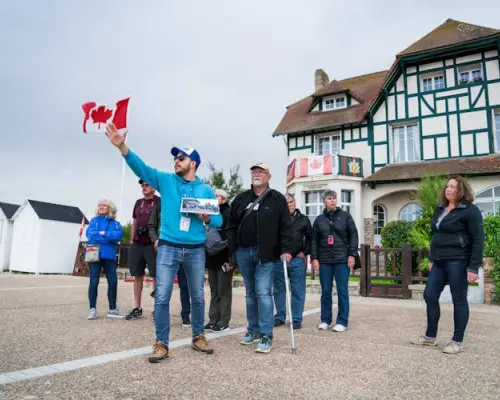
Normandy D-Day beaches with Juno Beach, bunkers and Canadian cemetery from Paris
- Retrace the footsteps of the Canadian troops on Juno Beach on this day trip from Paris. Find out how the events of the Battle of Normandy really played out.
Package Options


Product Info
Purchase Notice
Reminders
Please refer to your voucher for final information regarding meeting points, pick-up locations, and pick-up time
Meeting point description: Meet with your driver-guide outside of the café 15 minutes before the tour starts.(12 Avenue des Ternes, Paris, France)
This is a small group tour: max 8 people per group
Participants must be at least 7 years old
FAQ
The specific code name for the Canadian landing beach during D-Day on June 6, 1944, was Juno Beach. It was a crucial sector stretching from Courseulles-sur-Mer to Saint-Aubin-sur-Mer, where Canadian forces played a vital role in the Allied invasion of Normandy.
On D-Day, June 6, 1944, the five Allied landing beaches in Normandy were codenamed Utah Beach, Omaha Beach, Gold Beach, Juno Beach, and Sword Beach. Utah and Omaha were assigned to American forces, Gold to British forces, Juno to Canadian forces, and Sword to British and French forces.
On Juno Beach, the 3rd Canadian Infantry Division and the 2nd Canadian Armoured Brigade led the assault. Despite facing heavy German defenses, including formidable concrete bunkers and machine-gun nests, Canadian troops managed to penetrate further inland than any other Allied force on D-Day. They secured key objectives like the towns of Courseulles-sur-Mer, Bernières-sur-Mer, and Saint-Aubin-sur-Mer, establishing a vital foothold.
The Beny-sur-Mer Canadian War Cemetery is located near Reviers in Normandy, France, not far from Juno Beach. It is one of two permanent Canadian cemeteries in Normandy and serves as the final resting place for over 2,000 Canadian soldiers who fell during the D-Day landings and the subsequent Battle of Normandy in 1944. It commemorates their sacrifice and bravery.
Visitors to the Normandy D-Day beaches, particularly around Juno Beach, can explore remnants of the Atlantic Wall. These include concrete bunkers, pillboxes, and casemates that housed machine guns, anti-tank artillery, and observation posts. Their role was to defend the coastline against Allied invasion, providing strategic firing positions and protection for German forces. Many are well-preserved and offer a tangible connection to the past.
The primary objective of the D-Day landings was to establish a crucial Allied beachhead in German-occupied Western Europe, opening a second front against Nazi Germany. The subsequent Battle of Normandy aimed to secure this foothold, push inland, and ultimately liberate France and other Western European countries from German occupation, leading to the eventual defeat of Nazi Germany.
For a day trip from Paris to the Normandy D-Day beaches, many travelers opt for an organized guided tour, which often includes comfortable transportation, a knowledgeable driver-guide, and visits to key sites like Juno Beach and the Canadian cemetery. Alternatively, you can take a train from Paris Saint-Lazare station to Caen or Bayeux, then hire a local taxi or join a local tour to explore the beaches. Renting a car offers the most flexibility for self-guided exploration.
During a comprehensive tour of the Normandy D-Day beaches, visitors typically spend approximately 1.5 to 2 hours exploring Juno Beach and its associated sites. This includes dedicated time at the Juno Beach Centre, which provides extensive historical context and exhibits on Canada's role, as well as opportunities to walk on the beach, view remaining bunkers, and reflect at the memorials.
Get Help


