



Package Options


Product Info
Purchase Notice
Reminders
Please refer to your voucher for final information regarding meeting points, pick-up locations, and pick-up time
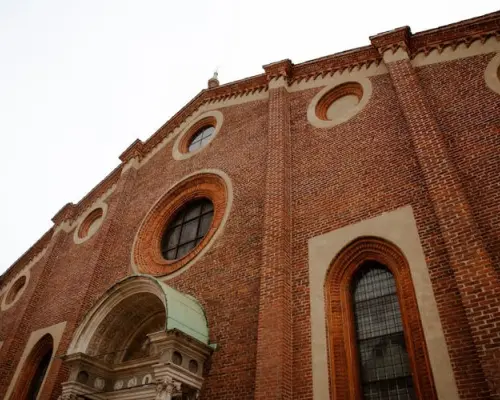
Meeting point description: Meet your guide by the entrance of Santa Maria delle Grazie church. The guide will have a yellow sign.(Piazza di Santa Maria delle Grazie, 20123 Milan, MI, Italy)
Not allowed:Children under 6 years cannot join this tour
Backpacks, large bags, food, and bottles of water are not allowed inside
Flash photography
Know in advance:It is mandatory to provide during the booking process the correct full names and dates of birth of every participant
Minors must be accompanied by an adult
This tour is guaranteed with a minimum number of 2 participants
Please arrive at the meeting point 10 minutes in advance
All visitors are allowed 15 minutes inside the Refectory with the Last Supper
Remember to bring:A valid ID document (no copies allowed), must be shown at the entrance
FAQ
1. What are some key historical facts about Da Vinci's Last Supper painting?
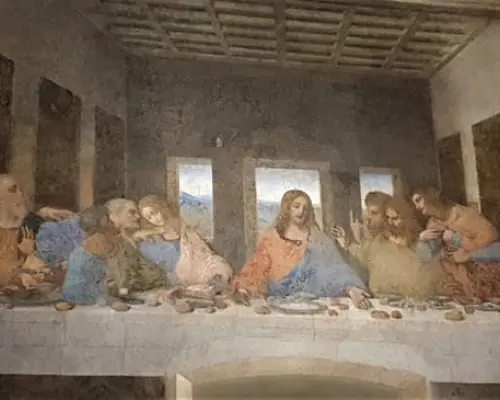
Da Vinci's Last Supper is a monumental mural painting, not a true fresco, created using an experimental tempera and oil on dry plaster technique. This innovative approach, however, led to its rapid deterioration over centuries. It was painted directly onto the refectory wall of the Santa Maria delle Grazie convent in Milan, depicting the moment Jesus announces one of his disciples will betray him, capturing the varied emotional reactions of the apostles.
2. Where is the original Da Vinci's Last Supper painting located in Milan?
The original Da Vinci's Last Supper painting is permanently located on the north wall of the refectory (dining hall) within the Convent of Santa Maria delle Grazie in Milan, Italy. The address is Piazza di Santa Maria delle Grazie, 2, 20123 Milano MI, Italy.
3. How can one get to Da Vinci's Last Supper from Milan's central train station?
From Milan Centrale Station, you can easily reach Da Vinci's Last Supper by taking the Metro. Board the M2 (Green Line) towards Abbiategrasso/Assago Forum and disembark at Cadorna FN station. From Cadorna FN, the Santa Maria delle Grazie convent is approximately a 10-15 minute walk away. Alternatively, you can take tram 16 from Cadorna FN for a few stops to get closer.
4. Is it possible to obtain tickets for Da Vinci's Last Supper on short notice?
Acquiring tickets for Da Vinci's Last Supper on short notice is exceptionally challenging due to high demand and strictly limited viewing slots. Tickets often sell out months in advance. For a higher chance of securing entry, it is highly recommended to book your guided tour or admission well in advance. You can book through KKday, which offers pre-arranged tours that simplify the booking process and ensure your entry, saving you the hassle of trying to find last-minute availability.
5. What unique aspects or details of Da Vinci's Last Supper are highlighted during a guided tour?
A guided tour of Da Vinci's Last Supper typically highlights Leonardo's revolutionary use of linear perspective, guiding the viewer's eye directly to Jesus. Guides explain the psychological drama depicted in the apostles' reactions to the betrayal announcement, the complex symbolism within the composition, and the innovative, yet fragile, painting technique. Insights into the masterpiece's turbulent history and meticulous restoration efforts are also provided.
6. What is the current condition of Da Vinci's Last Supper painting and what efforts are made for its preservation?
Da Vinci's Last Supper has suffered significant damage over centuries due to Leonardo's experimental technique, humidity, and historical events. Extensive restoration efforts have been undertaken to stabilize and recover its delicate state. Today, strict environmental controls within the refectory, limited visitor numbers per viewing session, and continuous monitoring are diligently implemented to protect the masterpiece from further deterioration and ensure its long-term preservation.
7. What should visitors know about the viewing experience and entry restrictions for Da Vinci's Last Supper?
Visitors are admitted in small, timed groups, typically around 25-30 people, for a brief viewing period of approximately 15 minutes, which is crucial for the fresco's preservation. Strict temperature and humidity controls are maintained, requiring visitors to pass through airlock chambers. Photography without flash is generally allowed, but large bags are often not permitted and must be checked into lockers before entry to ensure the safety and environment of the artwork.
8. How long is the typical viewing duration for Da Vinci's Last Supper painting?
The actual viewing time allowed directly in front of Da Vinci's Last Supper painting is strictly limited to approximately 15 minutes per group. This precise duration is a critical measure to preserve the delicate artwork and to efficiently manage the large number of visitors. The overall experience, including entry procedures and moving through controlled environments, might extend slightly beyond the direct viewing time.


