


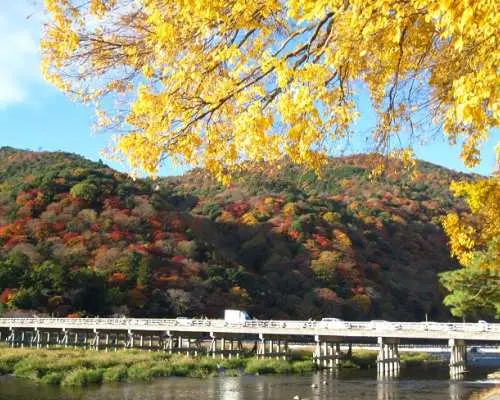

Arashiyama Houseboat & Genkoan Autumn Foliage Bus Tour from Osaka
- Enjoy a charming riverside moment at Keiryo Kawadoko, overlooking the autumn foliage.
- Admire the autumn-colored leaves of Arashiyama from a traditional houseboat.
- Enjoy free time to stroll through Arashiyama, beautifully dyed in autumn colors.
- Visit Genkoan Temple, famous for its “Window of Enlightenment” and “Window of Confusion,” offering stunning autumn views.
Sightseeing Tours
| Tour Type | Shared tour |
Product Info
Purchase Notice
This tour is a Japanese tour. The tour conductor will provide language support using a translator (Pocket Talk).
This is not a private tour; you will enjoy the tour with other guests.
If the minimum number of participants (20) is not met by (14) days before the scheduled date, the tour on that date might be canceled.
The peak autumn foliage period may vary depending on weather, but the tour will operate regardless of leaf conditions.
(Typical peak: Arashiyama – mid-November to early December, Genkoan – mid-November to late November)
This tour involves a fair amount of walking, so please wear comfortable clothing and shoes.
Lunch will be served at the riverside seating area (kawadoko); please dress warmly.
Any optional paid sightseeing during Arashiyama free time is at your own expense.
The Arashiyama boat cruise may be canceled at short notice due to bad weather. In such cases, the cruise fee (¥1,500) will be refunded.
Reminders
Important Notes During Bus Tour
Please refrain from drinking alcohol on the bus.
Members of the odd-numbered group may need to share seats with other passengers on the bus.
As stipulated by Japanese law, please wear your seat belt on the tour bus.
Please remain seated and avoid walking while the tour bus is moving.
Seating on the bus is assigned by H.I.S staff. Please do not change your seat during the tour.
Please be punctual and arrive at the designated meeting place on time. The bus will depart on time and will not wait for latecomers.
Latecomers who wish to rejoin the group will be responsible for all transportation fees.
8.Please wear the sticker provided by the tour guide visibly.
Avoid sticking the sticker on leather goods, as it may leave marks.
Do not use the seat reclining function or adjust the seat settings.
Please set all electronic devices, including mobile phones and game consoles, to silent mode.
Talking on mobile phones and making video calls are prohibited on the tour bus.
Smoking is strictly prohibited on the tour bus.
Arrival times at each sightseeing spot may vary depending on traffic conditions.
The use of drones for filming or other purposes is prohibited during the tour.
Please do not use perfume, sprays, or change baby diapers on the bus, as it may disturb other passengers.
Manage your valuable belongings yourself.
After the tour, please take all your trash with you and do not leave any on the bus.
Ensure you do not forget or leave any personal belongings on the bus after the tour.
For fruit-picking tours, please note that fruit is to be consumed only on the farm. Bringing it home in your own bag is strictly prohibited.
If you fail to follow these regulations and cause a disturbance on the bus, you may be asked to leave the bus, even during the tour.
Cancellation Policy
- Cancellations 11 day(s) (inclusive) before the selected date are allowed. Unused orders can be canceled for free
- For cancellations made 8 to 10 days prior to selected date, a cancellation fee of 20% will apply
- For cancellations made 2 to 7 days prior to selected date, a cancellation fee of 30% will apply
- For cancellations made 1 to 1 days prior to selected date, a cancellation fee of 40% will apply
- Cancellation is not allowed between 0–0 days from the selected date. Orders cannot be canceled or modified, and refunds will not be granted.
- Due to time zone differences, the confirmed cancellation date is based on the supplier’s local time. Please allow 2–5 business days to process your cancellation request, after which the cancellation fee will be charged according to the product’s cancellation policy. Once the cancellation is confirmed, you will receive your refund within 14 working days.
FAQ
To reach Arashiyama from central Kyoto, several convenient options exist. The JR Sagano Line departs from Kyoto Station, arriving at Saga-Arashiyama Station in about 15 minutes, which is close to the Bamboo Forest. Alternatively, the Hankyu Arashiyama Line connects from Shijo-Kawaramachi or Karasuma to Arashiyama Station, ideal for accessing the southern parts. The Randen Tram (Keifuku Arashiyama Line) from Shijo-Omiya also terminates at Arashiyama Station, offering a scenic ride and easy access to the central area.
To experience the Arashiyama Bamboo Forest with fewer crowds, planning an early morning visit, ideally before 8:00 AM, or a late afternoon visit after 4:00 PM, is highly recommended. Weekdays generally offer a more tranquil experience compared to weekends and national holidays. Exploring some of the side paths can also lead to quieter sections away from the main thoroughfare, allowing for a more serene appreciation of the bamboo grove.
The traditional houseboat ride in Arashiyama, often on a yakatabune, offers a serene and picturesque experience on the Hozugawa River. Visitors can expect to glide gently along the water, surrounded by the stunning autumn foliage that dyes the mountainsides in vibrant colors. It provides a unique perspective of Arashiyama’s natural beauty and allows for relaxation while admiring the scenery from the water, often with a traditional ambiance.
Genkoan Temple is renowned for its two distinct windows: the 'Window of Enlightenment' (Satori no Mado) and the 'Window of Confusion' (Mayoi no Mado). The circular 'Window of Enlightenment' symbolizes enlightenment and the universe, while the square 'Window of Confusion' represents human life with its four sufferings of birth, aging, sickness, and death. Both windows perfectly frame the temple's exquisite garden, offering breathtaking views, especially vibrant during autumn.
The best time to witness the vibrant autumn foliage in Arashiyama typically falls from mid-November to early December. During this period, the maple trees along the Hozugawa River, around Togetsukyo Bridge, and within the various temples and gardens transform into spectacular hues of red, orange, and yellow. Peak viewing can vary slightly each year depending on weather conditions, so it's advisable to check local forecasts closer to your travel date.
Genkoan Temple is highly recommended for autumn foliage viewing primarily due to the unique perspective offered by its 'Window of Enlightenment' and 'Window of Confusion.' These windows act as natural frames, showcasing the brilliantly colored maple trees in the garden like living artwork. The temple's serene atmosphere and traditional architecture, combined with the vivid reds and golds of the surrounding nature, create a deeply meditative and visually stunning experience during the autumn season.
During free time in Arashiyama's autumn landscapes, visitors can enjoy strolling through the iconic Bamboo Forest, admiring the colorful views from Togetsukyo Bridge, and exploring the expansive gardens of Tenryu-ji Temple, a UNESCO World Heritage site. You might also consider a leisurely walk along the Hozugawa River, browsing local craft shops, or sampling traditional Kyoto snacks from the many street vendors. The area offers a blend of natural beauty and cultural experiences.
The riverside lunch experience at Keiryo Kawadoko in Arashiyama offers a unique opportunity for 'kawadoko' dining, where meals are served on platforms built directly over or alongside the river. Guests can enjoy traditional Japanese cuisine while surrounded by the breathtaking autumn foliage and the soothing sounds of the stream. This setting provides a remarkably tranquil and scenic backdrop for a meal, creating a memorable connection with Arashiyama’s natural beauty during the fall season.
Get Help


