



8-Day Yellowknife, Canada Aurora Observation, Banff National Park, Johnston Canyon, and Lake Louise Tour
Aurora Activities
| Tour Type | Shared tour |
| Transportation method | Transfer from meeting point |
Sightseeing Tours
| Tour Type | Shared tour |
| Transportation method | Transfer from meeting point |
| Tour types | Guided tour |
| Meal arrangement | Arrange yourself |
| Sightseeing type | Natural sights |
| Transport | Bus tour |
Product Info
Purchase Notice
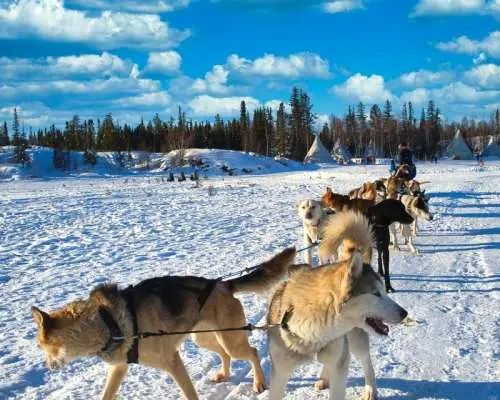
Dog Sledding - Event Time: 12/01-03/31
Indian Ice Fishing - Event Period: 11/28-04/11
Snowmobile - Event period: 12/01-03/31
Self-funded projects are recommended to be paid in US dollars. There are no recommended activities in other time periods, and you can arrange them yourself.
Booking Information
Minors or children under the age of 18 must be accompanied by an adult. Minors or children traveling alone are not allowed to join the tour. For the safety of pregnant women, pregnant women must not be more than 24 weeks pregnant at the end of the tour.
Please ensure you provide accurate and complete information when booking, including your name, gender, valid contact information (preferably a mobile phone number, so you can notify us if any questions arise), accurate flight information, and location of your group, to avoid booking errors that could affect your trip. You will be solely responsible for any losses incurred as a result of providing incorrect information.
North American hotels offer a variety of room types, such as a king/queen-size bed or two double-size beds. The maximum number of people legally allowed per room is between two and four, including adults and children. Furthermore, each hotel has different deposit collection methods (mostly credit cards), and group guests are required to comply with these regulations.
Guests are not permitted to bring their own tickets or use City Passes. Admission fees and meal prices are subject to change based on official notice from the attraction. Prices published by the attraction on the day of the tour will prevail.
While facilitating group operations, the itinerary sequence will be appropriately adjusted to ensure the smooth progress of the tour, but the items that should be included in the itinerary will not be reduced.
During the actual trip, the tour guide or driver has the right to appropriately adjust the order of visiting attractions, length of stay or meeting time according to weather, traffic and other conditions to ensure a smooth trip.
If a site is temporarily closed or closed for holidays (Thanksgiving, Christmas, New Year's), your guide will adjust the itinerary to include a different attraction or alternative attractions. The opening hours and capacity controls of various attractions and national parks are subject to change due to the pandemic. Any disruption to the itinerary is considered force majeure and we apologize for any inconvenience.
Children under eight years old are required to use a car seat. Rentals are available for $10.00 per person per day. Please inform us in advance when booking your trip so we can prepare. Any violations and fines incurred due to failure to notify us in advance will be the sole responsibility of the guest. Please understand that car seats are not required for day-of travel by bus, and the fee is refundable.
Many attractions on this itinerary require basic health conditions. Please contact us in advance if you have disabilities or have mobility issues. Without prior notification, we cannot guarantee wheelchair access or suitable seating.
The Northern Lights are a natural phenomenon unique to the polar regions. While there's a high chance of seeing them in good weather, there's also the possibility of seeing them faint due to weather or other natural factors. The itinerary sequence for this product is subject to adjustment based on your arrival date, local weather conditions, and other factors. The itinerary sequence is for reference only. Optional activities will be adjusted based on registration and weather conditions. The itinerary recommendations are for reference only and do not represent actual dates. Please confirm any unplanned activities in advance to avoid any schedule conflicts.
Reminders
This trip consists of 4 people. If the group is not formed, we will contact you 2 days in advance to cancel the order
If you have large luggage, each customer is limited to one piece of luggage
To ensure a smooth and complete itinerary, guests are responsible for strictly adhering to the meeting time indicated by the tour guide. If more than ten minutes pass before the meeting time, the vehicle will depart without waiting. However, due to uncontrollable factors such as weather, traffic, mechanical failure, strikes, government shutdowns, war, and terrorist attacks, our company cannot guarantee timely arrival at the pickup location. We are not responsible for any inconvenience or additional costs incurred by guests due to delays caused by such factors, including flights, trains, buses, and other travel expenses.
In order to facilitate the group operation, tourists will be transferred from the original vehicle to another vehicle during the journey and different tour guides and drivers will be assigned to provide services.
The following suggestions will help you check in faster and better: You must bring a valid ID (with a photo); please present a paper or electronic version of your itinerary.
This product is a group activity. If you choose to leave the group midway, please inform the tour guide in advance and obtain his consent. You will need to sign a departure agreement. The unfinished part will be deemed to be abandoned by you and the group fee will not be refunded.
Please note that if the complimentary items in the itinerary cannot be provided due to force majeure such as traffic or weather, or if you are unable to visit due to personal reasons, the fees will not be refunded. Please understand.
Smoking is prohibited on the tour bus and in most hotel rooms. Hotel cleaning staff are professionally trained, and security personnel will also collect evidence. Any violation will incur a cleaning fee of at least $250 per night. This fee is the responsibility of the guest and is not covered by our company. Please smoke in designated smoking areas.
Pets and animals are not allowed on the tour.
Only for products that include airport pick-up service: For each order, only one free airport pick-up service is provided within the pick-up time range. If the pick-up service cannot be arranged due to weather, flight delays, etc., please pay for the transportation costs yourself
Cancellation Policy
- Cancellations 18 day(s) (inclusive) before the selected date are allowed. Unused orders can be canceled for free
- For cancellations made 11 to 17 days prior to selected date, a cancellation fee of 50% will apply
- Cancellation is not allowed between 0–10 days from the selected date. Orders cannot be canceled or modified, and refunds will not be granted.
- Due to time zone differences, the confirmed cancellation date is based on the supplier’s local time. Please allow 2–5 business days to process your cancellation request, after which the cancellation fee will be charged according to the product’s cancellation policy. Once your refund request is confirmed, KKday will initiate the refund to your original payment method within 15 days. The actual refund timing depends on your card-issuing bank’s policy.
FAQ
1. What is the best time of year to visit Banff National Park?
Banff National Park offers distinct beauty in different seasons. Summer (June to August) is ideal for hiking, canoeing on turquoise lakes, and wildlife viewing, with pleasant temperatures. Winter (December to March) is perfect for snow sports like skiing and snowboarding, and experiencing frozen waterfalls and a serene, snow-covered landscape, particularly at Johnston Canyon. Spring and autumn provide fewer crowds and unique transitional scenery.
2. What is the recommended duration to experience Banff National Park's main attractions?
To truly immerse yourself in Banff National Park's diverse offerings, a stay of 3 to 5 days is generally recommended. This allows ample time to explore key attractions like Lake Louise and Johnston Canyon, participate in activities such as hiking or canoeing, and simply soak in the breathtaking Rocky Mountain scenery without feeling rushed. A multi-day visit provides a comprehensive experience.
3. What are the key differences between Lake Louise and Banff National Park attractions for visitors?
Lake Louise is a specific, iconic glacial lake known for its stunning turquoise waters and the Victoria Glacier backdrop, offering activities like canoeing in summer and ice skating in winter. It is one of many attractions within Banff National Park. Banff National Park itself is much larger, encompassing a vast wilderness area with multiple towns, mountains, hot springs, wildlife, and diverse trails, including scenic areas like Johnston Canyon and Bow Falls. While Lake Louise is a highlight, Banff National Park offers a broader range of experiences and landscapes.
4. What is the probability of seeing the aurora borealis in Yellowknife?
Yellowknife is renowned for its high probability of aurora sightings due to its location directly beneath the aurora oval and minimal light pollution. During the prime viewing season (mid-August to mid-April), if you stay for at least three nights, the chance of seeing the aurora is very high, often cited as over 90%. Clear skies are a crucial factor, and local tour operators constantly monitor weather and aurora activity for optimal viewing.
5. What are the optimal times at night to observe the aurora borealis in Yellowknife?
The aurora borealis can typically be observed from late evening into the early hours of the morning in Yellowknife, usually between 10:00 PM and 3:00 AM. Peak intensity often occurs around midnight. However, aurora activity is dynamic and unpredictable; some displays can begin earlier or last later. It is advisable to be prepared for viewing throughout this window, especially during strong solar activity.
6. What unique experiences can be enjoyed at Johnston Canyon and Lake Louise?
At Johnston Canyon, visitors can hike along a stunning series of catwalks clinging to canyon walls, leading to beautiful lower and upper waterfalls. In winter, icewalks offer a unique perspective of frozen falls and ice climbers. Lake Louise offers iconic views of its turquoise waters against the Victoria Glacier. Popular activities include canoeing on the lake, lakeside strolls, or snowshoeing and ice skating during winter, providing diverse experiences depending on the season.
7. What transportation options are available for exploring Yellowknife and reaching aurora viewing locations?
In Yellowknife, the downtown area is relatively walkable, but reaching aurora viewing locations outside the city requires transportation. Many aurora tours include pick-up and drop-off services from hotels, using specialized vehicles to transport guests to dark-sky viewing sites. Taxis and limited public transit are available for city navigation, but for aurora chasing, guided tour transportation is the most common and convenient option, ensuring access to optimal spots away from light pollution.
8. How far is Yellowknife located from the Arctic Circle?
Yellowknife is situated approximately 400 kilometers (about 250 miles) south of the Arctic Circle. While it is not within the Arctic Circle itself, its proximity places it well within the auroral oval, a band around the magnetic poles where aurora activity is most concentrated and frequent. This strategic location is why Yellowknife is recognized as one of the world's premier destinations for observing the aurora borealis.
Get Help


