


[One-Day Tour in Kyoto] Kinkaku-ji Temple, Kiyomizu-dera Temple, Kyoto Matcha Experience or Heian Jingu Shrine (Choose One) and Higashitenno Okazaki Shrine | Get on and off in Osaka or Kyoto
- Convenient transportation options: You can hop on and off the bus in Osaka or Kyoto, making it easy to start a day trip to Kyoto
- A blend of history and culture: Check out Kinkaku-ji Temple, Kiyomizu-dera Temple, and explore the Higashitenno Okazaki Shrine to experience the charm of history
- Choose one of the two special experiences: you can participate in the Kyoto matcha making experience, or visit the Heian Shrine to experience the solemnity
- Unique architectural style: Kinkaku-ji Temple integrates the characteristics of many eras, and the main hall of Kiyomizu-dera Temple, the Kiyomizu Stage, is magnificent.
Package Options


Sightseeing Tours
| Tour Type | Shared tour |
| Transportation method | Transfer from meeting point, Hotel transfer |
| Minimum participant requirement | 4 travelers |
| Tour types | Guided tour |
| Meal arrangement | Arrange yourself |
| Sightseeing type | City walking tour, Temples & shrines |
| Transport | Bus tour |
Product Info
The content of this product is provided by machine translation and may not reflect the actual information, please take this into consideration before booking.
—Introduction to attractions—
- Kinkaku-ji Temple
Rokuon-ji Temple is a famous Zen temple with hundreds of years of history. Today, it is more widely known as the "Golden Pavilion Temple", which is named after the famous Golden Pavilion (Shariden), the core building of the temple. Not only can you visit the lush green and mossy gardens and the teahouse in the temple, or observe the mirror reflection of the Golden Pavilion in the tranquil Mirror Lake, you can also witness the different views of the Golden Pavilion in the four seasons. The reference ticket price is 500 yen/person.
- Kiyomizu Temple Area
You can enjoy a local Kyoto-style lunch and admire the ancient buildings full of Japanese style.
Recommended attractions:
【Kiyomizu Temple】World Cultural Heritage, a popular tourist attraction in Kyoto. Founded in 778, it is the oldest temple in Kyoto and a national treasure of Japan. Jishu Shrine is located on the north side of the main hall of Kiyomizu Temple. It is a shrine for marriage and love in Japan. (Admission fee: Adults: 300 yen, elementary and middle school students: 200 yen) Please pay for the fee yourself.
【Ninenzaka and Sannenzaka】Ninenzaka and Sannenzaka, located outside Kiyomizu Temple, are slopes with unique Kyoto style and are listed as "Important Traditional Buildings Protection Areas" in Japan. On both sides of the stone slope are Japanese-style buildings full of ancient charm, with a strong Japanese style, and a variety of delicacies, paper fans, dolls, chopsticks and other handicrafts that are dazzling.
[Ishibe-Alley] Turn right at the end of Ninenzaka and continue walking north, you will see Ishibe-Alley. There are fewer tourists here. Elegant traditional Japanese houses are located on both sides of the cobblestone path, making people feel like they are going back in time, away from the hustle and bustle, and returning to tranquility.
【Gion·Hana-koji】An ancient and famous flower street. In the 1960s, there were nearly a thousand geishas in Kyoto. Today, there are still dozens of geisha teachers who provide training in traditional tea ceremony, flower arrangement, koto, gagaku, kyogen, maiko, bunraku, etc. Walking into the flower street, an ancient atmosphere hits you: tea houses with exquisite facades on both sides, wooden lattice windows and doors are tightly closed... This is a mysterious path running from north to south, with a total length of about 1 kilometer. The northern section is modern, the southern section is traditional, and the north and south have their own styles and are leading the trend.
Yasaka Shrine: Located in Higashiyama District, Kyoto City, Yasaka Shrine is one of the most famous and oldest shrines in Kansai. There are places for fortune-telling, writing ema, and getting amulets. The ema patterns are very diverse, and the heart-shaped ema for praying for love is very popular.
Recommended itinerary:
Recommendation 1: Kiyomizu Temple (ticket fee is at your own expense) - Ninzanzaka, Sannenzaka - Ishibe-koji - Gion, Hanami-koji - Yasaka Shrine
Guests can choose to visit some attractions according to their preferences and physical condition.
Recommendation 2: Kimono experience. Interested guests can put on a kimono, stroll along the ancient streets, visit Kiyomizu Temple, and capture the most beautiful moment.
You can choose any kimono shop in Kiyomizu Temple and make reservations in advance. You can refer to this product website .
- Kyoto Matcha Experience
The highest realm of tea ceremony is Ichigo Ichie, a term developed from Japanese tea ceremony. In tea ceremony, it means that the person performing the tea ceremony will sincerely treat every guest who comes to taste tea with the feeling of "it's rare to meet each other, so we should cherish each other in this world". People may only meet each other once in their lifetime, so we should treat each other in the best way. After experiencing matcha, it is recommended that everyone walk out of the matcha shop and go to Heian Jingu Shrine to check in the largest torii in Japan.
- Heian Shrine
Heian Shrine was built in 1895 to commemorate the 1100th anniversary of the relocation of the capital to Heian. It enshrines Emperor Kanmu and Emperor Komei of the Heian period. The shrine is famous for its architectural style imitating the Chodo-in of Ouchi-ri in Heian-kyo, and the vermilion torii is magnificent. The garden has beautiful scenery in all seasons, with cherry blossoms in spring and maple leaves in autumn. It is an important historical and cultural attraction in Kyoto.
- Higashitenno Okazaki Shrine
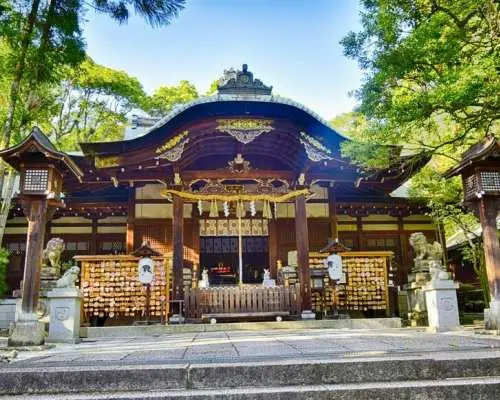
There are many rabbit statues in the shrine. The rabbit in the hand-watering building is made of black granite and is commonly known as the "child-seeking rabbit" (子授けうさぎ). Its action expresses the appearance of facing the moon and being full of strength. It is said that pouring water on the fertility rabbit and touching its belly can bless you to have a baby and a safe and smooth birth. In general shrines, stone lions are usually sitting on the approach to the shrine. However, in Okazaki Shrine, instead of stone lions, the shrine is guarded by stone rabbits. The two rabbits form a pair, the male rabbit on the right has its mouth open, and the male rabbit on the other side has its mouth closed. The two rabbits open and close their mouths, forming the so-called "Ahum". Touch the cute rabbits and pray for a good marriage!
—Important Notes—
- Each person can bring one piece of luggage for free, with no size limit (please note when registering).
- Children aged 0-3 years old can travel for free if they do not occupy a seat; children aged 4 years old and above travel the same as adults.
- If there is not enough space on the bus due to failure to make a reservation for children under 3 years old who do not occupy a seat, they will be refused boarding and the fee will not be refunded.
- Driver-guide service (for small groups of 4-13 people: driver-guide service; for groups of more than 13 people: driver + guide service).
- Reference vehicle models: 5-8 seater: Toyota Alphard; 9-14 seater: Toyota HAICE or equivalent; 18-22 seater: mini bus; 22 seater and above: large bus. The above vehicles are for reference only, and the actual vehicle model will be adjusted according to the number of people in the group on the day.
More recommended itineraries in Kansai:
Kinkakuji Temple: Officially known as Rokuon-ji Temple, the temple's "Golden Pavilion" is very distinctive. The building integrates the styles of many eras, and the upper two floors are covered with gold foil, which shines brightly in the sun and is reflected in the mirror lake. It is magnificent and is a landmark of Japan.


Kiyomizu Temple: An ancient temple in Kyoto, built in 778. The main hall, the Kiyomizu Stage, is magnificent, like a large ship in the sky. The scenery is charming in all four seasons, with cherry blossoms in spring, maples in autumn, and snow in winter each having its own charm. Standing on the stage, you can overlook the city of Kyoto.


Ni and Sannenzaka: These two streets are full of traditional Kyoto style. On both sides of the road are quaint townhouses selling special souvenirs and delicacies. Walking through them is like traveling back in time.


Ishibe-Alley: A poetic path with long stone walls and dotted with green plants. It is a quiet path where you can often see people wearing kimonos. It has a strong Kyoto flavor.


Yasaka Shrine: With a long history, it is the venue for the Gion Festival. The shrine is solemn and bustling during festivals, and many tourists come to pray during normal times.


Kyoto Matcha Experience: You can personally participate in the production of matcha, from grinding to brewing, taste the rich tea aroma, and gain a deeper understanding of Kyoto Matcha culture.


Heian Shrine: Built to commemorate the relocation of the capital to Heian, the building imitates the Heian-kyo court hall, magnificent and solemn, with flowers blooming in the garden all year round, peaceful and beautiful.


Heian Shrine is very close to Totenno Okazaki Shrine, also known as the "Rabbit Shrine". It takes about ten minutes on foot from Heian Shrine to Totenno Okazaki Shrine.


Purchase Notice
【Travel conditions】
Travel origin and destination: Osaka and Kyoto
Travel days: Round trip
Transportation: Chartered bus
Bus company name: Reisei Tourism Industry Co., Ltd.
Meals: Breakfast 0 times Lunch 0 times Dinner 0 times
Accommodation facilities: None
Minimum number of people in a group: 4
Team leader: 1
【Travel planning/implementation】
Name of operating company: TuYi Group Japan Co., Ltd.
Address: 722 Shuzenji, Izu City, Shizuoka Prefecture
License Number: Shizuoka Prefectural Governor Registered Travel Agency, No. 2-633
Travel Agency Association: Regular Member of the Japan Association of Travel Agents (JATA)
Reminders
A minimum of 4 traveler(s) are required for the tour to depart. If the number of participants does not reach the minimum requirement, the tour will be canceled. An email regarding tour cancellation will be sent 4 day(s) before the departure date
In the event of inclement weather such as typhoons or snowstorms, a decision on whether to cancel the tour will be made 1 day(s) before departure (local time 18:00). Notifications will then be sent via email
Please arrive at the designated location 10 minute(s) before the scheduled departure time, as the tour will depart on time
During the trip, please carry your passport and valuables with you and keep them properly. If they are lost, stolen, or damaged, you will be responsible for the consequences.
Elderly people, patients with cardiovascular diseases such as hypertension and heart disease, and pregnant women are advised to be accompanied by their relatives.
Elderly people aged 70 years and above must ensure that they are in good health and suitable for travel, and must be accompanied by family members or friends aged 22 years and above throughout the trip.
This is a fixed carpooling itinerary. Please be sure to abide by the stay time at each attraction and follow the arrangements of the driver and guide.
Please note that no refund will be given if you fail to participate or cancel the trip due to personal issues, lateness, etc.
If you leave the group on your own during the trip, the transaction will be deemed invalid and no fees will be refunded. If personal or property safety is affected as a result, the consequences will be borne by you.
The arrival time of each itinerary may change due to traffic conditions, weather, festivals, and crowds on the day. Please forgive us if the itinerary is delayed or cancelled due to the above or other force majeure factors. We cannot request a refund for this reason.
Please be sure to arrive at the designated pick-up location at the designated time and do not be late. Because this trip cannot be transferred to other flights or joined midway, if you fail to participate in the one-day tour due to your own reasons, you will be responsible for the corresponding losses. Please understand.
Traffic jams and other force majeure factors may occur during weekends and popular days. The driver will also adjust the itinerary according to the specific situation. Please be sure to prepare your psychological expectations before placing an order.
If you do not participate in the matcha experience, there will be no refund.
Cancellation Policy
- Cancellations 4 day(s) (inclusive) before the selected date are allowed. Unused orders can be canceled for free
- For cancellations made 2 to 3 days prior to selected date, a cancellation fee of 50% will apply
- Cancellation is not allowed between 0–1 days from the selected date. Orders cannot be canceled or modified, and refunds will not be granted.
- Due to time zone differences, the confirmed cancellation date is based on the supplier’s local time. Please allow 2–5 business days to process your cancellation request, after which the cancellation fee will be charged according to the product’s cancellation policy. Once the cancellation is confirmed, you will receive your refund within 14 working days.
FAQ
Kinkaku-ji Temple, also known as the Golden Pavilion, is renowned for its stunning architecture, with its top two floors completely covered in gold leaf. It is set against a beautiful pond, Kyo-kochi (Mirror Pond), creating a magnificent reflection. Its design blends elements from Muromachi, Edo, and Fujiwara periods. The surrounding tranquil garden, designated as a Special National Historic Site and Special Place of Scenic Beauty, enhances the visitor's experience, making it a visually striking and culturally significant landmark in Kyoto.
The admission fee for Kiyomizu-dera Temple grants access to a UNESCO World Heritage site with rich history and architectural marvels. Visitors can experience the iconic Kiyomizu-butai, a large wooden stage offering panoramic views of Kyoto, especially beautiful during autumn foliage and cherry blossom seasons. You can also visit the main hall, various sub-temples, and drink from the Otowa Waterfall, believed to offer wishes for longevity, success, or love, adding a unique spiritual element to the visit.
Typically, advance tickets are not strictly required for entry to Kinkaku-ji Temple. Visitors can purchase admission tickets directly at the entrance on the day of their visit. However, for those joining a guided tour that includes Kinkaku-ji Temple, like those offered on KKday, tickets are often pre-arranged as part of the package, providing seamless access and convenience, reducing the need to queue and ensuring a smooth entry experience.
For a thorough visit to Kinkaku-ji Temple, most visitors typically allocate around 45 minutes to 1 hour. This allows ample time to admire the Golden Pavilion from various angles, capture photographs, stroll through the surrounding traditional Japanese garden, and visit the small tea house and souvenir shops located within the temple grounds. The path is generally easy to navigate, making for a pleasant and efficient visit.
Higashitenno Okazaki Shrine is distinctly known for its charming rabbit motifs, with guardian rabbit statues greeting visitors at the entrance and various rabbit-themed items throughout. Often referred to as a "rabbit shrine," it is popular for those seeking blessings related to safe childbirth, fertility, and matchmaking. Its tranquil setting offers a peaceful escape from the city's hustle, allowing visitors to experience traditional shrine culture in a unique, endearing environment.
The Kyoto matcha making experience typically involves learning about traditional Japanese tea ceremony etiquette, whisking your own bowl of matcha, and tasting it along with Japanese sweets. Alternatively, at Heian Jingu Shrine, visitors can admire its magnificent, vibrant vermilion architecture, particularly the massive torii gate. The shrine also boasts expansive, beautifully landscaped gardens, the Shin'en, with ponds, seasonal flowers, and walking paths, reflecting classical Japanese garden design.
Kiyomizu-dera Temple is famed for its main hall, particularly the Kiyomizu Stage, a large wooden veranda built without using a single nail, supported by massive zelkova pillars. This impressive structure extends over a hillside, offering spectacular panoramic views. The temple's beauty is enhanced seasonally; it's a prime spot for cherry blossoms in spring and vivid autumn leaves, transforming the scenery into a breathtaking spectacle throughout the year.
Traveling between Kinkaku-ji Temple and Kiyomizu-dera Temple often involves Kyoto's extensive bus network, which provides direct routes or routes with one transfer. Taxis are another option for convenience, though generally more expensive. The journey can take 30-60 minutes by bus, depending on traffic. Joining a tour that includes both sites, like those found on KKday, offers the benefit of pre-arranged private transportation, saving time and simplifying navigation between these popular attractions.
Get Help


