



Iceland's Golden Circle Blue Lagoon Day Trip - Crater Lake & Geyser & Gullfoss (Comfort Zone Entrance Fee Included)
1. Visit Thingvellir National Park and stand on the dividing line between two tectonic plates to experience Iceland's geological wonders.
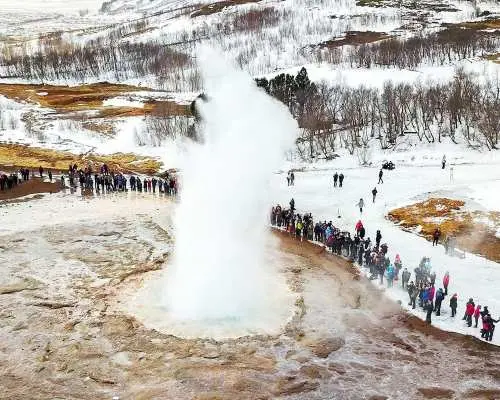
2. Enjoy the eruption of Strokkur geyser and experience the unique charm of the geothermal area.
3. Relax at the Blue Lagoon and enjoy the mineral-rich, milky-blue water to soothe your mind and body.
Product Info
Important Info
Reminders
A minimum of 5 traveler(s) are required for the tour to depart. If the number of participants does not reach the minimum requirement, the tour will be canceled. An email regarding tour cancellation will be sent 1 day(s) before the departure date
Travelers with the following conditions or other health issues that could be worsened by excessive stimulation should not participate in this activity: High blood pressure, Heart disease, Acrophobia, Asthma, Epilepsy, Pregnant women
Please arrive at the designated location 30 minute(s) before the scheduled departure time, as the tour will depart on time
Please bring a valid ID or passport for identity verification on the day of the event.
Please check your emails or social media such as WhatsApp and WeChat for confirmation messages from the operator.
Please arrive at the meeting point 30 minutes before the start of the activity. Late arrivals will be considered as automatic forfeiture and no refund will be given.
Due to weather or other unforeseen circumstances, the itinerary may be subject to temporary adjustments. Please pay close attention to notifications from your operator or updates on their official website.
The operator does not provide services such as luggage storage or stroller storage; please make your own arrangements accordingly.
Tourists who fail to arrive on time or voluntarily abandon their trip will not receive a refund.
FAQ
1. Are there any specific rules or restrictions for activities like swimming at Iceland's Crater Lake?
Visitors to Iceland's Crater Lake (Kerið) should be aware that swimming is generally not permitted. The area is preserved for its unique geological formations and natural beauty. Activities are typically restricted to observing the crater from designated walking paths, ensuring the protection of this natural wonder and the safety of visitors.
2. What are the key geographical features and general facts about the Crater Lake in Iceland?
Iceland's Crater Lake (Kerið) is a striking volcanic crater lake approximately 55 meters deep. Its most distinctive features are its vivid red volcanic rock slopes and the opaque, turquoise-green water. Unlike many other volcanic craters, it is believed to have formed from a magma chamber collapsing inwards rather than an explosive eruption.
3. What makes Iceland's Crater Lake a significant natural landmark for visitors?
Iceland's Crater Lake is significant due to its unique geological formation and vibrant visual appeal. The contrast between the intense reddish-brown volcanic rock, lush green moss, and the striking blue-green water creates a picturesque and memorable landscape. It offers a unique opportunity to witness the raw power of volcanic activity in a visually stunning setting.
4. Can visitors still see the 'Old Man of the Lake' phenomenon at Crater Lake in Iceland?
The 'Old Man of the Lake' is a specific, centuries-old tree stump that floats vertically in Crater Lake in Oregon, USA. This phenomenon is not observed at Iceland's Kerið Crater Lake. Visitors to Iceland's Crater Lake can instead appreciate its unique volcanic landscape and vibrant water colors.
5. Are there any known seasonal closures or accessibility changes for Iceland's Crater Lake?
Iceland's Crater Lake (Kerið) is typically open to visitors year-round. However, access might be temporarily affected by severe weather conditions, especially during winter with heavy snow or ice. It's always advisable to check local conditions before planning your visit to ensure paths are safe and accessible.
6. How was the Crater Lake formed, and what is its typical depth?
Iceland's Crater Lake, Kerið, was formed approximately 6,500 years ago. Instead of an explosive eruption, it is believed that a magma chamber beneath the ground emptied, causing the overlying cone to collapse into itself, forming the caldera. The lake inside the crater is typically around 7 to 14 meters deep, depending on groundwater levels.
7. What are the general characteristics of a geyser basin, and what can be observed at Iceland's Geysir geothermal area?
A geyser basin is a geothermal area characterized by hot springs, mud pots, fumaroles, and geysers—hot springs that periodically erupt with superheated water and steam. At Iceland's Geysir geothermal area, visitors can observe these features, most notably the active Strokkur geyser, as well as various bubbling pools and steam vents demonstrating Earth's powerful heat.
8. How frequently does the Strokkur geyser erupt at Iceland's Geysir Basin, and what can visitors expect?
The Strokkur geyser at Iceland's Geysir Basin is highly active, erupting approximately every 5 to 10 minutes. Visitors can expect to witness a spectacular column of hot water shooting up to heights of 15 to 20 meters, and sometimes even higher. There's a moment of anticipation as the water bubbles and recedes before its powerful burst.


