
Unduh aplikasi untuk mendapatkan diskon.
Konten produk ini sedang dalam proses optimalisasi, untuk sementara tidak dapat menampilkan bahasa yang Anda pilih secara lengkap.
Kode produk #285904


Pusat perbelanjaan
【By Osaka Castle】Learning Zen of Japanese Beauty Calligraphy in kimono
Pemesanan dikonfirmasi 1 hari setelah pemesanan
Durasi perjalanan:1 jam
Bahasa: Bahasa inggris / Jepang
1 hari yang lalu dapat dibatalkan gratis.
Harap tunjukkan e-voucher di lokasi
➤Hospitality and guidance from a master calligrapher for each student.
Even beginners can learn how to use the brush by practicing repeatedly. It is important to note, however, that it is important to understand the technique used, rather than just practicing in the dark. Practice will be more effective after you understand the technique.
➤Please observe and learn from the teacher's demonstration by example.
Calligraphy is a traditional Japanese culture that uses brush and ink to express characters artistically, and is appreciated for the neatness of the characters, the way the brush is carried, the shade of the ink, and the beauty of the overall arrangement.
➤Calligraphy is a traditional Japanese culture that uses brush and ink to ex
Your name is converted into Kanji characters and a calligraphy master writes a stroke on a wooden plaque. Each kanji character has its own meaning, so find out what the characters used in your name mean.
➤When writing, it is important to keep the mind quiet and focused.
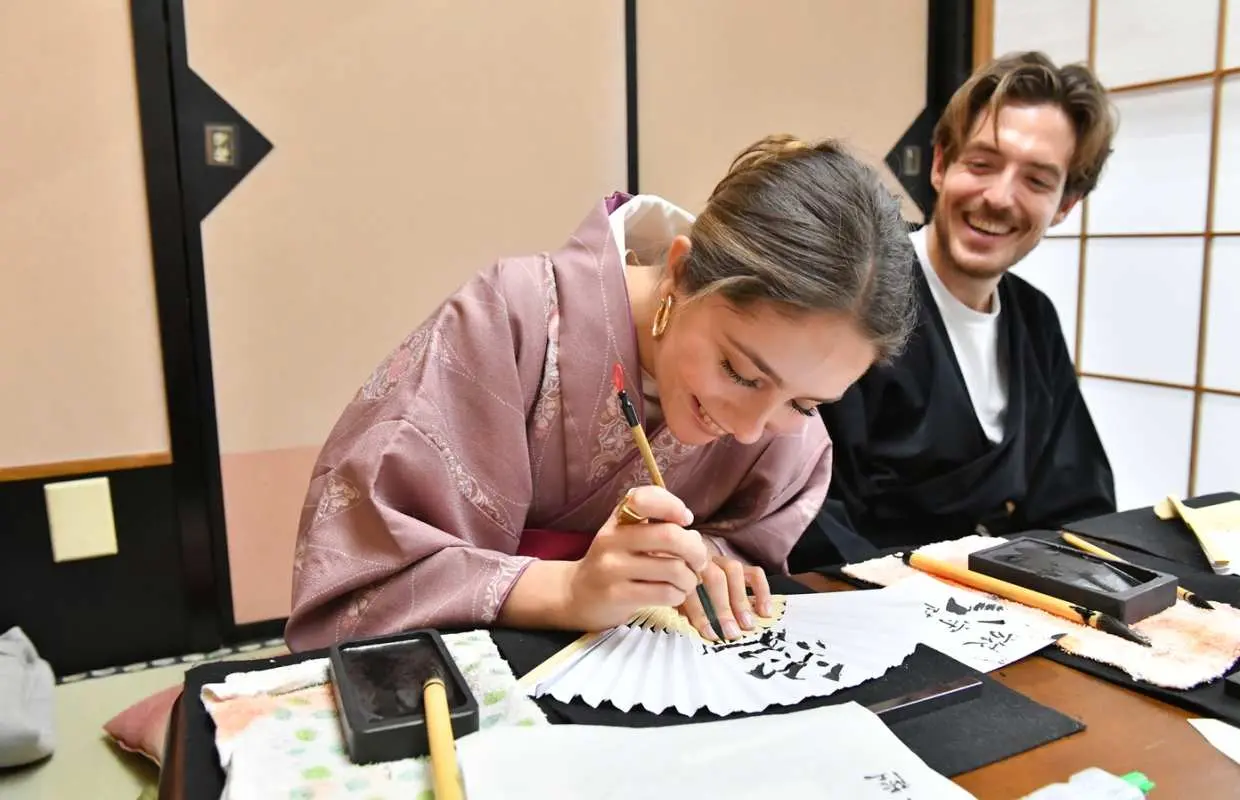
Seisho] Participants will be asked to write selected kanji characters on a fan or a piece of colored paper for calligraphy, keeping in mind what they have learned so far. The folding fan is a tool that is still very familiar to the Japanese people as it appears at milestones in their lives. You will also write on a fan, which was born in Japan.
➤ This experience plan is fun and challenging for children.
Children can also feel a sense of Japan by wearing kimonos, and the experience of calligraphy, a traditional Japanese culture, will bring children closer to the history of Japan.
➤ The whole family can enjoy it together.
For family travelers with children, experiencing traditional culture together as a family will become a precious family memory that will last for a long time to come.
Even beginners can learn how to use the brush by practicing repeatedly. It is important to note, however, that it is important to understand the technique used, rather than just practicing in the dark. Practice will be more effective after you understand the technique.
➤Please observe and learn from the teacher's demonstration by example.
Calligraphy is a traditional Japanese culture that uses brush and ink to express characters artistically, and is appreciated for the neatness of the characters, the way the brush is carried, the shade of the ink, and the beauty of the overall arrangement.
➤Calligraphy is a traditional Japanese culture that uses brush and ink to ex
Your name is converted into Kanji characters and a calligraphy master writes a stroke on a wooden plaque. Each kanji character has its own meaning, so find out what the characters used in your name mean.
➤When writing, it is important to keep the mind quiet and focused.
Seisho] Participants will be asked to write selected kanji characters on a fan or a piece of colored paper for calligraphy, keeping in mind what they have learned so far. The folding fan is a tool that is still very familiar to the Japanese people as it appears at milestones in their lives. You will also write on a fan, which was born in Japan.
➤ This experience plan is fun and challenging for children.
Children can also feel a sense of Japan by wearing kimonos, and the experience of calligraphy, a traditional Japanese culture, will bring children closer to the history of Japan.
➤ The whole family can enjoy it together.
For family travelers with children, experiencing traditional culture together as a family will become a precious family memory that will last for a long time to come.
Pilih paket
Pengalaman budaya
| Waktu aktivitas | Pagi, Siang, Malam |
| Metode transportasi | Datang sendiri ke lokasi |
| Lokasi | Dalam ruangan |
| Tingkat aktivitas | Pemula |
| Jenis pengalaman | Belajar bahasa, Sewa kostum, Seni |
| Durasi sewa | 2 jam |
| Jenis busana | Kimono |
| Layanan & fasilitas tambahan | Layanan fotografi |
| Syarat peserta minimum | 1 pelancong |
| Jenis pengalaman budaya | Pengalaman Ninja/Samurai, Kaligrafi, Pengalaman budaya tradisional |
Info produk
Yang dapat Anda harapkan
Durasi: 1 jam
Hari 1
- Preparation] ・The calligraphy contains the aesthetic sense of Japanese culture. Before experiencing calligraphy, you will be asked to change into traditional Japanese clothing. Men should wear Hakama and Dorogi and become a Samurai. Women should wear a kimono and become a Yamato Nadeshiko.
- ➤Last kanji character Reflecting on your life so far, choose one kanji character as your last word in this world. Each kanji character has its own meaning Kanji characters themselves are very popular among foreigners, as each character has its own meaning and the appearance of the calligraphic style is perceived as beautiful. Customers are asked to choose such Kanji characters.
- 【Description】 The students will gain a deeper understanding of the difference between calligraphy as a form of character decoration , which also exists overseas, and Japanese “shodo” Calligraphy is a traditional Japanese culture that uses brush and ink to express characters in an artistic way, and is appreciated for the neatness of the characters, the way the brush is carried, the shade of the ink, and the beauty of the overall arrangement.
- [Practice] Calligraphy has a delicate sense of beauty, and the subtle changes in fine lines, dots, and shading enhance its beauty. There is also an aesthetic sense of stillness, and it is important to keep one's mind quiet and focused when writing. In addition, it is important to have basic manners, such as sitting upright, keeping the back straight, and holding the brush in a straight line. ・Practice basic calligraphy techniques such as “tome,” “hane,” and "harai.
- Learn the stroke order of the chosen kanji. Please learn by observing the teacher's demonstration with a model. Japanese aesthetic sense includes “beauty of margins,” and it is believed that by being conscious of margins, not only letters but also spaces become more beautiful.
- [Basic Practice] There are basic calligraphy techniques such as “tome”, ‘hane’, and “harai” that you should practice. Each kanji character has its own meaning, so please be aware of what meaning the last character you chose has.
- Please observe and learn from the teacher's demonstration by example.
- [Seisho] With an awareness of what you have learned so far, you will write the kanji you have chosen on a half-sheet of paper for Seisho.
- The fan is still a familiar tool for Japanese people as it appears at every milestone in their lives. We will also write calligraphy on this fan, which was born in Japan.
- [Photography] ・Why don't you record your work and this experience in a space with a Japanese atmosphere and make it a memory?
- Your name is converted into Kanji characters and a calligraphy master writes a stroke on a wooden plaque. Each kanji character has its own meaning, so find out what the characters used in your name mean.
- Kakejiku/The Essence of Traditional JpnArt with 1300years of History Kakejiku in the tokonoma (alcove) can remind family members and visitors of the beauty and cultural value of the four seasons. Challenge yourself to write the kanji you have practiced on the hanging scroll or ask a master to write your mastery skills on it as a souvenir.
- This experience plan is fun and challenging for children. Children can also feel a sense of Japan by wearing kimonos, and the experience of calligraphy, a traditional Japanese culture, will bring children closer to the history of Japan.
- The whole family can enjoy it together. For family travelers with children, experiencing traditional culture together as a family will become a precious family memory that will last for a long time to come.
- The Japanese aesthetic sense includes the “beauty of margins,” and it is believed that by being conscious of margins, not only the text but also the space becomes more beautiful.
![Preparation]
・The calligraphy contains the aesthetic sense of Japanese culture. Before experiencing calligraphy, you will be asked to change into traditional Japanese clothing.
Men should wear Hakama and Dorogi and become a Samurai.
Women should wear a kimono and become a Yamato Nadeshiko.](https://image.kkday.com/v2/image/get/c_fit%2Cq_55%2Ct_webp%2Cw_960/s1.kkday.com/product_285904/20250519180202_Jzudy/jpg)


![[Practice]
Calligraphy has a delicate sense of beauty, and the subtle changes in fine lines, dots, and shading enhance its beauty.
There is also an aesthetic sense of stillness, and it is important to keep one's mind quiet and focused when writing. In addition, it is important to have basic manners, such as sitting upright, keeping the back straight, and holding the brush in a straight line. ・Practice basic calligraphy techniques such as “tome,” “hane,” and "harai.](https://image.kkday.com/v2/image/get/c_fit%2Cq_55%2Ct_webp%2Cw_960/s1.kkday.com/product_285904/20250519180147_iaWe8/jpg)

![[Basic Practice]
There are basic calligraphy techniques such as “tome”, ‘hane’, and “harai” that you should practice.
Each kanji character has its own meaning, so please be aware of what meaning the last character you chose has.](https://image.kkday.com/v2/image/get/c_fit%2Cq_55%2Ct_webp%2Cw_960/s1.kkday.com/product_285904/20250519180144_VBxgF/jpg)

![[Seisho]
With an awareness of what you have learned so far, you will write the kanji you have chosen on a half-sheet of paper for Seisho.](https://image.kkday.com/v2/image/get/c_fit%2Cq_55%2Ct_webp%2Cw_960/s1.kkday.com/product_285380/20250510230202_TiSKd/jpg)

![[Photography]
・Why don't you record your work and this experience in a space with a Japanese atmosphere and make it a memory?](https://image.kkday.com/v2/image/get/c_fit%2Cq_55%2Ct_webp%2Cw_960/s1.kkday.com/product_285904/20250519180150_Z0ZKs/jpg)


Pemberitahuan pembelian
Clothing and personal belongings
You will change from casual clothes to Iaidogi (Hakama), so you can wear whatever you want.
About Rental Items (FREE)
Dressing of guests when dressing
When you wear hakama for a sword fight, you will sweat and get sweaty easily, so please wear the following clothing.
① His upper body is a long-sleeved undershirt. I ask you to put on a samue.
② The lower part of the body is an easy to move samue.
③ We have tabi socks for your feet.
④ Swim caps are available for the head.
Assistant staff will do things like wearing hakama and armor. You can't wear it alone
Termasuk/Tidak termasuk
- Air kemasan botol
- Tip
- Pajak konsumsi
- Biaya layanan
- Tiket
- Photo Shooting - Send data to designated e-mail address
- Samurai Calligraphy Works
- English guide
- 10% Service charge
- Material fee
- Taxes
- Experience fees
- Professional coach
- Clean clothes
- Pengeluaran pribadi
- Akomodasi
- Biaya transportasi
- Asuransi
- Antar-jemput hotel
- Movie Shooting *Paid option
- Round-trip shuttle
Pengguna yang memenuhi syarat
Catatan
- Children (6 years and older) Adults (90 years and younger)
Pengingat
time one is supposed to meet
Please arrive 30 minutes before your appointment time to change into kimono and prepare for your appointment.
Cancellation
Cancellations and changes must be notified by e-mail at least 24 hours in advance.
Cara menggunakan
Cara menggunakan voucher Anda
- Harap tunjukkan e-voucher di lokasi
Lokasi pengalaman
Nama lokasi: SAMURAI HONOR
Alamat: 日本、〒536-0014 大阪府大阪市城東区鴫野西2丁目3−19 エクセレンス高山 1F
Cara menuju ke sana
By train
1.1-minute walk from Osaka Business Park Station (Exit 1) on the Osaka Municipal Subway
2.Approx. 2 minutes walk from "Osaka Castle Park" Station on JR Osaka Municipal Subway L
3. Approx. 10 minutes walk from West Exit of Kyobashi Station on JR
Jam operasional
Senin 10:00–21:00 (Waktu masuk terakhir: 20:00)
Selasa 10:00–21:00 (Waktu masuk terakhir: 20:00)
Rabu 10:00–21:00 (Waktu masuk terakhir: 20:00)
Kamis 10:00–21:00 (Waktu masuk terakhir: 20:00)
Jumat 10:00–21:00 (Waktu masuk terakhir: 20:00)
Sabtu 10:00–21:00 (Waktu masuk terakhir: 20:00)
Minggu 10:00–21:00 (Waktu masuk terakhir: 20:00)
Kebijakan pembatalan
- Pembatalan 1 hari (termasuk) sebelum tanggal yang dipilih diperbolehkan. Pesanan yang belum digunakan dapat dibatalkan gratis
- Pembatalan tidak diperbolehkan antara 0–0 hari dari tanggal yang dipilih. Pesanan tidak dapat dibatalkan atau diubah, dan tidak ada pengembalian dana.
CATATAN
- Karena perbedaan zona waktu, tanggal pembatalan yang dikonfirmasi didasarkan pada waktu setempat pemasok. Harap beri waktu 2–5 hari kerja untuk memproses permintaan pembatalan Anda, setelah itu biaya pembatalan akan dikenakan sesuai kebijakan pembatalan produk. Setelah pembatalan dikonfirmasi, Anda akan menerima pengembalian dana dalam 14 hari kerja.
Dapatkan bantuan

Chat Mal


