


Excursion d'une journée à Kamikochi (Japon) en autonomie | Départ aller-retour de Nagoya | Réservation possible pour 1 personne
- Kamikochi, un joyau caché des Alpes japonaises, est magnifique en toutes saisons, et particulièrement idéal pour échapper à la chaleur estivale et admirer les couleurs d'automne.
- Service de navette directe pour Nagoya, très pratique sans correspondance, idéal pour une excursion d'une journée.
- En traversant des sites populaires comme la rivière Azusa, le pont Kappa et l'étang Taisho, le paysage est si beau que vous n'aurez plus envie de partir.
- Le parc national géographique du Japon, un paradis pour les randonneurs, où les voitures privées sont interdites.
- Flânez dans Kamikochi, le pays des dieux au Japon, découvrez certains des panoramas montagneux les plus spectaculaires du pays, empruntez les ponts Kappa et Myojin et admirez la pureté des eaux cristallines du Japon.
- Kamikochi est un site rare au Japon et bénéficie de deux désignations : « Site d'une beauté pittoresque exceptionnelle » et « Monument naturel exceptionnel ».
Choisir le plan


Circuits touristiques
| Type de circuit | Visite en groupe partagé |
| Mode de transport | Transfert depuis le point de rendez-vous |
| Heure de départ | Départ standard (8h-9h) |
| Limite de bagages | 1 pièce |
| Nombre minimum de participants | 1 voyageur |
| Types de circuits | Aucun |
| Organisation des repas | À organiser soi-même |
| Service et équipement supplémentaires | Transfert inclus |
| Adapté aux familles | Gratuit pour les enfants de moins de 2 ans (sans siège) |
| Saisonnier | Érables d'automne |
| Type de visite | Sites naturels, Randonnée |
| Transport | Voiture avec chauffeur, Circuit en bus |
Informations sur le produit
Le contenu de ce produit est fourni par traduction automatique et peut ne pas refléter les informations réelles. Veuillez en tenir compte avant de réserver.
Itinéraires de randonnée classiques recommandés dans la région du Haut-Kochi
Découvrez Kamikochi, surnommée le « joyau caché des Alpes japonaises », et partez pour une randonnée facile le long de la limpide rivière Azusa et de la majestueuse chaîne de montagnes Hotaka. Les sentiers plats et faciles sont parfaits pour les débutants et les familles.
Itinéraire suggéré 1 : Gare routière de Kamikochi → Étang Taisho - Étang Tashiro → Pont Kappa → Gare routière de Kamikochi
Étang Taisho → Rive gauche de la rivière Azusa / Environ 25 minutes (environ 1,2 km) à pied → Étang Tashiro et marais de Tashiro → Environ 20 minutes (environ 1 km) à pied → Pont Tashiro et pont Hodaka → Rive droite de la rivière Azusa / Environ 10 minutes (environ 0,5 km) à pied → Monument Weston → Environ 20 minutes (environ 1,1 km) à pied → Pont Kappa → Environ 6 minutes (environ 0,3 km) à pied → Arrêt de bus
Itinéraire suggéré 2 : Gare routière de Kamikochi > Pont Kappa > Marais de Takezawa > Pont Myojin > Sanctuaire Hotaka Okumiya et étang Myojin > Gare routière de Kamikochi
Arrêt de bus Kamikochi ⇄ 5 min (env. 0,4 km) Pont Kappa ⇄ Route de la rive droite de la rivière Azusa / Env. 10 min (env. 0,5 km) ⇄ Marais de Takezawa / Env. 40 min (env. 2,0 km) ⇄ Pont Myojin ⇄ Sanctuaire Hotaka Okumiya et étang Myojin

Le lac Taishō, situé à Kamikōchi, préfecture de Nagano, s'est formé naturellement en 1915 après l'éruption du volcan actif Yake‑dake, dont les coulées de boue ont bloqué la rivière Azusa. La surface du lac est aussi calme qu'un miroir, reflétant les pics de Ho‑taka et le ciel azur, offrant un décor à la fois serein et grandiose. Le « arbuste mort » au centre du lac est le panorama le plus emblématique du lac Taishō ; il se transforme avec la brume matinale, la lumière du soleil et les saisons, créant une atmosphère onirique et mystérieuse. La brume légère du matin rend ce lieu encore plus enchanteur, faisant du lac Taishō un site photographique très prisé à Kamikōchi.

Tashiro-ike, situé à Kamikōchi, préfecture de Nagano, entre le lac Taishō et le pont Kappa, est un étang de type marécageux formé par des sources souterraines. L'eau est claire et transparente, la surface de l'étang est calme, reflétant les sommets de la chaîne de Hotaka et le ciel bleu. Comparé au lac Taishō, Tashiro-ike a une eau moins profonde, entourée de plantes humides et de prairies, verdoyantes au printemps et en été, dorées en automne, chacune avec son charme. Le matin, une fine brume l'enveloppe souvent, créant une atmosphère paisible et douce, c'est l'un des sites naturels incontournables sur le parcours de promenade de Kamikōchi.

Le pont Kappa, situé à Kamikōchi, préfecture de Nagano, est un pont suspendu en bois traversant la rivière Azusa, emblème de Kamikōchi. Depuis le pont, on peut admirer les sommets de Ho‑taka et le volcan Yake‑dake, l'eau claire révélant le fond, offrant un panorama spectaculaire. Les quatre saisons y sont distinctes : printemps‑été verdoyants, automne aux feuillages flamboyants, hiver d'une blancheur silencieuse. Le site dispose de restaurants, cafés et boutiques de souvenirs, très fréquenté par les visiteurs pour se reposer, prendre des photos et comme nœud central des sentiers de randonnée de Kamikōchi.

Sur le chemin menant au pont Kappa, il est possible d'apercevoir occasionnellement des familles de macaques japonais sauvages se déplaçant dans la forêt. Ils apparaissent souvent en groupe, les adultes montant la garde et les petits jouant, se blottissant les uns contre les autres pour se toiletter, une scène chaleureuse et adorable. Ces singes appartiennent à l'espèce Macaca fuscata, endémique du Japon, et habitent généralement les zones montagneuses et les vallées fluviales. ※ Petit rappel : Veuillez garder une distance appropriée, ne les nourrissez pas et ne les dérangez pas, afin d'assurer votre sécurité et celle des animaux.
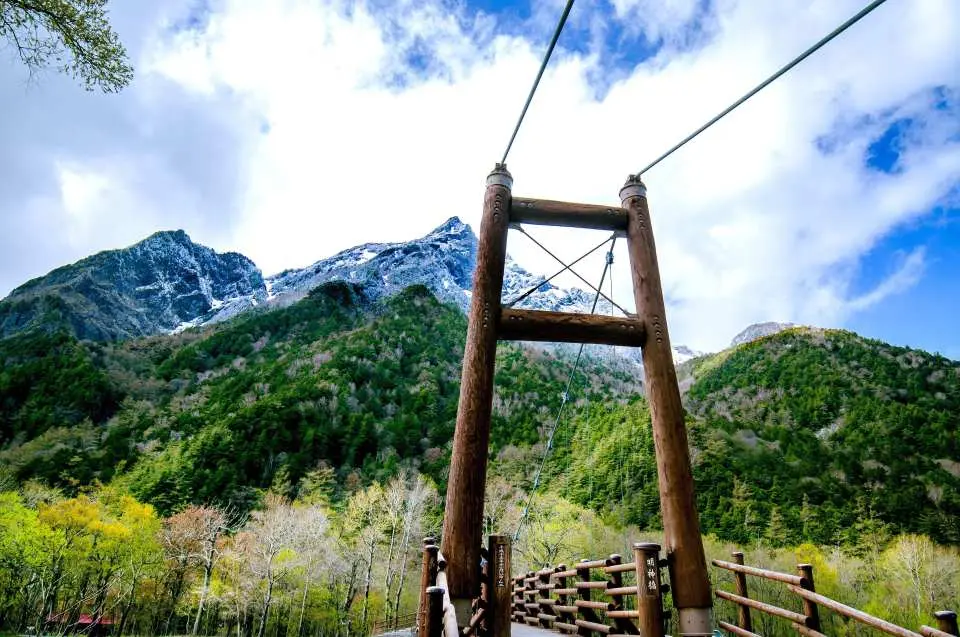
Le pont Myōjin, situé en amont de la rivière Azusa à Kamikōchi, près du Sanctuaire Ho‑taka Okumiya, est un pont en bois aux garde‑fous rouges, offrant une atmosphère encore plus calme et idyllique que le pont Kappa. L'eau qui s'écoule sous le pont est d'un vert éclatant, entourée d'une forêt vierge, empreinte d'une forte présence naturelle. En automne, les érables teintent le pont rouge d'une beauté particulière, la brume matinale ajoutant encore plus de mystère. Accessible à pied depuis le pont Kappa en environ une heure, c'est un site recommandé aux randonneurs passionnés et aux amateurs de paysages montagneux.

Le premier étang de l'étang Myojin est situé dans l'enceinte du sanctuaire Hotaka Okumiya. C'est la partie la plus ouverte de l'étang Myojin et le paysage le plus représentatif. L'eau du lac est claire comme un miroir, reflétant souvent les montagnes et les forêts, créant une atmosphère solennelle et paisible. Les petites îles dans le lac et les arbres anciens se complètent, ajoutant une touche de mystère lorsqu'une légère brume flotte le matin. En tant que domaine sacré du sanctuaire, une offrande est requise pour y entrer. C'est un endroit idéal pour ralentir et ressentir la beauté de la nature et de la foi entrelacées.

Le double lac Myōjin, situé au cœur de Kamikōchi, fait partie du domaine sacré du Sanctuaire Ho‑taka Okumiya, offrant un cadre paisible et solennel. L'eau provient de sources souterraines, limpide et transparente, entourée d'une forêt primitive, créant une ambiance sacrée et sereine. Des sentiers de visite et un petit quai bordent le lac ; à l'automne, le feuillage rouge reflété dans l'eau crée une scène émouvante. Comparé à l'animation du pont Kappa, le lac Myōjin convient mieux à une promenade lente, permettant de ressentir la quiétude de la nature et de l'âme.

Sainte‐maison Ho‑taka : le Sanctuaire Ho‑taka Okumiya se situe dans la région de Myōjin à Kamikōchi, entouré de montagnes, d'eau et de forêts, offrant une atmosphère solennelle et paisible. Le dieu principal est Ho‑taka‑mi‑no‑mikoto, protecteur de la mer et de la sécurité du trafic, également considéré comme le gardien des Alpes du Nord. Le rituel de visite est simple : 1️⃣ se purifier les mains et la bouche au chozu‑ya 2️⃣ déposer une offrande dans la boîte à dons 3️⃣ s'incliner deux fois, taper des mains deux fois, puis s'incliner une fois (deux inclinaisons, deux claquements de mains, une inclinaison). Le lac Myōjin se trouve à côté du sanctuaire ; après la visite, vous pouvez vous promener autour du lac, ressentant la quiétude où la nature et le divin se mêlent. Le printemps et l'été offrent une verdure fraîche, l'automne des feuillages colorés, chaque saison étant idéale pour prier et se ressourcer.
Informations d'achat
[Conditions touristiques]
Point de départ et destination du voyage : Aichi et Nagano
Durée de l'excursion : Excursion d'une journée
Transport : Autocar nolisé
Nom de la compagnie de bus : AMA Transportation, etc.
Repas : Petit-déjeuner 0 fois, Déjeuner 0 fois, Dîner 0 fois
Hébergement : Aucun
Taille minimale du groupe : 1
Chauffeur/Guide touristique : 1
Guide touristique : 0
【Planification/Mise en œuvre du voyage】
Nom de la société exploitante : KKT Corporation
Adresse : n° 1770-23, Kashiwai-cho 1-chome, ville de Kawa, préfecture de Chiba
Numéro de licence : Agence de voyages enregistrée auprès du gouverneur de la préfecture de Chiba n° 2-1131
Rappels
En cas d'intempéries telles que des typhons ou des tempêtes de neige, la décision d'annuler le circuit sera prise 1 jour(s) avant le départ (heure locale 18:00). Les notifications seront ensuite envoyées par e-mail
Les voyageurs présentant les conditions suivantes ou d'autres problèmes de santé pouvant être aggravés par une stimulation excessive ne doivent pas participer à cette activité: Hypertension, Maladie cardiaque, Acrophobie, Asthme, Épilepsie, Femmes enceintes
Veuillez arriver au lieu désigné 15 minute(s) avant l'heure de départ prévue, car le circuit partira à l'heure
Ce produit est un « service de navette pure ». Il n'y a pas d'accompagnateur pendant tout le trajet. Seuls des services linguistiques tels que le lieu et l'heure de rassemblement dans les sites touristiques sont fournis.
En fonction des conditions de circulation, de la météo, des festivals et de l'affluence du jour, les horaires d'arrivée de chaque étape peuvent varier. En cas de retard ou d'annulation dû à ces facteurs ou à d'autres causes de force majeure, veuillez nous en excuser et ne pas exiger de remboursement pour cette raison.
0‑2 ans les enfants n'occupent pas de place et peuvent voyager gratuitement, les 3 ans et plus payent le même tarif que les adultes.
Chaque passager peut emporter un petit sac à main. Si vous souhaitez emporter une valise ou des bagages volumineux, vous devrez acheter un forfait bagages au prix de 2000 JPY par pièce. Veuillez contacter le service client à l'avance pour confirmation ou laisser une note dans votre commande.
Une fois la commande confirmée, la date ne peut être modifiée sans préavis. Tout préjudice subi sera à la charge du client. Veuillez contacter le service client pour toute assistance en cas de problème.
Aucun remboursement ne sera effectué pour les participants absents ou en retard pour des raisons personnelles. Veuillez en être conscient.
Si vous quittez le groupe en cours de route, la transaction sera considérée comme nulle et aucun remboursement ne sera effectué. De plus, toute conséquence sur votre sécurité personnelle ou vos biens sera à votre charge.
Située en haute altitude (environ 1 500 mètres), Kamikochi bénéficie d'une région montagneuse où les températures sont relativement instables et la météo imprévisible. Il est donc conseillé d'emporter des chaussures de sport confortables et légères, un imperméable, un parapluie, un chapeau, des lunettes de soleil et une veste légère à adapter aux variations de température.
Types de véhicules de référence : 1 à 6 places : Toyota Alphard ou équivalent ; 9 à 13 places : Toyota Hice ou équivalent ; 14 à 22 places : minibus ; 22 places et plus : autocar. Ces véhicules sont donnés à titre indicatif et seront adaptés en fonction du nombre de participants le jour de l’excursion.


