
![[Grand Sumo Wrestling Viewing Tour] Includes sumo wrestling viewing at Ryogoku Kokugikan in Tokyo and lunch at "Sky Restaurant 634" at Tokyo Skytree.](https://image.kkday.com/v2/image/get/c_fill%2Ch_800%2Cq_55%2Ct_webp%2Cw_1240/s1.kkday.com/product_263324/20250313001119_5NyMM/png)
![[Grand Sumo Wrestling Viewing Tour] Includes sumo wrestling viewing at Ryogoku Kokugikan in Tokyo and lunch at "Sky Restaurant 634" at Tokyo Skytree.](https://image.kkday.com/v2/image/get/c_fill%2Ch_400%2Cq_55%2Ct_webp%2Cw_500/s1.kkday.com/product_scm_8800/20251218025355_3029g/jpg)
![[Grand Sumo Wrestling Viewing Tour] Includes sumo wrestling viewing at Ryogoku Kokugikan in Tokyo and lunch at "Sky Restaurant 634" at Tokyo Skytree.](https://image.kkday.com/v2/image/get/c_fill%2Ch_400%2Cq_55%2Ct_webp%2Cw_500/s1.kkday.com/product_scm_8800/20260324065052_7UXDX/jpg)
![[Grand Sumo Wrestling Viewing Tour] Includes sumo wrestling viewing at Ryogoku Kokugikan in Tokyo and lunch at "Sky Restaurant 634" at Tokyo Skytree.](https://image.kkday.com/v2/image/get/c_fill%2Ch_400%2Cq_55%2Ct_webp%2Cw_500/s1.kkday.com/product_scm_8800/20260324055623_ChaYy/jpg)
![[Grand Sumo Wrestling Viewing Tour] Includes sumo wrestling viewing at Ryogoku Kokugikan in Tokyo and lunch at "Sky Restaurant 634" at Tokyo Skytree.](https://image.kkday.com/v2/image/get/c_fill%2Ch_400%2Cq_55%2Ct_webp%2Cw_500/s1.kkday.com/product_scm_870/20251118065233_pcoNg/jpg)
[Grand Sumo Wrestling Viewing Tour] Includes sumo wrestling viewing at Ryogoku Kokugikan in Tokyo and lunch at "Sky Restaurant 634" at Tokyo Skytree.
- We have secured hard-to-get tickets for the Grand Sumo Tournament in Tokyo (Ryogoku Kokugikan)!
- This is a great value plan that includes watching sumo wrestling and a lunch course at "Sky Restaurant 634 (musashi)".
- Enjoy French cuisine fused with Japanese flavors at our special restaurant located 345 meters above ground level inside Tokyo Skytree.
- After your meal, please make your own way to Ryogoku Kokugikan. Your tickets will be given to you in front of Ryogoku Kokugikan.
- Re-entry is permitted after admission. You can also go out for a meal or shopping during your visit.
- If you wish to re-enter, please return by 5 PM.
Package Options


Product Info
The content of this product is provided by machine translation and may not reflect the actual information, please take this into consideration before booking.
- Sky Restaurant 634
This restaurant is located 345 meters above ground on the Tokyo Skytree® Observation Deck. At lunchtime, you can enjoy a French-based cuisine fused with Japanese elements while taking in the panoramic view of Tokyo's cityscape from the large windows. Using carefully selected ingredients from all over Japan, you can enjoy a special moment in the spacious, open space that is unique to daytime dining. Enjoy a high-quality lunch as the highlight of your Tokyo sightseeing.
- Tour to see the great national sport of sumo wrestling
Sumo is Japan's national sport, and its competitors are not just fat people. Beneath the fat lie superbly trained muscles. And despite their large physiques, they have incredible flexibility, with legs as strong as tree trunks. Their physical abilities are truly acrobatic, and sumo wrestlers are the ultimate athletes, built for fighting. At the moment of a serious match, the sound of the wrestlers colliding with each other resonates throughout the arena. Be sure to see the clash with your own eyes!
- Viewing points
Sumo's history stretches back over 1,500 years
Sumo, Japan's national sport, has origins dating back to the age of mythology, and is said to have begun as a contest of strength. It continued as an imperial court event for around 300 years, held annually as a festival ritual to predict the year's harvest, and then during the Sengoku period, sumo became a form of training for samurai. Later, in the Edo period, sumo became more commercialized, with the introduction of kanjin sumo, and the foundations of modern-day professional sumo were laid. Today, sumo has taken on a formal form as a sport, beloved by many. At the venue, you can experience sumo's long history and one aspect of traditional culture up close.
- Ring-entering
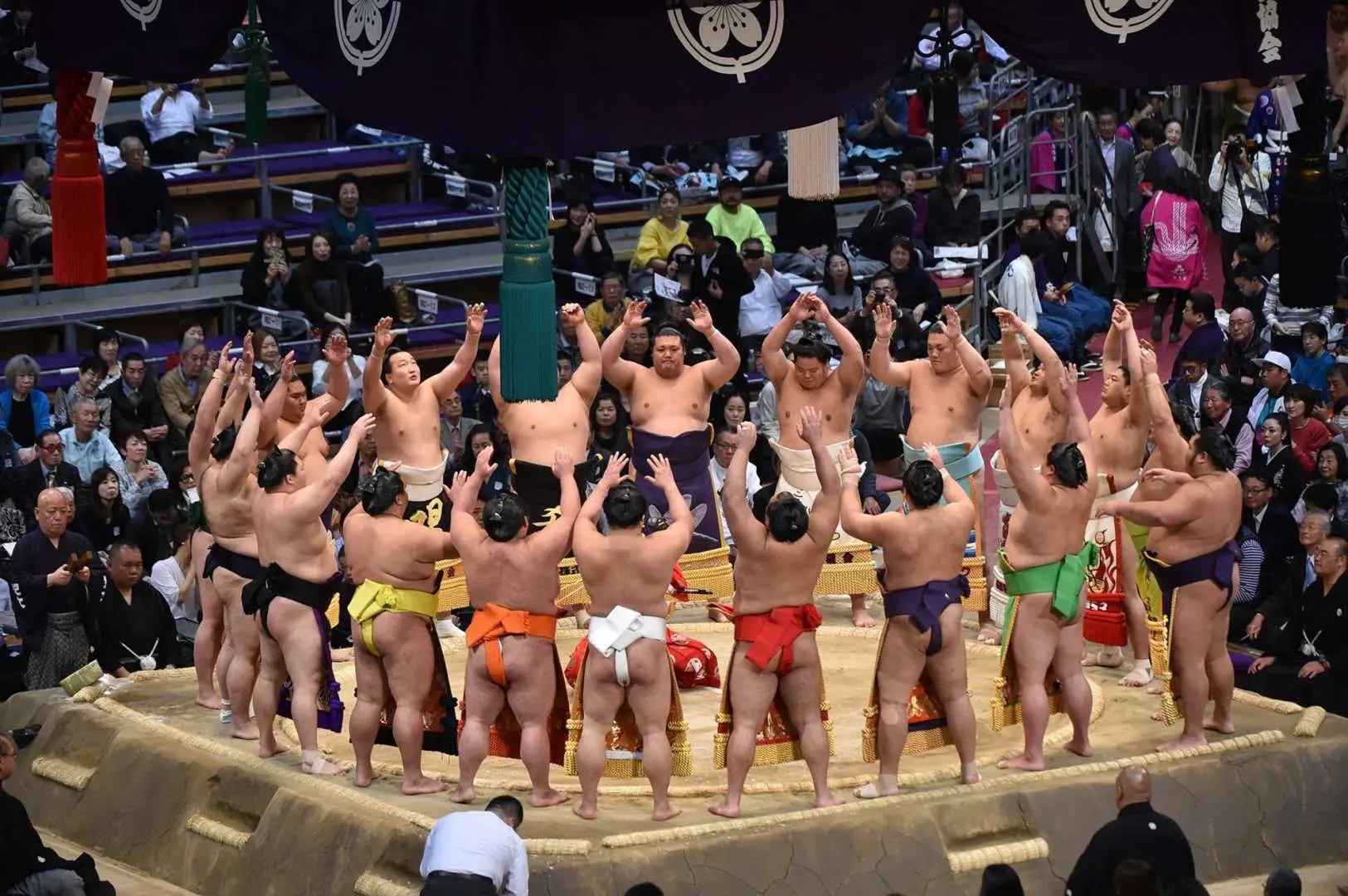
This is a ceremony that takes place before a sumo match, in which the juryo and makuuchi wrestlers enter the ring wearing colorful mawashi. It is an introduction to the audience, and also serves as a religious ritual to ward off evil spirits from the arena. The wrestlers enter the ring in east and west groups, and in order of lowest rank, they line up in a circle and perform certain movements, such as lifting up the edge of their mawashi and lightly clasping their hands together.
- Yokozuna ring-enter
The sumo wrestlers enter the ring and make their appearance in the dohyo-iri ceremony. The "yokozuna dohyo-iri" is held separately from the juryo and makuuchi dohyo-iri, and offers a slightly different, sacred ritual. Accompanied by two wrestlers, the "tsuyuharai" (decoy barai) and the "tachimochi" (sword bearer), the yokozuna enters the ring through the runway, claps his hands, and then raises his leg high and performs a stomp. As he performs this stomp, shouts of "Yoisho!" from the audience reverberate throughout the venue. The yokozuna's kesho mawashi (mawashi) and white rope are also highlights.
- FAQ:
Q&A
Q: Can I eat or drink while watching sumo?
A: You can eat and drink at your seat. You cannot bring in bottles, cans, or food from outside, but soft drinks such as tea and juice, as well as alcoholic beverages such as beer and chuhai will be sold at the venue's convenience stores.
Q: What souvenirs or foods should I buy when I go to watch sumo wrestling?
A: The popular items are the cheering towels with the wrestlers' names printed on them and the cute wrestler cookies.
Q: What is the etiquette when watching sumo wrestling?
A: Sumo matches often end in just a few seconds, so please try not to move seats during the match. People behind you may miss the moment of victory or defeat. You can take photos in the chair seats, but please do not use a strong flash.
Q: Are there any dress codes when watching sumo wrestling?
A: There are no specific dress codes, but please avoid wearing large hats that may block the view of other spectators.
Sky Restaurant 634 (Musashi) is located on the 345th floor of the Tokyo Skytree® Observation Deck. *Image of the restaurant interior


At lunchtime, you can enjoy French cuisine fused with Japanese elements while overlooking the Tokyo cityscape through the large windows. *Example of restaurant dishes*


"Dohyo-iri" (The Juryo-Dohyo-iri takes place around 14:15 and the Makuuchi-Dohyo-iri takes place around 15:40, except on the final day) This is a ceremony held before the sumo matches in which the Juryo and Makuuchi-ranked sumo wrestlers enter the ring wearing colorful ceremonial aprons. It serves as an introduction to the audience and also has the meaning of warding off evil spirits from the arena as a Shinto ritual. The wrestlers appear divided into east and west sides, and enter the ring in order of their rank, lining up in a circle and performing prescribed actions such as pinching and lifting the ends of their ceremonial aprons and lightly putting their hands together.

"Nobori Flags" Nobori are brightly colored flags bearing the names of sumo wrestlers, their stables, sponsors, and so on. They are lined up outside the venue, adding to the festive atmosphere and serving as auspicious symbols to pray for the wrestlers' success.


Yokozuna Toyoshoryu hails from Ulaanbaatar, Mongolia. He won his second championship at the January 2025 Grand Sumo Tournament and was promoted to the 74th Yokozuna. He is a Mongolian sumo wrestler whose uncle was former Yokozuna Asashoryu. He had to withdraw from the March 2025 tournament, the tournament in which he was promoted, due to injury, and also withdrew from the July tournament midway through. It has been a tough start as a Yokozuna, but expectations are high that he will lead the sumo world as the East and West Yokozuna together with Oonosato.


Yokozuna "Ōnosato" hails from Ishikawa Prefecture. He continues to inspire many people affected by the earthquake and is currently the most powerful sumo wrestler, having set numerous speed records. With his hair styled in a messy, unstyled manner, he has climbed the ranks, and in the May 2024 tournament, he achieved a new record by winning the top division championship in just seven tournaments since his debut. Subsequently, in the May 2025 tournament, he achieved his fourth championship, becoming the fastest Japanese-born sumo wrestler to be promoted to Yokozuna since his stablemaster, Nishonoseki Oyakata (former Yokozuna Kisenosato), making him a truly unique wrestler.


Ozeki Kotozakura hails from Matsudo City, Chiba Prefecture. He is a sumo thoroughbred, having grown up in a sumo family; his grandfather was former Yokozuna Kotozakura, nicknamed "The Fierce Bull," and his father was the first Kotonowaka, a former Sekiwake and his current stablemaster. He steadily climbed the ranks from the time he joined sumo, and was promoted to Ozeki after the January 2024 tournament. In the May tournament of the same year, he inherited his grandfather's ring name, Kotozakura, and achieved his long-awaited first championship in the November tournament of the same year. Unfortunately, his challenge for the Yokozuna title in the January 2025 tournament did not come to fruition, but he is a popular sumo wrestler who will continue to aim for the same highest rank as his grandfather, Yokozuna.


Ryogoku Kokugikan Seating Chart


Purchase Notice
- This tour does not include staff accompaniment.
- For our "Iki" lunch course, you can choose either a fish or meat dish as your main course on the day of your visit.
- After your meal, please come to the front of Ryogoku Kokugikan between 1:00 PM and 3:00 PM. A staff member will give you your ticket.
- Seats for sumo matches cannot be reserved. You will be assigned seats on the day of the event.
- If you would like adjacent seats within your group, please make your reservation using the same booking record. We will do our best to arrange seats as close together as possible, but we cannot guarantee that we will be able to accommodate your request.
- Children aged 3 and under are welcome to enter, but they must sit on their parent's lap. If a separate seat is required, please purchase a child's ticket.
- "Information about Sky Restaurant 634 (Musashi)"
<How to visit our store>
On the day of your reservation, please arrive at the Sky Restaurant 634 dedicated reception counter at the West Entrance on the 4th floor of Tokyo Solamachi® Tower Yard by 11:30 AM and state your name. You will receive your admission ticket and then proceed to the observation deck by elevator.
Upon arrival, please proceed to Sky Restaurant 634 on floor 345 by 12:00 PM.
Please refer to this page for access information.
<Regarding the dress code>
Sky Restaurant 634 has a "smart casual" dress code.
Please check here for details.
The following clothing items are not permitted.
We apologize for any inconvenience, and we appreciate your understanding and cooperation.
T-shirt
・Jeans (clothing made of denim fabric)
・Shorts
Cargo pants
• Hats (caps, knit hats)
• Sportswear (tracksuits, tank tops, sweatshirts, hoodies)
Sandals, Crocs
*The dress code applies to children aged 6 and older.
<For customers with allergies or dietary restrictions>
We kindly request that customers concerned inform us of this when booking their tour.
We will not be able to accommodate requests made on-site on the day of the event.
Also, vegetarians, vegans, and those with dietary restrictions for religious reasons,
We regret to inform you that we cannot accommodate requests from individuals who cannot consume either dairy products or eggs, or those with severe allergies that make cross-contamination unacceptable.
Reminders
A minimum of 2 traveler(s) are required for the tour to depart. If the number of participants does not reach the minimum requirement, the tour will be canceled. An email regarding tour cancellation will be sent 10 day(s) before the departure date
Please arrive at the designated location 5 minute(s) before the scheduled departure time, as the tour will depart on time
If you arrive at Ryogoku Kokugikan after 3 PM, we will not be able to hand over your tickets. Please be mindful of the travel time from the restaurant.
During sumo matches, large luggage such as suitcases cannot be placed on the seats. Please make arrangements to leave your luggage elsewhere beforehand.
Bringing food, drinks, and alcohol into Ryogoku Kokugikan is prohibited. Please use the shops inside the venue.
Please refrain from moving around during matches, the sumo wrestlers' ring-entering ceremonies, and the Yokozuna's ring-entering ceremonies.
Get Help


