


Attraction Tickets
| Ticket type | Fast track ticket |
| Attraction type | History & culture, Traditional house experience |
| Tour types | Guided tour, Audio guide |
| Additional service & facility | Fast Track |
Product Info
Important Info
Reminders
Please refer to your voucher for final information regarding meeting points, pick-up locations, and pick-up time
Meeting point description: Vişnezade, Meclis-i Mebusan Cd. 38 A, 34357 Beşiktaş/İstanbul, Turkey
Know in advance:You'll receive your ticket with QR code directly from the local operator via email or WhatsApp after 6 pm the day before your visit. Same-day bookings are processed immediately
The free audio guide is available in English, French, German, Italian, Polish, Russian, Spanish, Turkish, Arabic and Chinese
Remember to bring:You will need to present a valid ID or passport to the palace officials to receive the audio guide. Your ID or passport will be returned to you at the exit
How to Redeem Your Voucher
How to Use Your Voucher
- Please present the e-voucher on-site
Validity Period
- The voucher must be used on the selected date and within operating hours; Invalid after expiration
FAQ
Dolmabahce Palace offers a breathtaking glimpse into the lavish lifestyle of the Ottoman Empire's later period. Its opulent Baroque and Rococo architecture, combined with stunning Bosphorus views, provides a unique and memorable experience. Visitors can explore grand ceremonial halls, imperial apartments, and the magnificent Crystal Staircase, making it highly recommended for those interested in history, art, and exquisite design during their first trip to Istanbul.
Dolmabahce Palace represents the Ottoman Empire's shift towards Western architectural styles, featuring grand European Baroque and Rococo designs with immense luxury. Topkapi Palace, in contrast, showcases classical Ottoman architecture, reflecting centuries of imperial life and a more traditional design. Dolmabahce offers a more modern, opulent aesthetic with richly decorated interiors, while Topkapi provides a historical journey through distinct courtyards, pavilions, and treasuries.
Dolmabahce Palace served as the main administrative center of the Ottoman Empire from 1856 to 1922, replacing Topkapi Palace. It symbolizes the Empire's attempt to modernize and Westernize, reflecting a period of significant political and cultural transformation. It's also historically significant as the place where Mustafa Kemal Atatürk, the founder of the Republic of Turkey, lived his final years and passed away, making it a pivotal site in Turkish history.
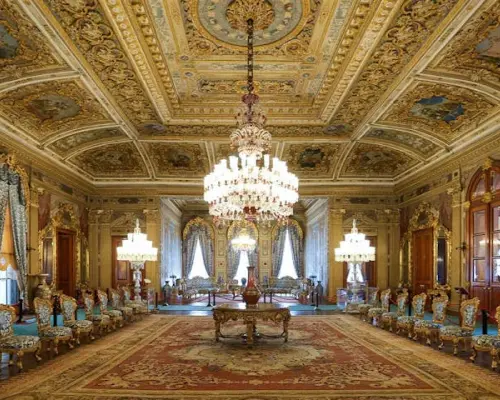
Dolmabahce Palace boasts a spectacular fusion of Baroque, Rococo, and Neoclassical styles. Key highlights include the grand Ceremonial Hall with its 4.5-ton Bohemian crystal chandelier, the magnificent Crystal Staircase, and the lavish state rooms adorned with gold and precious materials. The palace also features extensive use of Baccarat crystal, intricate parquetry, and an impressive collection of European artwork, all set against the beautiful Bosphorus waterfront.
To thoroughly explore Dolmabahce Palace, including both the Selamlık (State Apartments) and the Harem sections, it is generally recommended to allocate approximately 2.5 to 3 hours. This allows sufficient time to appreciate the detailed architecture, opulent interiors, and the stories presented by the audio guide. Additional time might be desired for the gardens and the clock tower section.
While there is no strict dress code for Dolmabahce Palace, it is advisable to dress respectfully, as it is a historical and culturally significant site. Comfortable walking shoes are recommended due to the extensive walking involved. Photography is generally permitted in the gardens and exterior areas, but usually restricted inside the palace rooms to preserve the artifacts and maintain the visitor experience.
Visitors can secure skip-the-line tickets for Dolmabahce Palace, which often include access to the Harem and an audio guide, through reputable online travel platforms. Booking via KKday offers convenience, allowing you to pre-purchase your tickets and avoid long queues, thus saving valuable time and ensuring a smoother entry experience to explore the palace's magnificent interiors and historical significance.
The Harem section of Dolmabahce Palace provides insight into the private lives of the Sultan, his family, and concubines. Visiting this area typically includes access to numerous rooms and chambers, such as the Sultan's apartments, the Valide Sultan's (Queen Mother's) residence, and rooms for other royal family members. It offers a fascinating contrast to the public ceremonial halls, showcasing more intimate and functional, yet still lavish, living spaces.
Get Help


