



Gyeongju UNESCO World Heritage + Night View Tour: Bulguksa Temple, Yangdong Village, Hanok Village, Daereungwon and Cheonma Tomb, Cheomseongdae Observatory, Woljeonggyo Donggung Palace and Wolji Pond| Departing from Busan
- Visit Gyeongju, home to a thousand-year-old historical site, and explore UNESCO World Heritage sites, historical sites, and national treasures!
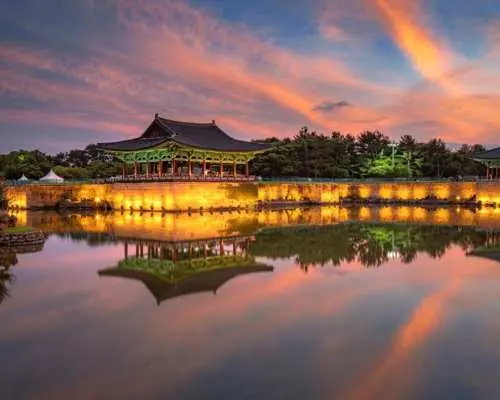
- The palace is even more magnificent at night! Don't miss the amazing night view of the palace~
- The quaint Hanok Village and the beautiful scenery of nature - there are royal cherry blossoms in spring and maple leaves in autumn~
---------------------------------------------
<<More recommended Korean attractions>>
Must-visit suburban attractions>Winter Sonata Nami Island🚤
Family fun>Asia's largest Legoland🎡
Suitable for flower viewing in all seasons> Hetan Forest🌺🌳
Every summer I go to the beach > Donghae Gangneung, Sokcho trip & Incheon feeding seagulls 🌊
Visit Korea's ancient capital and experience its history and culture> Hanbok experience at Jeonju Hanok Village
Package Options


Product Info
-Itinerary Introduction-
Bulguksa Temple
Bulguksa Temple and Seokguram Grotto, located on the hillside of Tohamsan Mountain (745m), which is known as the "cloud-swallowing mountain", are the core of the brilliant Buddhist culture of Silla Buddhism and were built to seek peace and prosperity for the country and the people. After the Imjin War, important cultural relics including buildings were almost all burned or looted. Before 1920, only some buildings and dilapidated towers remained, and it is only through continuous restoration work and the collection of seven national treasures that the temple has its current majestic appearance. Bulguksa Temple was officially registered as a UNESCO World Heritage Site on December 6, 1995, and has gained international fame.
Yangdong Hanok Village
Yangdong Village is the largest collective surname village in South Korea that has completely preserved the traditional culture and natural environment of the Joseon Dynasty. It is composed of the Wolseong Sun clan and the Yeogang Yi clan. The village houses many national treasures, treasures, folk materials and other cultural assets, and the entire village has been designated as a national folk cultural asset. Judging from the size and state of preservation of the village, the number and tradition of the cultural heritage it retains, and its beautiful natural environment and local characteristics, Yangdong Village is extremely valuable and well worth a visit. In 1993, Prince Charlie, then a British prince, visited this place. In addition, the living conditions of the glorious ancestors of the noble families 200 years ago are still preserved today, and about 54 old houses are preserved, and you can see the traditional structures of various Korean houses in the mid-Joseon period at a glance.
Daereungwon
Daereungwon, one of Gyeongju's representative historical sites, is a historical park that houses 23 ancient tombs of various sizes. The Tianma Tomb was excavated in 1973 and various artifacts including a golden crown were unearthed. At that time, a saddle with a picture of a heavenly horse was unearthed, and the tomb was named "Celestial Horse Tomb". This is also the only ancient tomb in Daereungwon whose interior is open to the public. It is speculated that the Tianma Tomb is an ancient tomb built between the late 5th century and the early 6th century. The golden crown, golden hat, bird-wing-shaped crown ornaments, golden belt, golden bronze shoes, etc. in the tomb were still worn by the deceased when they were unearthed. Among them, the Tianma Tomb Gold Crown is the largest and most gorgeous gold crown unearthed so far!
Star Observatory
Built during the reign of Queen Seondeok (632-647), the 27th king of Silla, Cheomseongdae is the oldest surviving observatory in the East and one of Gyeongju's landmarks. The overall building is about 9 meters high, and the stones used to construct the Cheomseongdae have their own meanings. The shape of the circle on top and the square on the bottom symbolizes heaven and earth, and the 365 or so stones represent the 365 days of a year. The 27th layer symbolizes the 27th Queen Seondeok. Together with the well-shaped stone on the top, there are 29 to 30 layers in total, representing the number of days in a lunar month. Based on the windows, there are 12 layers above and below, representing the 12 months in a year and the 24 solar terms. At that time, people calculated the suitable period for farming or predicted the fortune of the country through observation. The importance of the Star Observatory at that time can be seen.
Woljeong Bridge
Woljeonggyo Bridge is located in Gyo-dong, Gyeongju City. It was built during the Unified Silla era and is also the largest wooden bridge in South Korea. It was damaged during the war in the Joseon Dynasty and it took nearly 10 years until April 2018 to restore it based on research. According to the Samguk Sagi, Woljeongyo Bridge was built in the 19th year of King Gyeongdeok of Silla (760) and served as a bridge for at least 520 years until 1280 (the 6th year of King Chungnyeol of Goryeo). The night view of the Woljeongyo Bridge lit up at night, coupled with its reflection in the water, is very spectacular and romantic!
Gyeongju Donggung Palace and Wolji Pond
Gyeongju Donggung Palace and Wolji Pond are the remains of the annex palace of the Silla royal palace. In the past, together with other ancillary buildings, it served as the Donggung Palace where the crown prince lived and where banquets were held when there were national happy events or to welcome distinguished guests. In the 1980s, pottery fragments engraved with the words "Wolchi" were excavated, confirming its original name "Wolchi", which means "a pond reflecting the moon." This is Gyeongju's premier attraction with a beautiful night view that will immerse you in the scenery.

Attractions

Attractions

Attractions

Attractions

Attractions

Attractions

Attractions

Attractions
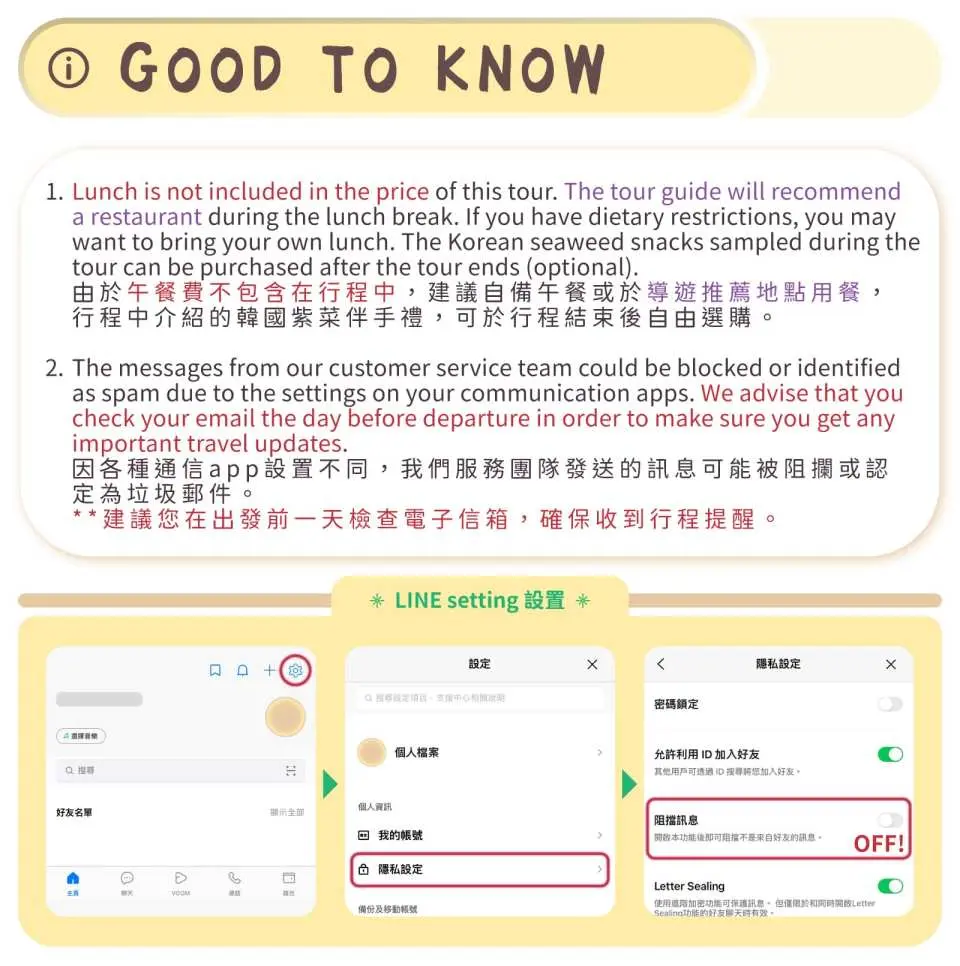
GOOD TO KNOW
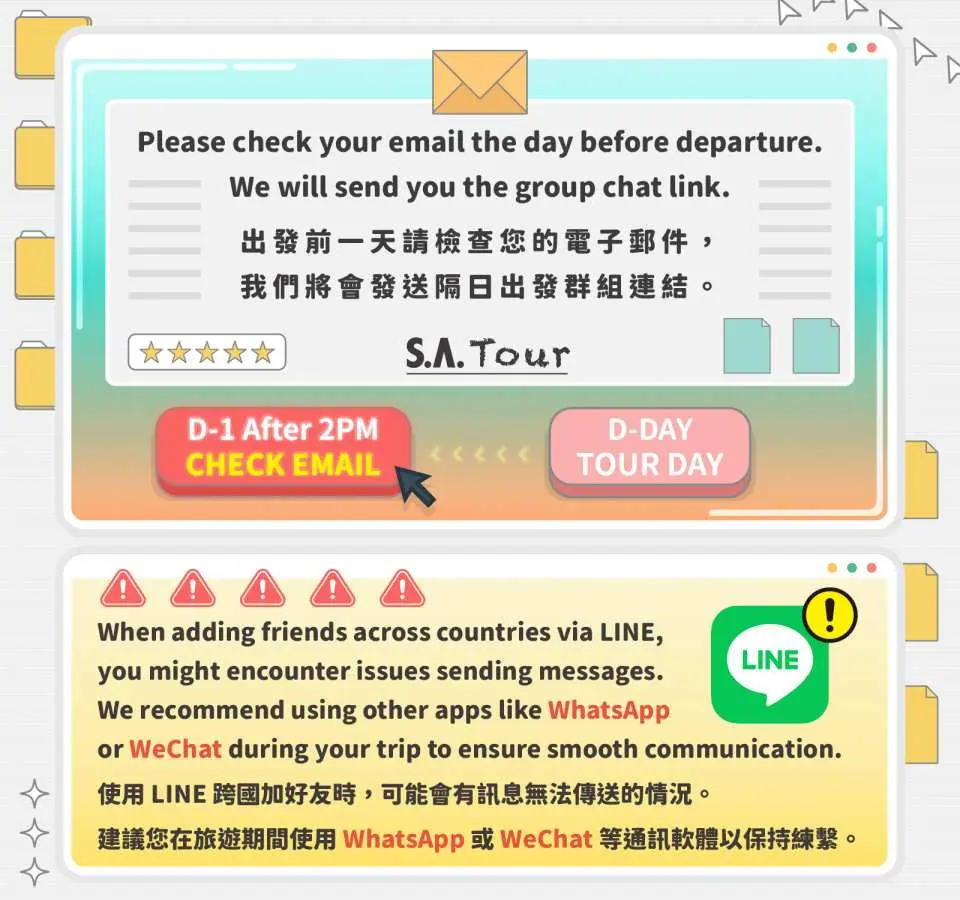
Contact information before departure
Purchase Notice
- Please provide your correct contact information (LINE / WhatsApp) when booking. If you fail to provide the correct contact information and are unable to contact us before departure, we regret that we will not be able to offer a refund.
- Children under 3 years old who do not occupy a seat can participate in the tour for free, but meals, admission fees, and parking spaces are not included. Please indicate this in the remarks column when booking.
- The tour is pre-selected to be conducted in Chinese or English. Please indicate your preferred language on the payment page. (If the tour is fully booked or the minimum number of participants is not reached, arrangements will be made according to availability. We apologize for any inconvenience.)
- If you are booking separately from your travel companions, please provide the total number of members booking separately and the name of each member in the remarks.
- Please note that the cherry blossom season is from early April, and the blooming status is subject to weather changes and cannot be guaranteed.
- Lunch is not included in the itinerary. It is recommended that you bring your own lunch or dine at a location recommended by the tour guide. Korean seaweed souvenirs introduced in the itinerary can be purchased at your own discretion after the tour.
- If the tour cannot proceed due to insufficient participants, we will proactively notify you to reschedule or offer alternative solutions. If you wish to cancel, you can apply for a refund directly on the platform. Please check your email for notifications before departure.
Reminders
A minimum of 8 traveler(s) are required for the tour to depart. If the number of participants does not reach the minimum requirement, the tour will be canceled. An email regarding tour cancellation will be sent 1 day(s) before the departure date
In the event of inclement weather such as typhoons or snowstorms, a decision on whether to cancel the tour will be made 1 day(s) before departure (local time 18:00). Notifications will then be sent via email
Please arrive at the designated location 10 minute(s) before the scheduled departure time, as the tour will depart on time
Admission tickets will not be included for travelers under the age of 3 and are required to be purchased on-site
Children aged 0-3 years old (under 36 months) can participate in this tour for free, but they do not occupy a separate seat. If they are not informed or their age is not true, they will need to pay the normal fare.
Please be sure to confirm and arrive at the meeting point in advance. As the dispatched vehicles need to take turns to pick up at different locations, the bus will only stop and wait for 5 minutes at the scheduled meeting time. Latecomers will not be able to request rescheduling or refunds. Please be advised.
If you change your departure date within 48 hours before departure due to personal reasons, the change fee is KRW20,000/person
It is recommended that you purchase accident and/or travel insurance before attending this activity.
⚠️ All travel itineraries of our company do not include personal travel insurance. Outdoor activities present specific risks and dangers. Guests must assess their own fitness or ability. The company is not responsible for any bodily damage or injury caused by accidents or unforeseen factors.
The actual type of vehicle will be arranged according to the number of reservations, please pay attention
Will be arranged according to the predetermined language preference. If the reservation is full or the number of participants is not reached, we will arrange it according to the situation. Thank you for your understanding.
Lunch is not included in the itinerary. It is recommended that you bring your own lunch or eat at the place recommended by the tour guide. The Korean seaweed souvenirs introduced in the itinerary can be purchased freely after the trip.
Please note that the cherry blossom season is early April and the blooming conditions are not guaranteed due to weather changes.
If the tour cannot proceed due to insufficient participants, we will proactively notify you to reschedule or offer alternative solutions. If you wish to cancel, you can apply for a refund directly on the platform. Please check your email for notifications before departure.
FAQ
1. Why is Bulguksa Temple considered a significant UNESCO World Heritage site?
Bulguksa Temple is a prime example of Silla Buddhist art and architecture, recognized for its exceptional aesthetic and religious importance. It houses several National Treasures, including the Dabotap and Seokgatap stone pagodas, and the Cheongun-gyo and Baegun-gyo bridges. Its historical value as a spiritual center and a testament to the advanced craftsmanship of the Silla Kingdom makes it a truly significant site.
2. What makes Bulguksa Temple a recommended stop for visitors exploring Gyeongju's historical sites?
Visitors to Bulguksa Temple can immerse themselves in centuries of Korean history and spirituality. The temple grounds offer serene beauty, intricate architectural details, and a glimpse into ancient Buddhist practices. Key highlights include the stunning pagodas, the tranquil main halls, and the overall peaceful atmosphere, making it a culturally enriching experience amidst Gyeongju's diverse historical attractions.
3. What is the appropriate dress code and etiquette for visiting Bulguksa Temple?
When visiting Bulguksa Temple, it is recommended to dress respectfully. This typically means covering shoulders and knees. Avoid overly revealing clothing. Visitors should also maintain a quiet demeanor, especially inside temple halls, and remove hats before entering. Photography is generally allowed in most areas, but avoid flash in sensitive areas and be mindful of worshippers.
4. How much time should visitors allocate for exploring Bulguksa Temple?
To fully appreciate Bulguksa Temple and its various structures, including the main halls, pagodas, and surrounding grounds, visitors should plan to spend approximately 1.5 to 2 hours. This allows ample time for leisurely walking, photography, and absorbing the historical and spiritual atmosphere without rushing through the experience.
5. What are the recommended transportation options for visiting Gyeongju's UNESCO sites like Yangdong Hanok Village and Donggung Palace?
While public transport options like buses are available, navigating between Gyeongju's spread-out UNESCO sites can be time-consuming for first-time visitors. Taxis are an option, but for convenience, consider joining a guided tour that includes transportation. These tours offer seamless travel between sites like Yangdong Hanok Village and Donggung Palace, often with knowledgeable guides.
6. Which historical sites in Gyeongju offer the best night view experience?
Gyeongju is renowned for its enchanting night views of historical sites. Donggung Palace and Wolji Pond (formerly Anapji Pond) are particularly famous, with illuminated structures reflecting beautifully on the water. Cheomseongdae Observatory and Woljeonggyo Bridge also offer spectacular nighttime displays, creating a magical atmosphere that highlights Gyeongju's ancient beauty after dark.
7. What unique historical discoveries can be seen at Daereungwon and Cheonmachong Cemetery?
Daereungwon is a large tomb complex in Gyeongju, featuring over 20 large burial mounds. The most significant is Cheonmachong (Heavenly Horse Tomb), where visitors can enter the recreated tomb chamber. Inside, you can see replicas of artifacts found, including the famous "Heavenly Horse Painting" and golden crowns, providing a direct insight into the Silla royalty's burial practices and opulent treasures.
8. What kind of experience can visitors expect at Yangdong Hanok Village, a UNESCO site?
Yangdong Hanok Village offers a unique journey into traditional Korean life, showcasing well-preserved Joseon-era architecture amidst beautiful natural scenery. Visitors can wander through quaint alleyways, admire traditional hanok houses, and observe the daily life of a living folk village. It's an opportunity to experience Korea's cultural heritage in an authentic, picturesque setting, especially beautiful with spring cherry blossoms or autumn maple leaves.


