



Luxor: Full-Day Tour of the East and West Banks
- Visit the East and West banks of Luxor with an Egyptologist tour guide
- Admire the Temple of Karnak, known for its age-old pylons and chapels
- Explore Luxor Temple & Colossi of Memnon
- Marvel at the pristine tombs of the three pharaohs in Valley of the Kings
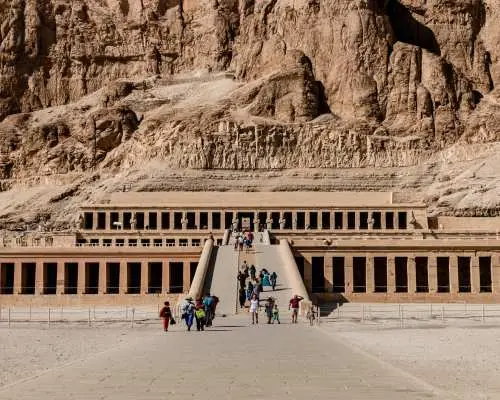
- Visit the splendid Temple of Queen Hatshepsut
Product Info
Meet your Egyptologist tour guide to Start your journey in a private air-conditioned vehicle and relax in comfort as you travel to explore the most important historical monuments in Luxor. Hop out on the West Bank and discover the valley of kings on the west bank of Luxor. There you will visit the remarkable tombs and last resting place of the Kings Ramesses III, Ramesses VI, and Mrenptah. Entrance to the tomb of Tut-Ankh-Amon is also included depending on which price option you select.
Proceed to Queen Temple of Hatshepsut, dedicated to an only female ruler who ruled Egypt for 20-years with wealth and peace. See the mortuary temple of Amenhotep III at the Colossi of Memnon, then stop for lunch at a local restaurant.
Continue your journey to the East Bank to witness The Complex of Karnak which might be the largest temple in the world. You have one more stop before you leave the place - the magnificent Luxor Temple, a large ancient Egyptian temple that you will have time to explore.
Capture the grandeur of ancient Egypt here.


Explore the hidden tombs in the Valley of Kings. Discover ancient secrets within.


Admire the architecture at the Mortuary Temple of Queen Hatshepsut. Appreciate the legacy of a powerful ruler here.


Mortuary Temple of Amenhotep in Luxor. Feel the history of a forgotten era here.


Wander through the Temple of Karnak. Experience the grandeur of ancient worship here.


Purchase Notice
- Please carry a passport or ID card during the tour.
- There is no particular dress code for this tour. You can wear comfortable clothes.
- Tour duration is fixed for all tours/activities, but it may vary depending on the city traffic.
- The duration of the tour includes, both pick up and drop off timings as well.
- This tour is not wheelchair accessible
- Pets, luggage or large bags are not allowed on this tour.
- Please share your correct nationality, hotel name, address, and room number. The pick-up point will be at the main entrance of the "Main Gate" hotel on the highway, not at the reception gate or area.
- Pickup from West bank hotels is available at an extra cost of 10 USD per person.
Reminders
Please arrive at the designated location 15 minute(s) before the scheduled departure time, as the tour will depart on time
Cancellation Policy
- Cancellations 0 day(s) (inclusive) before the selected date are allowed. Unused orders can be canceled for free
- Due to time zone differences, the confirmed cancellation date is based on the supplier’s local time. Please allow 2–5 business days to process your cancellation request, after which the cancellation fee will be charged according to the product’s cancellation policy. Once the cancellation is confirmed, you will receive your refund within 14 working days.
FAQ
The East Bank of Luxor is renowned for its grand temple complexes, primarily the Karnak Temple and Luxor Temple. Karnak Temple is a vast open-air museum showcasing impressive pylons and chapels, while Luxor Temple is uniquely built with direct influence from various pharaohs. These sites offer visitors a deep insight into ancient Egyptian religious practices and architectural marvels.
The Karnak Temple, an expansive complex of temples, chapels, and other buildings, is prominently situated on the East Bank of the Nile River in Luxor. This location places it among other significant monuments accessible from the city center, and it served as a main cult temple for Amun-Re, a vital part of ancient Thebes.
While not strictly mandatory, an Egyptologist tour guide is highly recommended for visiting Luxor's temples and tombs. Their expertise provides invaluable historical context, deciphers hieroglyphs, and explains the intricate details and stories behind each site, such as the Karnak Temple, Luxor Temple, and the Valley of the Kings. This greatly enhances the understanding and appreciation of these ancient wonders.
Yes, a well-planned full-day tour can effectively cover the major highlights of both the East and West Banks of Luxor. Such an experience typically spans eight hours and includes key sites like the Karnak Temple and Luxor Temple on the East Bank, and the Valley of the Kings, Temple of Queen Hatshepsut, and Colossi of Memnon on the West Bank, offering a comprehensive overview of Luxor's ancient treasures.
To properly explore Luxor Temple and appreciate its architectural grandeur, including the colossal statues, courtyards, and colonnades, you should allocate approximately 2 to 3 hours. This allows sufficient time to take in the historical significance of its various sections, which reflect contributions from multiple pharaohs and later Roman additions.
Luxor's West Bank is home to some of ancient Egypt's most famous burial sites and mortuary temples. Key attractions include the Valley of the Kings, where pharaohs were entombed; the magnificent mortuary Temple of Queen Hatshepsut, carved into a cliff face; and the imposing Colossi of Memnon, two massive stone statues guarding the former mortuary temple of Amenhotep III.
To visit attractions on both the East and West Banks of Luxor, transportation typically involves a combination of land and river crossings. For land travel between sites, private cars or mini-buses are common. To cross the Nile River from the East to West Bank, or vice versa, ferries or private boats are widely used, providing convenient access between the two distinct archaeological zones.
The Valley of the Kings holds immense historical significance as the primary burial ground for pharaohs and powerful nobles of the New Kingdom (18th to 20th Dynasties) of Ancient Egypt. It features numerous rock-cut tombs, many intricately decorated with scenes from Egyptian mythology, illustrating funerary rituals and beliefs about the afterlife. This site offers unparalleled insights into royal burial practices and ancient Egyptian cosmology.
Get Help


