


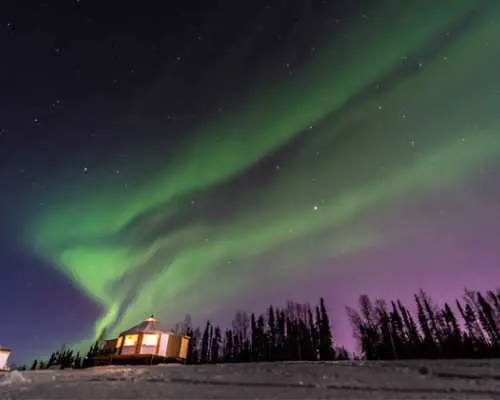

Northern Lights & Dog Sledding Tour from Fairbanks|Alaska
Adventure to Alaska to experience the vivid Northern Lights. Embark on a unique dog sledding journey through the Alaskan wilderness. End your day with a delicious, hearty dinner while staring at a gorgeous starry night.
- Enjoy convenient pick-up service
- View the vibrant northern lights
- Traverse the Alaskan trails on a dog sled
- Tuck into a tasty home-cooked dinner in a wooden cabin
Sightseeing Tours
| Tour Type | Shared tour |
| Transportation method | Hotel transfer |
| Tour types | Guided tour |
| Meal arrangement | With dinner, Vegetarian |
| Additional service & facility | Transfer included |
| Sightseeing type | Natural sights, Eco-tourism |
| Transport | Charter car |
Product Info
Purchase Notice
- After we have received your hotel pickup information, you will be informed of the pickup time through a system message. If the hotel information has not been determined at the time of booking, you will be notified by e-mail after we have received your information
- Please note that the pickup time cannot be specified, and the travel agency will arrange it according to the number of travelers on the day of the tour
- Please note that children under age of 5 cannot be accommodated as this tour does not provide child safety seats
- Travelers must be below 250 lbs (113 kg) to participate in the dog sled activity
- For any special meal requests, please make sure to notify us so we can best accommodate you
- The Aurora Borealis/Northern Lights is a natural phenomenon and can not be guaranteed. There is no refund if the Aurora Borealis/Northern Lights do not appear
Reminders
A minimum of 2 traveler(s) are required for the tour to depart. If the number of participants does not reach the minimum requirement, the tour will be canceled. An email regarding tour cancellation will be sent 3 day(s) before the departure date
In case of delays caused by traffic, weather, or other force majeure factors resulting in the cancellation of some itinerary attractions, please contact customer service. We will arrange a partial refund for you
Please arrive at the designated location 10 minute(s) before the scheduled departure time, as the tour will depart on time
Travelers are advised to confirm pick-up time and location with the local agency 1 day before departure. Contact details: (+1) 907-590-5900
Cancellation Policy
- For cancellations made at least 31 day(s) prior to selected date, a cancellation fee of 5% will apply
- Cancellation is not allowed between 0–30 days from the selected date. Orders cannot be canceled or modified, and refunds will not be granted.
- Due to time zone differences, the confirmed cancellation date is based on the supplier’s local time. Please allow 2–5 business days to process your cancellation request, after which the cancellation fee will be charged according to the product’s cancellation policy. Once the cancellation is confirmed, you will receive your refund within 14 working days.
FAQ
The optimal months for viewing the Northern Lights in Fairbanks are typically from late August to April. During this period, the nights are longer and darker, significantly increasing the chances of seeing the aurora. Peak visibility often occurs in the colder, clearer months like December, January, and February, though sightings are possible throughout the entire season.
While aurora displays can occur at any time during the dark hours, the most common and intense viewing hours for the Northern Lights in Fairbanks are usually between 10:00 PM and 3:00 AM. Tours are typically timed to maximize your chances during this window, often involving late-night observation from a dark viewing location away from city lights.
Fairbanks is ideally located within the "aurora oval," making it one of the best places globally for Northern Lights viewing. On average, the aurora is visible about 240 days a year. Sighting frequency is influenced by solar activity (measured by the Kp-index) and weather conditions, particularly clear, dark skies. While highly probable, visibility is never guaranteed nightly due to natural phenomena.
This tour provides a comfortable and strategic viewing location specifically chosen to be away from urban light pollution. Guests typically observe the Northern Lights from a cozy wooden cabin, offering warmth and shelter while waiting for the aurora to appear. This setup allows for an enhanced viewing experience in the Alaskan wilderness, complemented by a home-cooked dinner.
The dog sledding experience on this tour offers an authentic journey through the Alaskan wilderness. Participants will have the opportunity to meet a team of trained sled dogs, learn about their unique characteristics and the sport of mushing, and then enjoy a thrilling ride pulled by these magnificent animals. This provides a unique immersion into a traditional Alaskan winter activity.
The tour includes a delicious, hearty home-cooked dinner served in a warm, rustic wooden cabin. This provides a comfortable and authentic Alaskan dining experience, allowing guests to relax and refuel in a cozy setting. The meal is designed to be substantial and comforting, perfectly complementing the evening's adventure in the cold Alaskan environment.
The tour includes convenient pick-up service directly from designated central locations in Fairbanks. This service aims to eliminate the hassle of arranging personal transportation to the starting point of the activities. Participants should confirm their exact pick-up time and location with the local operator after booking to ensure a smooth and timely start to their adventure.
For Northern Lights viewing in Fairbanks, it is essential to dress in multiple warm layers due to the extreme cold. Recommended gear includes thermal underwear, fleece pants and jackets, a waterproof and windproof outer shell, insulated boots, thick wool socks, warm gloves or mittens, a hat that covers the ears, and a scarf or neck gaiter. Hand and foot warmers can also be beneficial.
Get Help


