
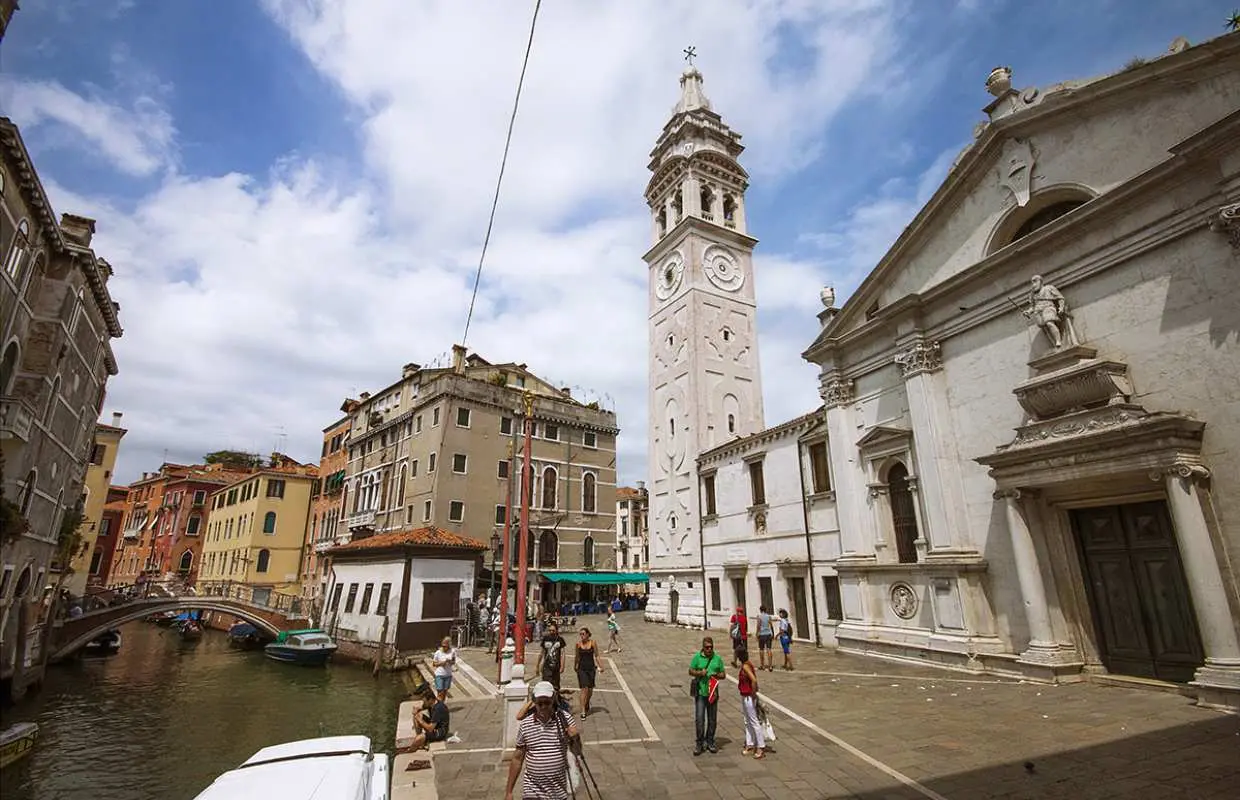


Venice Half-Day Tour | The Doge's Palace & Basilica of St Mark
- Explore the Doge's Palace and Basilica of St Mark and learn about local history
- Gain in-depth attraction info with the help of a professional tour guide
- Alleviate long ticket lines via fast track tickets and enjoy a hassle-free visit
Product Info
-What You Can Expect-
Through this tour, you will learn a lot about the history of Venice. The adventure starts at Calli and you will be greeted with countless archaic bridges and vast plazas. Have a glimpse at the local's livelihood and follow the tour guide to Campo Santa Maria Formosa, where the majestic SS. Giovanni e Paolo is located.
Go past Scuola Grande di San Marco and find out why it was called the Great School of Charity. Next, you will reach Mercerie where once was a business center. Though now the shopping area is situated between Mercerie and Campo Santa Maria Formosa.
* Please note that the itinerary specified above is outdoors only, travelers will not enter any attractions
As the tour continues, head to the Doge's Palace (Palazzo Ducale) and marvel at its white and grey marble exterior. This palace is one of Venice's most important architecture where visitors can easily capture the essence of the city. In addition to those towering walls, the palace's design is as splendid as the city itself. In this one-of-a-kind trip, you will discover this city's golden era. The Doge's Palace contains not only spectacular buildings but also artistic paintings and sculptures that decorate the palace perfectly.
Saint Mark's Basilica is also an attraction you will visit. We're certain that you don't want to miss out on the architecture that combines western style and Byzantine style. The church's interior is mainly gold-hued mosaic and marble, which is why it is also nicknamed the Church of Gold. Book now with KKday and witness the beauty of Venice.
* Travelers must wear appropriate attire to Saint Mark's Basilica. Off-the-shoulder tops, pants not covering knees, low collar shirts, mini skirts, slippers, and hats are not allowed. For safety reasons, backpacks are not allowed in the church, please consider before booking
-Important Info-
- Start Time: 11:00am/ 2:45pm (please arrive at the meeting point 15 mins in advance)
- Meeting Point: Campo San Zaccaria, 4683g. Check-in at the shop located opposite the church of San Zaccaria. Please be there 15 minutes before the scheduled start time.
- Duration: 4 hrs
- Return Point: the original meeting point
Explore Venice with a tour guide


Check out the incredible design of the Doge's Palace


Marvel at Basilica of St Mark's gold ornaments


Purchase Notice
- Free admission for children aged under 6, please notify us of the number of eligible children in the "Note" section when booking
- Travelers must wear appropriate attire to a church. Off-the-shoulder tops, pants not covering knees, low collar shirts, mini skirts, slippers, and hats are not allowed
- For safety reasons, please do not carry large-size backpacks to the church
- Basilica of St Mark may close due to high tides, religious activities, and other events without prior notification, please consider before booking
- Please note that certain attractions require security checks upon admission even with a fast track ticket
- Please arrive at the meeting point at least 15 mins in advance. Admission, refunds, cancellation, or booking changes will not be granted to late arrivals
- Please carry your passport at all times in case of identity verification
Includes/Excludes
How to Redeem Your Voucher
How to Use Your Voucher
- Please present the e-voucher on-site
Meeting Point
Location Name: Campo San Zaccaria, 4683g
Address: Campo San Zaccaria, 4683gExperience Location
Location Name: Venice
Address: Venice Metropolitan City of Venice ItalyCancellation Policy
- Cancellations 3 day(s) (inclusive) before the selected date are allowed. Unused orders can be canceled for free
- Cancellation is not allowed between 0–2 days from the selected date. Orders cannot be canceled or modified, and refunds will not be granted.
- Due to time zone differences, the confirmed cancellation date is based on the supplier’s local time. Please allow 2–5 business days to process your cancellation request, after which the cancellation fee will be charged according to the product’s cancellation policy. Once the cancellation is confirmed, you will receive your refund within 14 working days.
FAQ
The Doge's Palace served as the seat of power for the Venetian Republic for over 1,000 years. It was the residence of the Doge, the supreme authority, and housed the government's administrative offices, law courts, and prisons. Its architectural grandeur, a blend of Gothic, Renaissance, and Byzantine styles, symbolizes Venice's immense wealth, artistic prowess, and political influence during its maritime empire era. The palace is a testament to the city's unique history and governance.
A tour offers an immersive journey through centuries of Venetian history. At Doge's Palace, you'll traverse lavish Doge's apartments, grand council chambers, and cross the Bridge of Sighs to see the ancient prisons. Inside St Mark's Basilica, marvel at the dazzling mosaics, intricate altarpieces, and Byzantine art. With a guide, you gain insights into local history and art, enhancing your understanding beyond just sightseeing. Fast track tickets allow for a seamless visit, maximizing exploration time.
The correct pronunciation of "Doge's Palace" is typically "Dohj-ez Pal-us." "Doge" (pronounced "dohj," rhyming with "rouge" or "bodge") refers to the chief magistrate of the former Republic of Venice. While "palace" is pronounced as in English, the key is the "Doge" part, which is a historical title, not a common English word.
Admission tickets for Doge's Palace can be acquired through various channels. Many visitors choose to book in advance online to secure their entry and avoid queues, especially during peak seasons. You can book through KKday, which offers convenient online booking for popular attractions and ensures a hassle-free visit with fast-track entry options. This allows you to explore the palace without spending time waiting in line. Tickets can also be purchased directly at the palace, though this may involve longer waits.
The St. Mark's Square and Doge's Palace area, being central, is primarily accessed by walking or by Venice's unique water transport system, the vaporetto (public water bus). From Santa Lucia train station or Piazzale Roma (bus terminal/parking), you can take a vaporetto directly to the San Marco stop. Many parts of Venice are pedestrian-only, so prepare for walking once you arrive in the vicinity of these landmarks. Water taxis offer a more private, direct, but more expensive option.
The Doge's Palace is intrinsically linked to the Doges themselves, who were elected leaders governing Venice for over a millennium. Notable Doges include Francesco Foscari, under whom the republic reached a peak of power in the 15th century, and Andrea Gritti, a significant patron of arts. Additionally, figures like Giacomo Casanova are famously associated with the palace's prisons, from which he made a legendary escape, adding to the palace's intriguing history.
Yes, navigating between Doge's Palace, St Mark's Basilica, and St. Mark’s Square on foot is not only easy but the most common and enjoyable way. These three iconic landmarks are situated immediately adjacent to each other within St. Mark's Square itself. The area is entirely pedestrianized, allowing visitors to seamlessly walk from one attraction to another, immersing themselves in the historic surroundings without needing any additional transportation.
A professional tour guide offers rich historical context and cultural insights into the Doge's Palace and St Mark's Basilica. They explain the architectural styles, the significance of artworks and frescoes, and recount stories of the Venetian Republic's political intrigue, maritime power, and daily life. Guides also highlight key features, explain ceremonial traditions, and answer questions, providing a deeper understanding that self-guided visits often miss, making the visit more enriching and engaging.
Get Help


