


Entrance tickets to Paris' Panthéon
- Book your entrance ticket to visit the Panthéon, an early example of neoclassicism inspired by the Pantheon in Rome.
Attraction Tickets
| Ticket type | Fast track ticket |
| Exhibit type | Art exhibits, Historical exhibits |
| Attraction type | History & culture |
| Tour types | None |
| Additional service & facility | Fast Track |
Product Info
Purchase Notice
Reminders
Please refer to your voucher for final information regarding meeting points, pick-up locations, and pick-up time
Meeting point description: Present your ticket at the entrance of the Panthéon. Nearest metro stop: Cardinal Lemoine (line 10).(Place du Panthéon, 75005 Paris, France)
Not allowed:Luggage and big items exceeding 55cmx35cmx20cm will not be accepted
Know in advance:Free admission for children under 18 years, EU citizens (age 18-25), disabled people and their companion, French unemployed people, Pass Education holders
Free admission for all visitors on the first Sunday of each month from November to March and on the European Heritage Days (the third weekend of September)
The monument is closed on 1st January, 1st May, and 25th December
The ticket gives access to an unguided tour of the monument
How to Redeem Your Voucher
How to Use Your Voucher
- Please present the e-voucher on-site
Validity Period
- The voucher must be used on the selected date and within operating hours; Invalid after expiration
FAQ
The Panthéon in Paris holds profound historical significance as a mausoleum for distinguished French citizens. Originally built as a church dedicated to St. Genevieve, it was transformed during the French Revolution into a national temple for the country's most revered figures. Its neoclassical architecture symbolizes French grandeur and the ideals of the Enlightenment, celebrating reason and patriotism. It stands as a testament to the nation's history and its great minds.
The crypt of the Panthéon in Paris is the resting place for many of France's most illustrious citizens. Among those honored are prominent writers such as Victor Hugo, Émile Zola, and Alexandre Dumas, as well as philosophers like Voltaire and Jean-Jacques Rousseau. Scientists Marie Curie, the first woman interred for her own merits, and Louis Braille are also buried here, alongside political figures and military heroes.
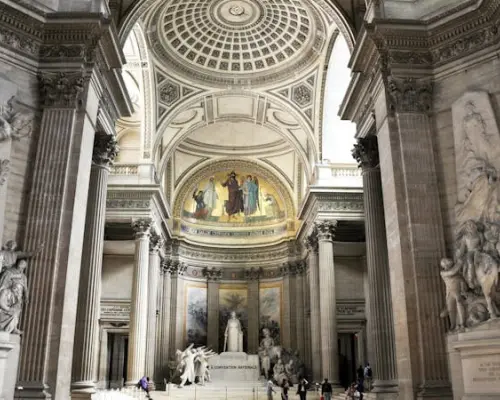
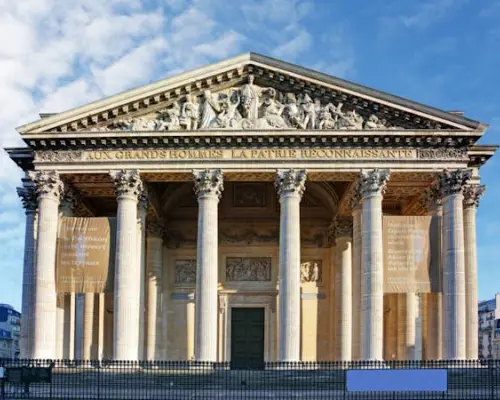
The Panthéon in Paris is a prime example of neoclassical architecture, drawing heavy inspiration from classical Greek and Roman temples. Its defining features include a grand portico with Corinthian columns and a large dome reminiscent of the Pantheon in Rome, but with a unique triple-shell structure. The building's symmetry, monumental scale, and classical motifs reflect the Enlightenment's emphasis on rationality and classical ideals.
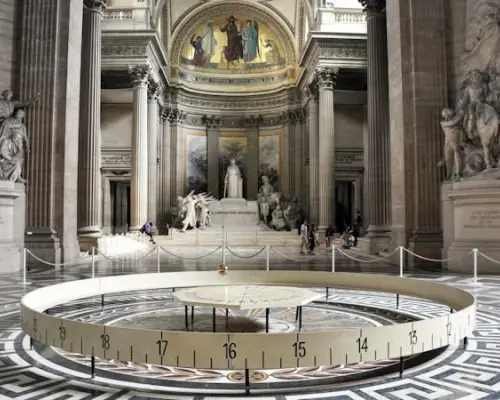
Beyond the crypt, visitors to the Panthéon in Paris can admire its magnificent interior architecture, including the vast nave and impressive dome. A highlight is Foucault's Pendulum, suspended from the dome, demonstrating the Earth's rotation. The walls are adorned with large-scale mural paintings depicting scenes from French history and the life of Saint Genevieve, offering a visual narrative of the nation's past and cultural heritage.
Yes, visitors to the Panthéon in Paris can ascend to the dome for a spectacular 360-degree panoramic view of the city. This offers a unique perspective of iconic Parisian landmarks such as the Eiffel Tower, Notre Dame Cathedral, and the Sacré-Cœur Basilica. The ascent involves climbing a significant number of stairs, providing a rewarding experience for those seeking elevated perspectives of Paris.
To reach the Panthéon in Paris via public transportation, you have several convenient options. For the Metro, take Line 10 to Cardinal Lemoine station (approximately 5-7 minute walk) or Maubert Mutualité station (approximately 5-7 minute walk). For the RER, take RER B to Luxembourg station (approximately 10-12 minute walk). Several bus lines also stop near the Panthéon, including lines 21, 27, 38, 82, and 85, with stops like Panthéon or Luxembourg. These options provide direct access from various parts of Paris.
For a comprehensive visit to the Panthéon in Paris, it is generally recommended to allocate about 1.5 to 2 hours. This duration allows ample time to explore the grand main hall, view Foucault's Pendulum, delve into the crypt to see the tombs of notable figures, and, if desired, ascend to the dome for panoramic city views. Allowing extra time also enables appreciation of the detailed murals and architectural nuances.
Yes, an entrance ticket is required for most visitors to access the Panthéon in Paris, though certain groups like EU citizens under 26 may have free entry. To acquire tickets, you can typically purchase them directly at the monument's entrance or, for greater convenience and to potentially save time, book them in advance through platforms like KKday. Booking through KKday offers the advantage of a streamlined process, allowing you to secure your entry ahead of time and plan your visit more efficiently.
Get Help


