
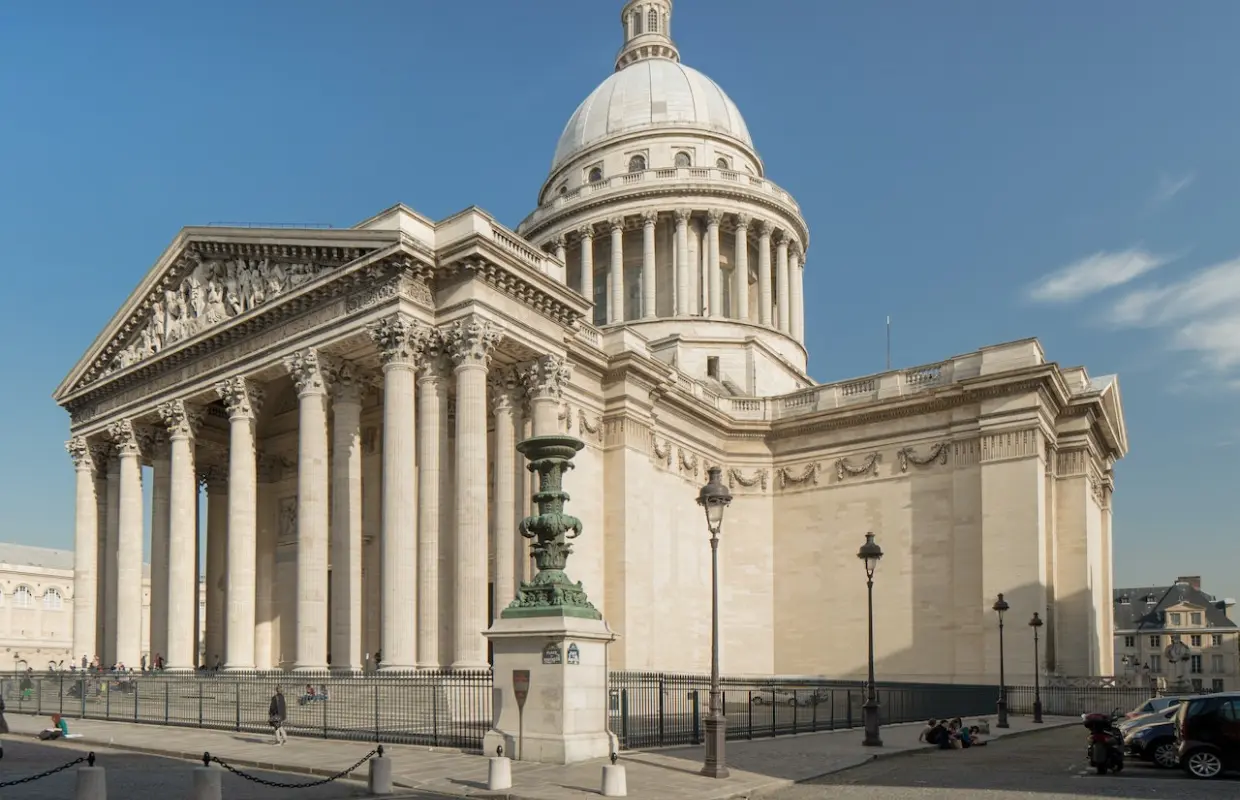


Paris: Pantheon Skip-the-Line Admission
- See the canvas paintings depicting highlights in the life of Saint Genevieve, the birth of Christianity, and the French monarchy. Enter the crypt and see the tombs of famous French personalities - including Voltaire, Victor Hugo, Émile Zola, Louis Braille, and Marie Curie. See (an exact replica of) the original Foucault’s Pendulum, suspended from the dome.
Product Info
France's most enchanting burial place. A neo-Classical church situated in the Latin Quarter and 5th arrondissement of Paris, from here, on the top of Montagne Sainte Geneviève, you'll get a pigeon's eye view over the whole city. It functions mainly as a burial place for French VIPs. Enter with priority access, check out the canvas paintings illustrating the birth of Christianity, and visit the crypt!


Important Info
Includes/Excludes
Reminders
Please refer to your voucher for final information regarding meeting points, pick-up locations, and pick-up time
Experience Location
Location Name: Panthéon, Place du Panthéon
Address: Panthéon, Place du PanthéonCancellation Policy
- Once the order has been completed, it cannot be canceled, modified, or refunded
- Due to time zone differences, the confirmed cancellation date is based on the supplier’s local time. Please allow 2–5 business days to process your cancellation request, after which the cancellation fee will be charged according to the product’s cancellation policy. Once the cancellation is confirmed, you will receive your refund within 14 working days.
FAQ
The Pantheon Paris stands as a powerful symbol of French history and culture. Originally built as a church dedicated to Saint Genevieve, it was later transformed into a secular mausoleum. It now serves as the final resting place for eminent French citizens who have significantly contributed to the nation's intellectual, scientific, and cultural heritage, making it a profound site of national memory and architectural grandeur.
The name "Pantheon" originates from ancient Greek, meaning "to all gods." This reflects its initial purpose as a temple dedicated to all deities, similar to its Roman namesake. In Paris, the monument was originally commissioned by King Louis XV as a church honoring Saint Genevieve, the patron saint of Paris, before its transformation into a secular mausoleum during the French Revolution.
Most visitors find that allocating approximately 1.5 to 2 hours is sufficient to explore the Pantheon Paris thoroughly. This allows time to appreciate the grandeur of the main nave, view the captivating Foucault's Pendulum, examine the historical paintings, and respectfully visit the crypt where many notable French figures are interred. For those who wish to delve deeper into the exhibits, slightly more time might be beneficial.
The Pantheon Paris is conveniently accessible by various public transportation options. You can take Metro Line 10 and alight at either "Cardinal Lemoine" or "Maubert-Mutualité" stations, both within a short walking distance. Alternatively, the RER B train to "Luxembourg" station will also bring you close. Several bus lines, including 21, 27, 38, 82, and 84, also have stops near the monument, offering flexible travel choices.
Absolutely, visiting the Pantheon Paris is highly recommended for first-time visitors interested in French history, architecture, and culture. It offers a unique opportunity to admire stunning neoclassical architecture, witness the famous Foucault's Pendulum, and pay homage to some of France's most revered intellectuals and artists in its solemn crypt. The monument provides profound insights into the nation's legacy.
Generally, a ticket is required for admission to the Pantheon Paris. However, there are specific conditions under which entry may be complimentary, such as for EU citizens and residents aged under 26. For other visitors, purchasing a ticket is necessary to access the monument. You can secure your admission in advance through platforms like KKday, which offers skip-the-line access, enhancing your convenience and saving time upon arrival.
Inside the Pantheon Paris, visitors can discover a remarkable collection of canvas paintings that vividly depict significant moments. These artworks illustrate key highlights in the life of Saint Genevieve, chronicle the birth of Christianity in France, and portray pivotal moments of the French monarchy. Additionally, the interior showcases the impressive neoclassical architecture and an exact replica of Foucault's Pendulum, demonstrating the Earth's rotation.
The solemn crypt of the Pantheon Paris serves as the final resting place for numerous distinguished French personalities. Among the renowned figures interred there are the Enlightenment philosopher Voltaire, literary giants Victor Hugo and Émile Zola, the inventor of the tactile reading system Louis Braille, and the pioneering physicist and chemist Marie Curie. Their tombs honor their immense contributions to France and the world.
Get Help


