

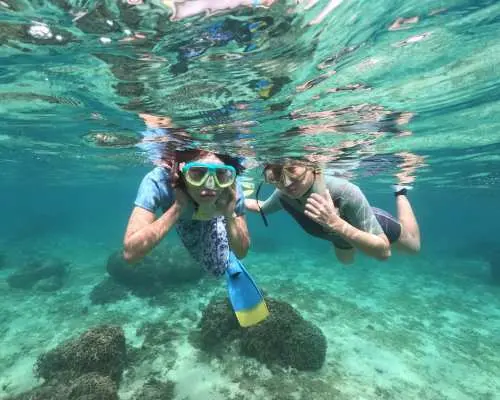
![[Certification course] SNORKELER certification_age 7 and up](https://image.kkday.com/v2/image/get/c_fill%2Ch_400%2Cq_55%2Ct_webp%2Cw_500/s1.kkday.com/product_268557/20250204004824_21rgS/jpg)


[Certification course] SNORKELER certification_age 7 and up
- In accordance with international certification standards, those who meet the requirements will be issued a "Beginner, Intermediate, or Advanced" snorkeler certificate (C card).
Package Options
Water Activities
| Water activity type | Snorkeling, Diving certification class |
| Activity season | Spring, Summer, Fall, Winter |
| Tour Type | Private tour, Shared tour, Small Group |
| Minimum participant requirement | 1 traveler |
| Instruction language | Mandarin, Japanese |
| Activity level | Beginner, Intermediate |
| Transportation method | Transfer from meeting point, Hotel transfer, Get there on your own |
Product Info
What You Can Expect
Important Info
Includes/Excludes
- Consumption tax
- Insurance
- Training
- repair
- Certification Application
- postage
- Equipment Rental
Eligible Users
Eligible Nationalities/Regions
- Taiwan, Hong Kong, China, Japan
Reminders
What to bring
★Things you'll need★
Food and drink, swimsuit, sandals, towels, change of clothes,
Writing implements and insurance card (copies accepted)
● Useful items ●
Hair ties, rash guards and other marine wear, cold weather clothing,
Hat, sunglasses, sunscreen, etc.
To avoid overcrowding, please wear a swimsuit and light clothing that you don't mind getting wet.
Those over 60 years old and those with a chronic illness or medical history are required to submit a "medical history certificate signed by a doctor."
Those under 16 must be accompanied by a parent or guardian, and those under 18 must have parental consent.
Those who are pregnant or suspected to be pregnant, or who have a condition that causes seizures such as epilepsy, cannot participate.
We will not allow anyone who has been drinking alcohol, has an extreme hangover, or is using dangerous drugs, or who is suspected of doing so, to participate (will be treated as a cancellation on the day).
The contents may be changed or canceled depending on the weather and sea conditions.
How to Redeem Your Voucher
How to Use Your Voucher
- Please present your e-voucher and passport on-site
Meeting Point
Location Name: Odohama Beach Parking Lot
Address: 26.090376670738117, 127.70900984955442Cancellation Policy
- Cancellations 3 day(s) (inclusive) before the selected date are allowed. Unused orders can be canceled for free
- For cancellations made 1 to 2 days prior to selected date, a cancellation fee of 50% will apply
- Cancellation is not allowed between 0–0 days from the selected date. Orders cannot be canceled or modified, and refunds will not be granted.
- Due to time zone differences, the confirmed cancellation date is based on the supplier’s local time. Please allow 2–5 business days to process your cancellation request, after which the cancellation fee will be charged according to the product’s cancellation policy. Once your refund request is confirmed, KKday will initiate the refund to your original payment method within 15 days. The actual refund timing depends on your card-issuing bank’s policy.
FAQ
1. Is a SNORKELER certification required for general snorkeling activities?
Generally, a SNORKELER certification is not strictly required for recreational snorkeling in many public areas. However, some organized tours, specific marine parks, or resorts may recommend or require a certification for safety reasons or to access certain equipment. Obtaining certification ensures you have the necessary skills and knowledge for a safer and more enjoyable experience.
2. What is the typical curriculum for a SNORKELER certification course?
A typical SNORKELER certification course covers essential theoretical knowledge and practical skills. This includes understanding snorkeling equipment, basic water safety, proper finning techniques, breath-holding methods, equalization, mask clearing, and safe entry and exit procedures. The curriculum aims to build confidence and competence in various snorkeling environments.
3. Are there any age or physical requirements to enroll in a SNORKELER certification course?
Yes, participants typically need to meet certain requirements. For this SNORKELER certification course, the minimum age is usually 7 years old. Generally, individuals should also be comfortable in the water and have basic swimming abilities, though no prior snorkeling experience is required. A general health declaration might also be part of the enrollment process to ensure participant safety.
4. What kind of recognition does the SNORKELER certification provide internationally?
Upon successful completion, the SNORKELER certification (C card) is issued in accordance with international standards. This recognition signifies that the holder has met globally accepted safety and proficiency benchmarks for snorkeling. It can be useful for validating your skills when participating in international snorkeling excursions or renting equipment from reputable operators worldwide.
5. What does the SNORKELER certification qualify individuals to do after completion?
The SNORKELER certification qualifies individuals to safely and confidently participate in snorkeling activities, applying proper techniques and water safety protocols. It demonstrates proficiency in equipment use, entry/exit, breath control, and emergency procedures. This enables certified snorkelers to enjoy underwater exploration more responsibly and independently in appropriate conditions.
6. What factors influence the overall cost of a SNORKELER certification course?
The overall cost of a SNORKELER certification course can vary depending on several factors. These include the duration of the course, the inclusion of equipment rental, whether pool and open water sessions are separate or combined, the instructor-to-student ratio, and the specific certification body. Prices generally reflect the comprehensive training, safety measures, and instructional expertise provided.
7. Can participants achieve different levels of SNORKELER certification, such as Beginner, Intermediate, or Advanced?
Yes, this SNORKELER certification course is designed to allow participants to achieve different levels based on their skill development and mastery. Those who meet specific requirements will be issued a "Beginner, Intermediate, or Advanced" snorkeler certificate (C card), in accordance with international certification standards, reflecting their demonstrated proficiency.
8. What kind of practical skills are taught during a SNORKELER certification training?
Practical skills taught during SNORKELER certification training include proper mask and snorkel fitting, effective fin propulsion, controlled surface swimming with equipment, various clearings (snorkel and mask), safe ascent and descent techniques, and basic breath-holding exercises. Emphasis is placed on buoyancy control and efficient movement in the water for a comfortable experience.
Get Help


