
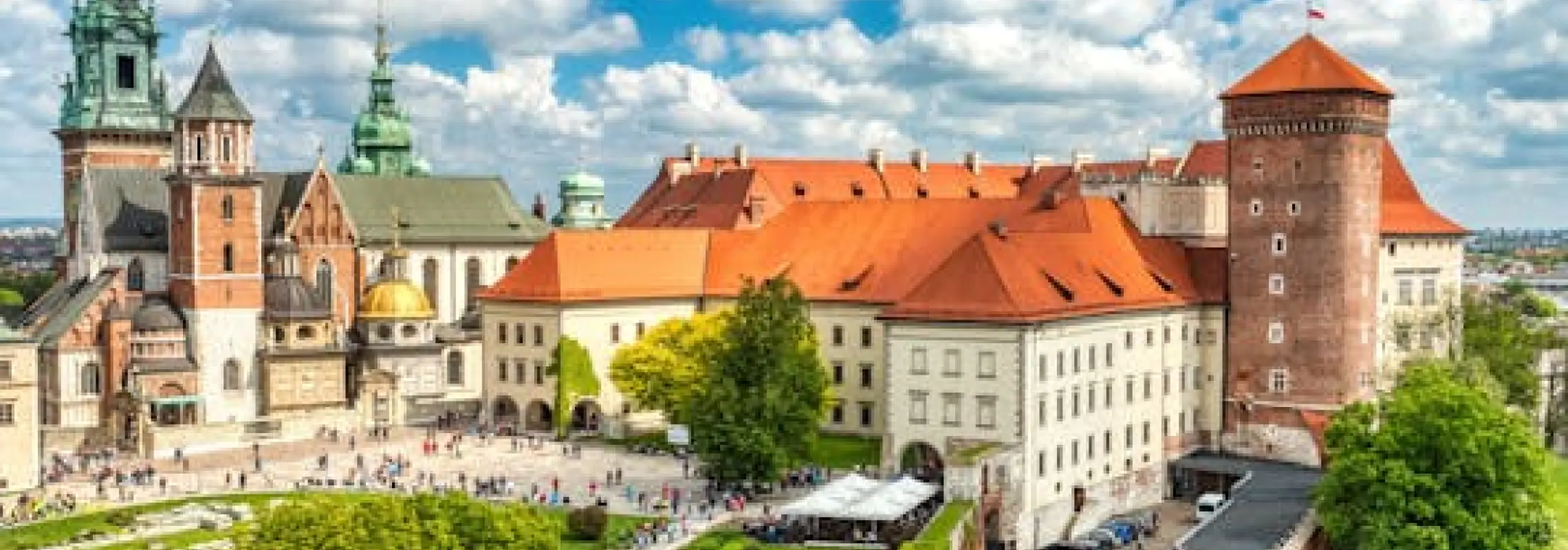
Wawel Hill audioguided tour
- Explore Wawel Hill in Kraków, one of the most significant places in Poland.
Package Options


Product Info
Purchase Notice
Reminders
Please refer to your voucher for final information regarding meeting points, pick-up locations, and pick-up time
Meeting point description: Collect the audio guide in your preferred language at the Krakowbooking Tourist Information Point.(Bracka 15, Kraków, Poland)
Know in advance:Note, this audio guided tour begins from Kanonicza Street and continues up to Wawel Hill. It follows only free-to-enter areas of the Wawel Hill, and does not enter any paid parts of the Castle
The audio guide is available in English, Italian, French, Spanish, German, Russian, and Polish
Comfortable shoes are recommended
FAQ
1. What is the historical significance of Wawel Hill in Kraków?
Wawel Hill holds immense historical and cultural significance as one of Poland's most important sites. For centuries, it served as the seat of Polish kings, housing Wawel Royal Castle and Wawel Cathedral. It symbolizes Poland's national identity, embodying its rich past from early medieval times through the Renaissance, and is recognized as a UNESCO World Heritage site.
2. What is the origin and meaning of the name 'Wawel'?
The name 'Wawel' is widely believed to originate from an Old Slavic word that describes a ravine or gorge, referencing the distinct geological features of the hill. Another theory connects it to 'wał,' meaning rampart or wall, reflecting its historical role as a fortified stronghold. Essentially, it refers to the ancient, prominent hill in Kraków.
3. What are the visitor access options for Wawel Royal Castle?
Wawel Royal Castle provides multiple visitor routes to explore its various sections, including the State Rooms, Royal Apartments, Crown Treasury, Armory, and the Lost Wawel exhibition. Each of these distinct areas requires a separate entry ticket. However, visitors are generally free to explore the castle's outer courtyards and grounds without a ticket.
4. Who were the notable historical inhabitants of Wawel Royal Castle?
Wawel Royal Castle was the residence of numerous influential Polish monarchs and historical figures. Key inhabitants include King Casimir III the Great, responsible for much of the castle's reconstruction, and Sigismund I the Old, who spearheaded its transformation into a Renaissance masterpiece. The castle also hosted queens, dukes, and significant clergy, all contributing to Polish history.
5. Does Wawel Cathedral have an entry fee for visitors?
Entry to the main nave of Wawel Cathedral, a revered site for Polish coronations and royal burials, is typically free of charge. However, specific historic areas within the Cathedral, such as the Royal Tombs, the Sigismund Bell Tower, and the Cathedral Museum, do require a paid ticket for access. These tickets are available for purchase at the cathedral's ticket office.
6. Is there a cost to see the Wawel Dragon statue and its cave?
Seeing the famous Wawel Dragon statue at the base of Wawel Hill is free, and visitors can enjoy watching it periodically breathe fire. However, entering the Dragon's Den (Smocza Jama), the legendary cave beneath the castle, usually requires a small fee. Tickets for the cave typically need to be purchased near its entrance during its operational seasons.
7. What are the main attractions and historical buildings on Wawel Hill?
Wawel Hill features several prominent attractions. The two most significant are Wawel Royal Castle, the former seat of Polish royalty, and Wawel Cathedral, which served as the coronation and burial place for monarchs. Other notable sites include the legendary Wawel Dragon's Den, the Wawel Archeological Reserve, and various defensive walls and towers offering scenic views of Kraków.
8. What is the architectural style of Wawel Royal Castle?
Wawel Royal Castle exhibits a rich blend of architectural styles, reflecting centuries of construction and modifications. Its most recognizable style is Renaissance, notably seen in its stunning arcaded courtyard, designed by Italian masters. Earlier Gothic elements are also preserved, particularly in the castle's older structures and throughout the neighboring Wawel Cathedral, showcasing its diverse historical layers.


