


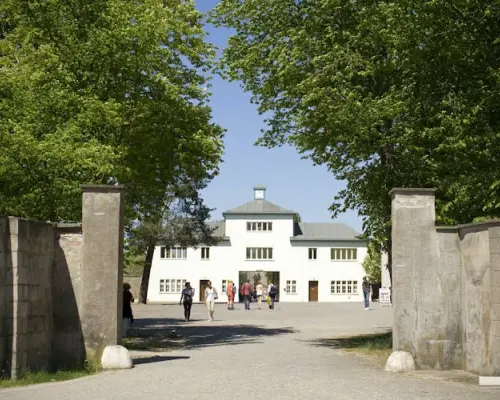

Sachsenhausen concentration camp memorial from Berlin
- Uncover the realities of life and death in the camp where more than 200,000 people were imprisoned by the Nazis. Visit Sachsenhausen Concentration Camp Memorial during your stay in Berlin.
Package Options
Product Info
Purchase Notice
Reminders
Please refer to your voucher for final information regarding meeting points, pick-up locations, and pick-up time
Meeting point description: Meet your guide outside Friedrichstrasse train station, on the square beside the 'Traenenpalast' (Palace of Tears). Look for the guides with the yellow umbrellas. Please be at the meeting point 15 minutes before departure, as latecomers will not be able to join the tour.(Reichstagufer 17, 10117 Berlin, Germany)
Accessibility:This tour is not wheelchair accessible
Not suitable for guests with walking impairments
Know in advance:Roundtrip transportation to the camp is not included. Train tickets can be easily purchased at the meeting point, the cost of the train ticket is 9.40€
The reduced ticket is available for over 65s and for students with a valid ID
Remember to wear appropriate clothes and comfortable shoes
How to Redeem Your Voucher
How to Use Your Voucher
- Please present the e-voucher on-site
Validity Period
- The voucher must be used on the selected date and within operating hours; Invalid after expiration
FAQ
1. Can visitors explore Sachsenhausen concentration camp memorial independently, without a guided tour?
Yes, visitors are welcome to explore Sachsenhausen concentration camp memorial independently. The site provides comprehensive information panels and maps in multiple languages throughout the memorial. You can download audio guides or utilize guidebooks for a self-paced, in-depth understanding of the historical context and the significance of various sections within the former camp. This allows for personal reflection and a focused exploration based on individual interests.
2. What do guided tours typically cover at Sachsenhausen concentration camp memorial?
Guided tours at Sachsenhausen concentration camp memorial typically offer a structured and in-depth exploration of the site, led by knowledgeable historians or educators. They cover key areas such as the Kommandantur (commandant's office), Watchtowers, Prisoner Barracks, Punishment Cells, the Pathological Department, and Station Z (extermination facility). Tours often provide detailed historical context, personal testimonies, and explanations of the Nazi regime's system of terror, offering profound insights into the lives of the prisoners and the camp's function.
3. How much time should be allocated for a comprehensive visit to Sachsenhausen concentration camp memorial?
For a comprehensive visit to Sachsenhausen concentration camp memorial, it is generally recommended to allocate at least 3 to 5 hours. This allows sufficient time to explore the various outdoor areas, barracks, museum exhibitions, and informational displays at a respectful pace. If you choose to join a guided tour or listen to an audio guide for a more in-depth experience, plan for closer to 5-6 hours, including travel time from Berlin. Taking your time ensures a meaningful and educational experience.
4. What are the recommended transportation options for reaching Sachsenhausen concentration camp memorial from Berlin?
To reach Sachsenhausen concentration camp memorial from Berlin, the most common and recommended method is by public transport. You can take an S-Bahn train (S1 line) from central Berlin to Oranienburg station. The journey usually takes about 40-50 minutes. From Oranienburg station, the memorial is approximately a 20-30 minute walk or a short bus ride (Bus 804 or 821) directly to the site. Ensure to check the latest public transport schedules before your trip for optimal planning.
5. What key areas and exhibits can visitors expect to see at Sachsenhausen concentration camp memorial?
Visitors to Sachsenhausen concentration camp memorial can expect to see several poignant areas. These include the Watchtowers, the original camp perimeter wall, and the Kommandantur (headquarters). You can explore reconstructed prisoner barracks, the infirmary, and the pathology department, which now houses exhibitions. Other significant sites include Station Z, the execution site and gas chamber, and various memorials dedicated to different groups of victims. The main museum also offers extensive documentation and personal accounts.
6. What is the historical significance of Sachsenhausen concentration camp memorial?
Sachsenhausen concentration camp memorial holds immense historical significance as it was one of the first concentration camps established by the Nazis in 1936, initially for political opponents. It served as a model camp and administrative center for the entire concentration camp system. Over 200,000 people were imprisoned here, and tens of thousands perished due to forced labor, starvation, disease, medical experimentation, and systematic extermination. After 1945, it was used as a Soviet special camp, further highlighting layers of post-war history. Its purpose today is to educate and remember the victims.
7. Are there any particularly impactful sites or memorials to focus on during a visit to Sachsenhausen concentration camp memorial?
Yes, several sites at Sachsenhausen concentration camp memorial are particularly impactful. "Station Z" is a profoundly disturbing area, serving as the camp's execution and gas chamber facility. The "Prisoner Barracks" offer a glimpse into the inhumane living conditions, while the "Infirmary and Pathology Department" highlight medical crimes. Additionally, numerous "Memorials to Victims" throughout the site, including those for Jewish prisoners, homosexuals, and Soviet prisoners of war, provide solemn spaces for reflection and remembrance of the diverse groups persecuted here.
8. What essential advice should visitors consider before visiting Sachsenhausen concentration camp memorial?
Before visiting Sachsenhausen concentration camp memorial, it is essential to prepare for a sobering and emotionally challenging experience. Dress appropriately for walking outdoors, as the site is extensive. Consider bringing water and comfortable shoes. Photography is generally permitted, but always show respect and avoid disrespectful posing. Be mindful that it is a place of remembrance, not a tourist attraction. Allocate ample time and consider reading some historical context beforehand to enhance your understanding of this significant historical site.


