




Guided Morning Walk Around Uluru | Northern Territory
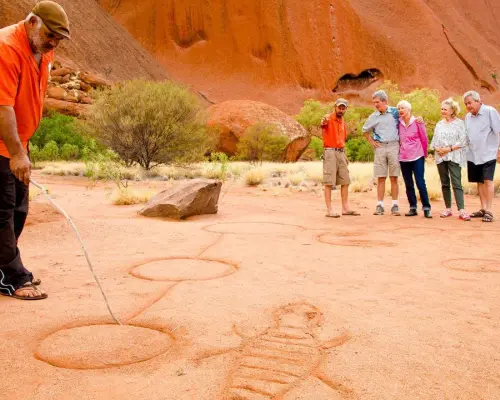
In the intimacy of a small group, join your guide on a 10.5-kilometre walk around the entire base of Uluru. Visit sacred sites, view Aboriginal rock art, and experience a rushing waterfall in the middle of the desert.
- Enjoy a light breakfast — tea, coffee or hot chocolate
- Visit Red Centre Sunrise, Kantju Gorge, and Mutitjulu Waterhole
- Recieve a certificate for your accomplishments
Package Options


Sightseeing Tours
| Departure Time | Early Departure (Before 8 am) |
| Tour types | Guided tour |
| Meal arrangement | Breakfast included |
| Sightseeing type | Natural sights, Hiking |
| Transport | Walking |
Product Info
— What You Can Expect —
Wake up early to embark on a long walk around the entire base of Uluru at sunrise! This UNESCO World Heritage Site is also known as Ayers Rock—as it was named by European explorers in 1873. Before you set off, fuel up on a light breakfast. Admire the gorgeous morning light as you appreciate the beauty of the vast landscape around you. Visit breathtaking historical sites where you can see ancient Aboriginal rock art. Stop off at Kuniya Piti, a place sacred to the Uluru people. Be amazed by a waterfall in the middle of the red desert! Learn about Australia’s Aboriginal culture when you walk around the base of Australia’s most iconic sandstone rock formation! Learn about what makes it sacred to local Aboriginal Anangu people—and if you stick around for the rest of day, you can even see how it magically changes colour from red to deep hues at sunset. Experience the best of the unique Australian Outback at Uluru!
— Important Info —
- All belongings must be carried for the whole duration of the 10.5-km walk; please ensure you bring only what you are capable of carrying
- A moderate level of fitness is required to complete the full base walk
- This experience does not include admission to Kata Tjuta National Park. Passengers are advised to purchase tickets in advance and show them to the driver when boarding the bus. Tickets for Kata Tjuta National Park can be purchased from the National Park website
- Flight information: Flights to depart after 1.15pm (Oct-Mar) and 2.00pm (Apr-Sep) from Ayers Rock airport
- Pick-up is available at the following locations: Sails in the Desert (Front of Hotel), Ayers Rock Campground (Meet at Bus Stop on Main Road), Outback Hotel (Front of Hotel), and Desert Gardens (Front of Hotel). Provisional pick-up information can be viewed here
- Please note that pick-up times and locations are estimates and may vary throughout the year based on operational schedules. Guests must contact AAT Kings at 1300 228 546 48 - 72 hours prior to departure to confirm the final pick-up time and location

Arrive at the base of Uluru at sunrise. Have breakfast and start your journey around the iconic formation
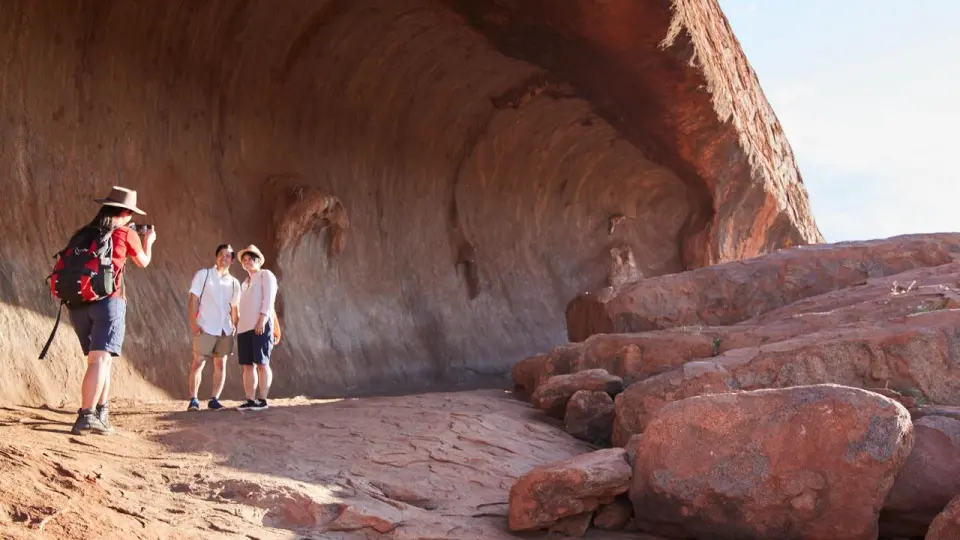
Travel along the Mala Walk as you learn more about the stories and beliefs of the Anangu people. See all the important geographical landmarks

After a short rest, continue along the Lungkata Walk where your guide will tell you the Tjukurpa story of a cheeky Blue Tongued Lizard!

Make your way to the Mutitjulu Waterhole, once an important water source for the Anangu people, before heading back to the starting point
Purchase Notice
– What to bring–
- Enclosed walking shoes
- Warm layers in cooler months
- Water bottle to hold 1.5 litres
- We recommend you dress accordingly
- Sunglasses, sunscreen and hat
- Flynet in summer months (optional)
Reminders
Please arrive at the designated location 10 minute(s) before the scheduled departure time, as the tour will depart on time
Travelers must have a moderate level of fitness to complete the walk around the base of Uluru, as it is quite a distance
Refunds will not be granted to travellers who do not wish to see all the attractions on the itinerary
Inclusions that are not utilised are non-refundable and non-transferable
Travel insurance is highly recommended for all guests covering all applicable dates of travel with the Provider
The tour operator reserves the right to cancel the trip due to unforeseen circumstances
For emergency regarding the trip, please contact +61 29028 5180
Cancellation Policy
- Cancellations 3 day(s) (inclusive) before the selected date are allowed. Unused orders can be canceled for free
- For cancellations made 2 to 2 days prior to selected date, a cancellation fee of 50% will apply
- Cancellation is not allowed between 0–1 days from the selected date. Orders cannot be canceled or modified, and refunds will not be granted.
- Due to time zone differences, the confirmed cancellation date is based on the supplier’s local time. Please allow 2–5 business days to process your cancellation request, after which the cancellation fee will be charged according to the product’s cancellation policy. Once your refund request is confirmed, KKday will initiate the refund to your original payment method within 15 days. The actual refund timing depends on your card-issuing bank’s policy.
FAQ
1. What makes Uluru a significant cultural and natural landmark?
Uluru holds immense spiritual significance for the Anangu Aboriginal people, its traditional custodians, representing their creation stories and ancient law. Naturally, it is a striking sandstone monolith, unique in its geological formation and changing colors with the sun. It's a sacred place of deep cultural heritage and a powerful natural wonder, recognized globally for its ecological and cultural value.
2. Why is climbing Uluru no longer permitted for visitors?
Climbing Uluru was officially prohibited from October 2019 out of respect for the Anangu people, who consider it a sacred site. They requested visitors not to climb due to its spiritual significance and safety concerns. This decision aligns with the wishes of the traditional owners and fosters a deeper respect for Aboriginal culture and land.
3. How long does the Uluru Base Walk typically take to complete?
The full Uluru Base Walk covers approximately 10.5 kilometers and generally takes about 3.5 to 4 hours to complete at a moderate pace. This duration allows ample time to appreciate the sacred sites, view Aboriginal rock art, and observe the changing landscape, especially during a guided experience that includes interpretive stops.
4. What is the difficulty level and terrain of the Uluru Base Walk?
The Uluru Base Walk is considered an easy to moderate walk. The path is mostly flat and well-maintained, consisting of compacted earth and some paved sections, making it accessible for most fitness levels. While generally flat, some areas may have slight undulations. The main challenge often comes from the desert heat and sun exposure, requiring proper hydration and sun protection.
5. What significant cultural and natural sights are included on the Guided Morning Walk Around Uluru?
On a Guided Morning Walk Around Uluru, you will experience several significant sights. These often include visits to sacred sites, opportunities to view ancient Aboriginal rock art, and the chance to witness natural formations like Kantju Gorge and Mutitjulu Waterhole. You may also observe a unique rushing waterfall if conditions allow, along with a Red Centre Sunrise.
6. Is it possible to complete the Uluru Base Walk without a guided tour?
Yes, it is possible to walk the base of Uluru independently. The track is well-marked and easy to follow, allowing visitors to experience the natural beauty at their own pace. However, a guided tour offers invaluable insights into the cultural significance of the sites, traditional stories, and detailed explanations of the rock art from an expert, enhancing the overall understanding and experience.
7. What transportation options are available for getting around Uluru and its surrounding area?
To get around Uluru and the surrounding Uluru-Kata Tjuta National Park, options typically include shuttle services operating from Ayers Rock Resort, which connect to various viewpoints and the Cultural Centre. Rental cars are also available, providing flexibility for self-exploration. Some tours also include transport from the resort directly to the walk starting points.
8. What is the historical reason behind Uluru's dual naming with Ayers Rock?
Uluru is the traditional Aboriginal name for the monolith, used by the Anangu people for millennia. In 1873, it was sighted by European explorer William Gosse and named Ayers Rock after the then Chief Secretary of South Australia, Sir Henry Ayers. The dual naming reflects both its ancient Indigenous heritage and its more recent colonial history, with Uluru being the officially preferred and culturally appropriate name today.


