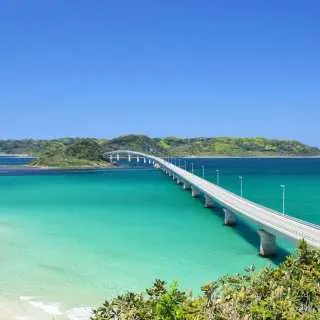
Highly recommended. However, be careful not to choose this tour on Sundays, as explained below. This is a relatively off-the-beaten-path classic tour, as it involves crossing the sea from Fukuoka to Yamaguchi Prefecture, which is quite a distance. I specifically signed up for this tour to see Japan's largest limestone cave. On the day of the tour, we took a minibus, and all the other tourists were foreigners—no, thinking about it, I was a foreigner too! But the company didn't lower the quality of the tour because of the small number of participants; the guide was still quite professional, providing English commentary throughout, and even gave me a Chinese commentary (but since I understand English, I didn't bother the guide and listened to the English commentary with everyone else). You could feel his considerable enthusiasm; he wasn't just guiding because of work, but because he genuinely enjoyed sharing Japanese scenery with us: On the way there, the bus stopped at the Kanmon Bridge rest stop, and the guide reminded us to go up to the observation deck to take pictures of the Kanmon Bridge after using the restroom. Upon arriving at Qiufang Cave, I was treated to a discount on admission tickets because I am a resident of Tainan. I simply told the ticket seller we were from Tainan, and they quickly checked our ID cards (Tainan and Meimi City, where Qiufang Cave is located, have a tourism reciprocity agreement since 2025; thank you Mayor Wei-che). We entered Qiufang Cave from the back entrance (Heigu Gate) and exited from the main entrance, saving us half the time by avoiding back and forth. Due to the language barrier, I helped a woman from Corsica climb to the Qiuji Terrace to view the karst topography from the surface (our tickets allow re-entry back into Qiufang Cave), and then back into the cave to see the stalactites. Therefore, our visit was more comprehensive than other members of our group! An hour and a half was actually quite rushed; a one-way trip inside the cave takes nearly an hour, and climbing Qiuji Terrace takes another half hour. However, the lighting inside the cave was so dim that all the photos I took were ruined. If you want to eat, you can leave half an hour at a shop outside the entrance (Qiufang Cave isn't a popular tourist spot, and the shops were quiet) to try the Tile Bridge Buckwheat Noodles. The afternoon itinerary included a visit to Motonosumi Shrine, located in the northernmost part of Yamaguchi Prefecture. Surprisingly, the shrine was closed on Sunday! It was the first time I'd known a shrine could close. Perhaps Motonosumi's location is somewhat dangerous, directly exposed to the strong waves and winds of the Sea of Japan. Therefore, if no one is on duty on holidays, the Thousand Torii trail is closed, preventing visitors from going up to worship; tourists can only take photos from the rocks below. The Tsunoshima Ohashi Bridge has a rather unique little beach, but the north wind was very strong and cold. Fortunately, our stay was short, so it was a bonus. I recommend the mixed dried fish and seaweed sold at local shops. On the way back, I asked the tour guide if the company could make a profit, given that there were fewer than ten people on the trip and they had to pay for the car, driver, and guide's salary. The guide honestly said they didn't, at best breaking even. Operating a business at such a less popular spot is difficult, but the guide didn't slack off and still provided a very responsible tour. On the way back, at the Kanmon Ohashi Bridge rest stop, he even treated us to fried pufferfish (lots of bones XD).
Anonymous User
Solo traveler
Tsunoshima Island Weather, Climate and Best Time to Visit
Data source:Meteostat Update date:2025-09
Tsunoshima Island year round climate
Spring (March–May): Average 10.8–19.1°C, mild climate but with relatively high rainfall, especially in April. Common activities: Spring outings, seaside walks. Recommended clothing: Light jacket, long-sleeved shirt, comfortable shoes.
Summer (June–August): Average 23.2–29.0°C, hot and humid, with the most rainfall in July. Common activities: Swimming, surfing, water sports. Recommended clothing: Light and breathable clothing, sun hat, sunscreen.
Autumn (September–November): Average 19.4–26.1°C, comfortable and pleasant climate, with decreasing rainfall. Common activities: Autumn foliage viewing (if applicable), seaside walks, outdoor activities. Recommended clothing: Light jacket, long-sleeved shirt.
Winter (December–February): Average 6.1–8.0°C, cold and dry, with the least rainfall. Common activities: Bird watching, indoor activities. Recommended clothing: Warm jacket, hat, scarf, gloves.
Tsunoshima Island climatological average
Annual average temperature: approx. 17.2°C / Annual rainfall: approx. 1688 mm / Summer humidity: 70%–80% / Rainiest month: July
Tsunoshima Island monthly average temperature and precipitation
Month
Air temperature (°C)
Precipitation (mm)
January
6.1°C
62.7
February
6.8°C
85
March
10.8°C
131.1
April
15.6°C
169.2
May
19.1°C
187.2
June
23.2°C
242.4
July
27.5°C
253.6
August
29°C
138.4
September
26.1°C
192.3
October
19.4°C
85
November
14.5°C
89.7
December
8°C
52
Tsunoshima Island weather for the next seven days
6/7
Sunday
Heavy rain
20.6°C/18.8°C
6/8
Monday
Patchy rain nearby
22.9°C/16.8°C
6/9
Tuesday
Partly Cloudy
24.6°C/15.8°C
6/10
Wednesday
Sunny
25.2°C/15.5°C
6/11
Thursday
Sunny
24.5°C/15.1°C
6/12
Friday
Sunny
24.8°C/15.9°C
6/13
Saturday
Sunny
26°C/15.4°C
KKday App
Your Best Travel Buddy
Use the code APP5OFF to enjoy an exclusive in-app deal of 5% off (cap at USD$3) on your 1st orderScan here to download the app