




Package Options


Product Info
Purchase Notice
Reminders
Please refer to your voucher for final information regarding meeting points, pick-up locations, and pick-up time
Meeting point description: Meet your guide at the side entrance of Bremen Town Hall (opposite the cathedral, next to the statue with the knight on the horse, small door to the left of the display case). Your guide will wear a name tag. Please be at the meeting point at least 5 minutes before the start of the tour. After that, entry is no longer possible.(Am Markt 21, 28195 Bremen, Germany)
Not allowed:Smoking, eating, and drinking are not permitted during the tour
Backpacks, shopping bags, umbrellas, water bottles, and wet jackets/coats are not permitted. These must be left in the cloakroom in the entrance area during the tour (no liability)
Know in advance:Guests may only walk through town hall accompanied by the guide
There are no public restrooms and seats in town hall
Please be at the meeting point at least 5 minutes before the start of the tour. After that, entry is no longer possible
To avoid delays, wheelchair users should register at the Tourist Information Office before the tour so that the guide can be informed in advance. Access for wheelchair users is only possible via a detour.
Due to the way events are scheduled in the town hall, tour dates are only released for booking around one month in advance. The town hall is closed to visitors during official receptions, council sessions and other events
FAQ
1. When was Bremen Town Hall built?
Bremen Town Hall was originally constructed between 1405 and 1410 in the Gothic architectural style. Its most distinctive feature, the ornate Renaissance façade, was a later addition, built between 1609 and 1612. This blend of styles reflects the city's rich history and architectural evolution over centuries.
2. What architectural style characterizes Bremen's Town Hall?
Bremen's Town Hall uniquely blends two prominent architectural styles. The older, foundational structure, including parts of its interior, is Gothic, dating back to the early 15th century. However, its iconic front façade, overlooking the Market Square, was redesigned and completed in the ornate Weser Renaissance style in the early 17th century, featuring elaborate gables, bay windows, and detailed sculptures.
3. What is the historical significance of Bremen's Town Hall?
Bremen's Town Hall holds deep historical significance as a enduring symbol of the city's civic autonomy, independence, and prosperity during the Hanseatic League era. For over 600 years, it has served as the seat of the city's council and government, representing its commitment to self-governance and its status as a free city. Its long history is closely intertwined with Bremen's identity.
4. Why is Bremen's Town Hall a UNESCO World Heritage site?
Bremen's Town Hall, along with the adjacent Roland statue, was designated a UNESCO World Heritage site for its exceptional universal value. It stands as an outstanding example of civil architecture that embodies civic autonomy and market freedom from the Holy Roman Empire, uniquely representing the development of civic self-governance and sovereignty in Europe over centuries.
5. How does Bremen's Town Hall reflect the city's distinct identity?
Bremen's Town Hall is central to the city's distinct identity, symbolizing its long and proud history as a free Hanseatic city. Its continuous function as the seat of government for centuries highlights Bremen's independence and enduring spirit. Coupled with the iconic Roland statue, it visually embodies the city's rich mercantile past, its dedication to justice, and its unique cultural heritage.
6. What unique features can be seen inside Bremen's Town Hall during a guided tour?
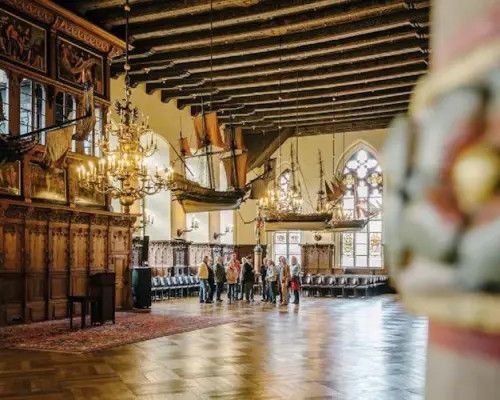
During a guided tour of Bremen's Town Hall, visitors can explore several unique and historically significant features. Highlights typically include the impressive Upper Hall (Große Halle), historically used for grand celebrations and important council meetings, and the lavish Golden Chamber (Güldenkammer), renowned for its intricate Art Nouveau decor. The tour offers insight into the building's intricate details and historical context.
7. What famous landmarks or squares are located near Bremen's Town Hall?
Bremen's Town Hall is prominently situated on the historic Market Square (Marktplatz), one of Germany's most beautiful public spaces. Immediately in front of the Town Hall stands the iconic Bremen Roland statue, also a UNESCO World Heritage site. Other famous landmarks nearby include the majestic St. Peter's Cathedral (St. Petri Dom), the picturesque Böttcherstraße, and the charming Schnoor Quarter, all easily accessible on foot.
8. Is it possible to visit the Ratskeller or other areas within Bremen's Town Hall?
Yes, the historic Ratskeller, one of Germany's oldest public wine cellars, is located beneath Bremen's Town Hall and is accessible to visitors. It is famous for its extensive collection of German wines and offers dining and wine tasting experiences. Access to the upper, ceremonial halls of the Town Hall, such as the Upper Hall and Golden Chamber, is typically available as part of a guided tour.


