




Toledo Day Tour from Madrid: Segovia, Ávila & Toledo | Spain
Discover UNESCO World Heritage cities near Madrid. Led by a professional guide, explore Segovia's Royal Alcazar, Toledo's Cathedral, and Ávila's medieval walls.
- Discover the rich history and diverse cultures of these cities
- Marvel at Segovia's Roman aqueduct, cathedral, and royal Alcazar
- Uncover the secrets of Toledo's Gothic Primada Cathedral and explore Ávila's medieval walls, Convent of Santa Teresa, and more
Package Options


Sightseeing Tours
| Tour Type | Shared tour |
| Transportation method | Transfer from meeting point |
| Departure Time | Early Departure (Before 8 am) |
| Tour types | Guided tour |
| Meal arrangement | Lunch included |
| Sightseeing type | City walking tour, Historic site tour |
| Transport | Bus tour |
Product Info
— What You Can Expect —
Embark on a fascinating journey through three UNESCO World Heritage cities: Toledo, Avila, and Segovia. Toledo, known as the Three Culture City, reflects the historical coexistence of Christians, Jews, and Muslims. Explore its iconic sites and hidden corners, guided by an expert who will unveil the secrets of its magnificent cathedral.
From Toledo, continue to Avila, a city steeped in history. Marvel at its well-preserved walls, which have protected the historic center for centuries. Discover the city's captivating heritage as you stroll through its charming streets.
After savoring a traditional Iberian meal in the Old Town, make your way to Segovia. Admire the grandeur of Plaza Mayor and the impressive Roman Aqueduct. Explore the cathedral and marvel at the majestic Alcázar, an ancient royal palace and fortress. Take advantage of free time to immerse yourself in the city, capturing memorable photos and finding unique souvenirs.
— Important Info —
- Departure time: 8:00 am (Please arrive 15 minutes prior to the departure time)
- Meeting point: Pl. de San Miguel, 7 28005 Madrid (Please refer to the voucher for the actual meeting point)
- Duration: approximately 11.5 hours
Immerse yourself in the grandeur of the Roman Aqueduct!


Step into the breathtaking beauty of Cathedral Primada de Toledo


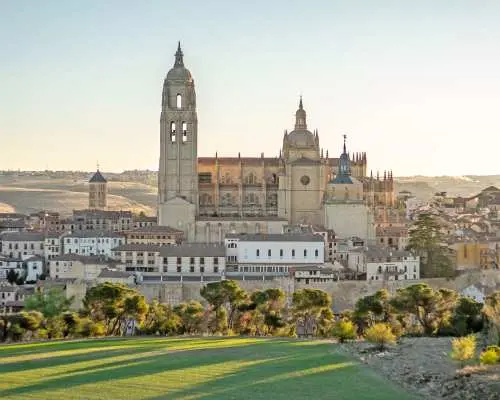
Prepare to be blown away by the stunning beauty of the Cathedral!


Experience the allure of the old royal palace and fortress: Alcázar de Segovia


Purchase Notice
- This tour is not wheelchair accessible and may not be suitable for those with mobility impairment
- The tour is led by a bilingual tour guide
- Please be aware that the itinerary may involve inclined climbs and stairs
- If you have any dietary requirements or allergies, please inform us when booking
- Please note that the tour requires a minimum number of participants. If this minimum is not met, alternative options of equal or higher value, or a full refund will be provided
- Please be sure to check your email again and also log into KKday system to ensure the status of the tour 24 hours before the trip. If there are any changes, a message will be left in the KKday message box or email to notify you of the latest itinerary details in. In the event that you overlook verifying the status due to personal oversight, kindly note that KKday cannot assume responsibility for any associated losses. We appreciate your understanding.
Reminders
Please arrive at the designated location 15 minute(s) before the scheduled departure time, as the tour will depart on time
Kindly note that the tour requires a minimum number of participants. If this minimum is not met, alternative options of equal or higher value, or a full refund will be provided
Cancellation Policy
- Cancellations 4 day(s) (inclusive) before the selected date are allowed. Unused orders can be canceled for free
- Cancellation is not allowed between 0–3 days from the selected date. Orders cannot be canceled or modified, and refunds will not be granted.
- Due to time zone differences, the confirmed cancellation date is based on the supplier’s local time. Please allow 2–5 business days to process your cancellation request, after which the cancellation fee will be charged according to the product’s cancellation policy. Once the cancellation is confirmed, you will receive your refund within 14 working days.
FAQ
Toledo is known as the "City of Three Cultures" for its long history of coexistence between Christian, Muslim, and Jewish communities. Key events include its capture by the Romans, its period as a Visigothic capital, and its vibrant medieval era under Arab rule, which fostered intellectual and artistic exchange. After its reconquest by Christians, it became a major religious and political center, evident in its impressive architecture and rich heritage.
Segovia's Roman Aqueduct is a remarkable feat of ancient engineering, built without mortar. Its most striking feature is the double-tiered arcades, reaching over 28 meters high in its central section. Constructed from massive granite blocks precisely fitted together, it originally transported water over 15 kilometers, showcasing advanced Roman construction techniques and enduring as a symbol of the city.
Yes, visitors can explore the interior of Segovia's Royal Alcazar. This fairy-tale castle, once a royal palace and military academy, features opulent rooms adorned with intricate Mudejar ceilings, stained glass, and historical artifacts. Highlights include the Hall of the Old Palace, the Throne Room, and the Royal Chapel, offering a glimpse into Spain's monarchical past and stunning views from its towers.
Toledo's Gothic Primada Cathedral is a masterpiece of High Gothic architecture, built on the site of a former mosque. Its dominant style is French Gothic, characterized by soaring vaults, stained-glass windows, and intricate tracery. However, it also incorporates Mudejar elements, particularly in its cloisters and chapels, reflecting the city's multicultural history. Notable art includes works by El Greco, Goya, and Velázquez.
Ávila's medieval walls are exceptionally well-preserved, forming a complete circuit around the old town, stretching over 2.5 kilometers with 88 towers and 9 gates. Visitors can walk along significant sections of the ramparts, offering panoramic views of the city and surrounding countryside. Exploring the walls provides a unique perspective on medieval military architecture and the historical defense of Ávila.
The Convent of Santa Teresa is highly significant in Ávila as it stands on the birthplace of Saint Teresa of Ávila, a prominent figure in the Catholic Reformation and a Doctor of the Church. The site, now a convent and museum, preserves relics and commemorates her life and mystical writings. It serves as a pilgrimage site and a testament to her enduring spiritual legacy in Spain.
Toledo uniquely displays the fusion of Christian, Muslim, and Jewish cultures, often called the "City of Three Cultures." This is evident in its diverse architecture, where a synagogue might stand near a mosque-turned-church, and in its artisanal traditions like Damascene work. The winding streets and historic quarters tell a story of centuries of coexistence and cultural exchange, offering a truly unique historical atmosphere.
Segovia is renowned for its Roman heritage, exemplified by its ancient aqueduct, and later for its royal connections, particularly the Alcazar. Ávila is defined by its strong medieval defensive walls and its pivotal role in Christian mysticism. Toledo boasts the longest and most complex history, encompassing Roman, Visigothic, Muslim, and Christian eras, fostering a unique blend of cultures visible in its art and architecture.
Get Help


