




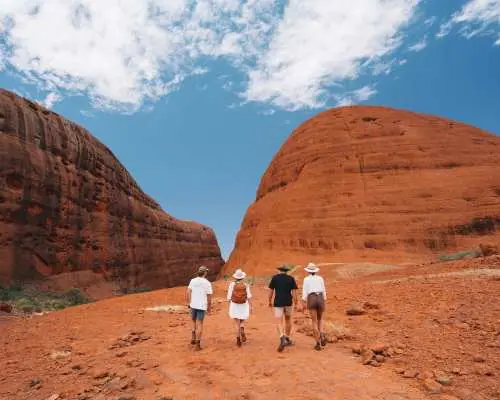
3-Day Uluru & Red Centre Safari Tour in the Northern Territory | Australia
Explore the Red Centre showcasing Uluru, Kata Tjuta, and Kings Canyon on this multi-day tour departing from either Alice Springs or Ayers Rock Airport.
Sightseeing Tours
| Tour Type | Shared tour |
| Transportation method | Transfer from meeting point |
| Luggage limit | 1 piece |
| Tour types | Guided tour |
| Meal arrangement | Arrange yourself |
| Room type | Double room |
| Sightseeing type | Natural sights, Eco-tourism, Nordic walking |
| Transport | Walking, Bus tour |
Product Info
Purchase Notice
- Children aged between 8 to 17 years old must be accompanied by an adult or legal guardian at all times and must stay in private twin rooms. This tour is not suitable for infants or children age 7 and below
- This tour is not suitable for mobility-impaired travellers, wheelchairs, walkers, or strollers
- A minimum moderate to advanced level of fitness is required to complete the walks. The length of walks will be between 2 km to 6 km each day, often over steep rocky sections, and in direct sunlight and high humidity. An approximate 9–11km walk is included in this tour. Embarking on walks will be at the guide’s discretion to ensure the safety of guests. Therefore, a medium/high level of fitness is required and a doctor's certificate is required for people over 70 years (30-days prior to travel)
- There is a limited storage space in our vehicle; please ensure your baggage is kept to 1 x 15 kg travel bag, and 1 x 5 kg day-bag
- What to bring:
- 2–3L refillable water bottle
- wide-brimmed hat
- sunglasses, sunscreen, and beach towel
- toiletries
- bathers or swimwear
- comfortable and sturdy hiking shoes (closed shoes)
- all-weather clothing (extreme conditions day/night)
- camera, flashlight, headlamp, or torch
- tropical strength insect repellent, mosquito, or fly net (suitable for summer months)
- 15 kg overnight bag and 1 small day-pack
- your own sleeping bag and pillow
- recharged power bank (limited access to power to charge phones or cameras)
- money for snacks and meals
- The weather in the Red Centre can fluctuate and be extreme. It is not unheard of for temperatures to reach over 50+ degrees Celsius in the dry season and drop dramatically in the evening. Please ensure you have checked the average temperatures for the time of year you are travelling and have packed adequate clothing. In the event of rain or inclement weather, your experience will still go ahead, unless contacted by the provider
- Autopia Tours reserves the right to alter the route or itinerary schedule during seasonal weather fluctuations and/or during park closures due to traditional landowner ceremonies
Reminders
Please arrive at the designated location 10 minute(s) before the scheduled departure time, as the tour will depart on time
Cancellation Policy
- Cancellations 33 day(s) (inclusive) before the selected date are allowed. Unused orders can be canceled for free
- Cancellation is not allowed between 0–32 days from the selected date. Orders cannot be canceled or modified, and refunds will not be granted.
- Due to time zone differences, the confirmed cancellation date is based on the supplier’s local time. Please allow 2–5 business days to process your cancellation request, after which the cancellation fee will be charged according to the product’s cancellation policy. Once the cancellation is confirmed, you will receive your refund within 14 working days.
FAQ
Uluru, also known as Ayers Rock, is an iconic sandstone monolith in Australia's Red Centre, celebrated for its striking red hues that dramatically change with the sun. It holds immense spiritual and cultural significance for the Anangu Aboriginal people, who are its traditional custodians. Visitors can experience its unique geological formation, learn about ancient Aboriginal rock art sites, and hear dreamtime stories that connect the land to its people.
Climbing Uluru has been permanently closed since October 26, 2019. This decision was made out of respect for the Anangu traditional owners, who consider Uluru a sacred place and prefer visitors not to climb it. The Anangu have always requested that guests choose to walk around the base of the rock instead, which aligns with their cultural beliefs and reduces safety and environmental impacts.
Uluru is the traditional Pitjantjatjara name for the monolith, deeply embedded in Anangu culture and spiritual beliefs. The name 'Ayers Rock' was given by explorer William Gosse in 1873. The dual naming of Uluru / Ayers Rock was in place for many years, but the full reversion to Uluru acknowledges and respects the site's profound Indigenous heritage and the wishes of its traditional custodians.
While Uluru is not officially listed as one of the 'Seven Natural Wonders of the World', it is undeniably a global natural and cultural icon. It is a UNESCO World Heritage site, recognized for both its outstanding geological features and its significant living cultural landscape. Its unique geology as an inselberg, breathtaking colour changes, and profound spiritual importance to the Anangu people make it incredibly special and a natural wonder in its own right.
Exploring Uluru and Kata Tjuta National Park typically involves guided tours, self-driving with a rental car, or utilizing shuttle services available from Ayers Rock Resort. Guided tours often include transport to key viewing areas and walking trails. Rental cars offer flexibility, allowing visitors to follow designated routes within the park. Park entry fees apply regardless of the transportation method.
Due to its remote location and limited population, ride-sharing services such as Uber are generally not available within the Uluru (Ayers Rock Resort) region. Visitors typically rely on pre-booked airport transfers, hotel shuttles, or dedicated tour operators for transportation needs between the airport, resort accommodations, and attractions within Uluru-Kata Tjuta National Park.
Yes, Ayers Rock Resort offers an internal shuttle bus that connects all major points within the resort, including hotels, the visitor centre, and the airport. For accessing attractions within Uluru-Kata Tjuta National Park, guests can often book dedicated shuttle services or join organized tours departing directly from the resort, providing convenient access to Uluru sunset/sunrise viewing areas and Kata Tjuta walks.
Yes, there is a dedicated 'Uluru Hop-on Hop-off' bus service that operates within Uluru-Kata Tjuta National Park. This service allows visitors to explore the park's key sites, including the Uluru base walk and various viewing platforms, at their own pace. Tickets for this service must be purchased in advance, and it provides a flexible option for independent exploration without needing a private vehicle.
Get Help


