
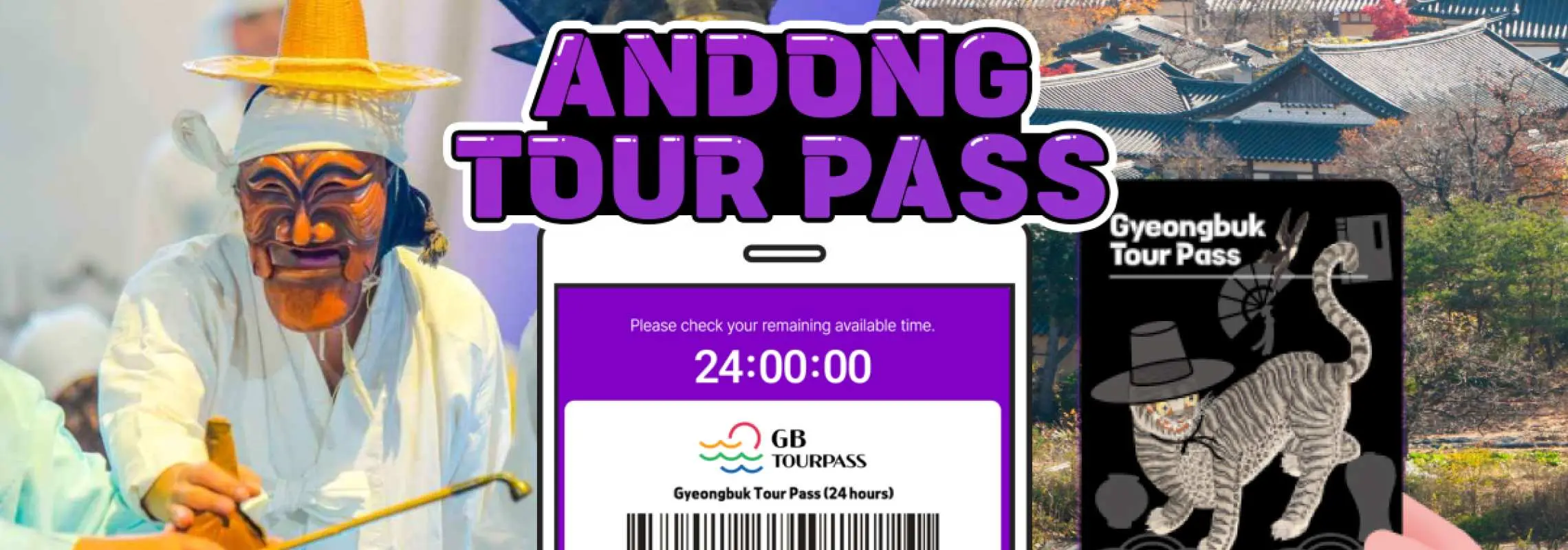
Gyeongbuk Tour Pass: Andong Tour Pass 24-Hour Ticket
This is a tourist pass that allows you to enter popular tourist attractions in Andong with one ticket. Book now at KKday.
Product Info
The content of this product is provided by machine translation and may not reflect the actual information, please take this into consideration before booking.


Purchase Notice
⚠️Things to keep in mind before purchasing
- When purchasing tickets, please refer to the adult/child basis.
Child criteria: ~Under 19 years of age
(Free admission standards vary by facility, so please inquire with each facility.)
- Tour pass usage criteria
- The first use time of the tour pass can be used at one-hour intervals for each facility, equal to the option time purchased as a local group.
- Please purchase only one ticket per person according to ticket type standards.
-For group tickets of 2 or more people, partial use is not possible.
-For detailed information, such as operating hours, closing days, and precautions for all affiliated stores, please check the website or by phone before visiting.
-This product must be purchased 1 hour prior to your visit.
-Please note that on-site waiting times may occur if you purchase just before your visit.
- Refunds are possible if the pass is not used after purchase. Refunds are not possible if the pass is used to enter even one place.
- One pass cannot be used multiple times within the usage time.
- Refund Policy
-Refund policies for unused tickets vary depending on the channel you purchased, so please contact customer service.
-Deduction verification is not possible even if some people do not use the tourist attraction, so if you purchase the wrong number of people, please get a refund and repurchase.
If you do not receive your mobile ticket, please contact customer service. (070-4263-7790)
⚠️Andong Tour Pass Notice
- Available travel destinations may change in real time, so please check the ‘Available travel destinations’, ‘Free facilities’, or ‘Special discount affiliated stores’ on your mobile ticket before using.
Changes will not be announced through separate text messages. - It may take up to 30 minutes to receive the barcode, and message reception time may vary depending on the data transmission status.
If the message is not received even after 30 minutes, please contact customer service by phone (070-4263-7790). - Please note that the expiration date specified on the product page is the expiration date of the ticket itself, so even if there is usage time remaining after the first use time, if the ticket itself has expired, it cannot be used.
- You can freely use each facility at one-hour intervals.
How to Use
- buy tickets
Ticket payment completed (confirm contact information) - Receive mobile tickets
Sent via text or KakaoTalk (different depending on purchase channel) - Use
Present mobile ticket at tourist attractions and coupon redemption locations
⛔️ If you do not receive your mobile ticket, please contact customer service (070-4263-7790)
Validity Period
- Valid for use before 2026-06-08; Invalid after expiration
Cancellation Policy
- Free cancellation is available for unused vouchers
- Due to time zone differences, the confirmed cancellation date is based on the supplier’s local time. Please allow 2–5 business days to process your cancellation request, after which the cancellation fee will be charged according to the product’s cancellation policy. Once the cancellation is confirmed, you will receive your refund within 14 working days.
FAQ
Andong is a treasure trove of Korean cultural heritage, renowned for its traditional villages, Confucian academies, and unique cuisine. Must-visit sites include Andong Hahoe Folk Village, a UNESCO World Heritage site showcasing traditional Korean architecture and customs, and Byeongsanseowon Confucian Academy, another beautiful UNESCO site. Visitors can also explore Dosanseowon Confucian Academy and the Mask Dance Festival Hall to gain deep insights into Korea's rich history and traditional lifestyle.
Traveling from Seoul to Andong typically takes about 2 to 2.5 hours by KTX high-speed train, departing from Cheongnyangni Station to Andong Station. Alternatively, intercity buses are available from Seoul's Dongseoul Bus Terminal or Gangnam Central City Bus Terminal, with a journey duration of approximately 3 hours, depending on traffic conditions. The KTX is generally the fastest and most efficient option for this route.
To reach Andong Hahoe Folk Village from central Andong, you can take a local city bus. Bus No. 246 operates frequently from Andong Station or the Andong Terminal directly to the village, with a journey taking approximately 40-50 minutes. Taxis are also readily available, offering a more direct and faster option, reaching the village in about 20-30 minutes, though at a higher cost.
To fully appreciate Andong's main attractions and effectively utilize the Andong Tour Pass, a visit of at least 2 days is recommended. This allows ample time to explore the vast Andong Hahoe Folk Village, visit one or two Confucian academies like Byeongsanseowon or Dosanseowon, and experience the city center, including Wolyeonggyo Bridge. A longer stay, such as 3 days, would allow for a more relaxed pace and deeper exploration of additional cultural sites or local culinary experiences.
The Andong Tour Pass simplifies entry to popular sites such as Andong Hahoe Folk Village and Byeongsanseowon Confucian Academy by offering a single ticket for multiple attractions. This enhances convenience, saving you time at individual ticket counters and streamlining your sightseeing experience. You can easily purchase the Andong Tour Pass through KKday, ensuring a smooth booking process and immediate access to your e-ticket, allowing you to plan your itinerary efficiently and focus on enjoying Andong's heritage.
From Incheon International Airport (ICN) to Andong, the most convenient method involves a transfer. First, take the Airport Railroad Express (AREX) to Seoul Station. From there, transfer to the KTX high-speed train at Cheongnyangni Station, connecting to a KTX bound for Andong Station. Alternatively, you can take an airport bus from Incheon Airport to major bus terminals in Seoul, then transfer to an intercity bus to Andong. The total journey can take 3.5 to 4.5 hours, depending on connections.
For exploring Andong's various attractions, local city buses are a convenient and cost-effective option. Key routes connect Andong Station, Andong Terminal, and major tourist sites like Andong Hahoe Folk Village and Dosanseowon Confucian Academy. Taxis are also widely available for direct travel, especially to sites less accessible by bus. Renting a car offers the most flexibility for those who prefer to explore at their own pace, particularly for destinations slightly further afield.
Andong offers unique historical and natural sites beyond the well-known villages. Wolyeonggyo Bridge, the longest wooden bridge in Korea, provides beautiful night views and a romantic atmosphere. Bongjeongsa Temple, a UNESCO World Heritage site, is one of Korea's oldest wooden temples, offering a serene spiritual experience. Additionally, the Andong Folk Village and Confucian Land provide immersive historical insights into traditional Korean life and Confucian culture, offering diverse perspectives on Andong's rich heritage.
Get Help


