


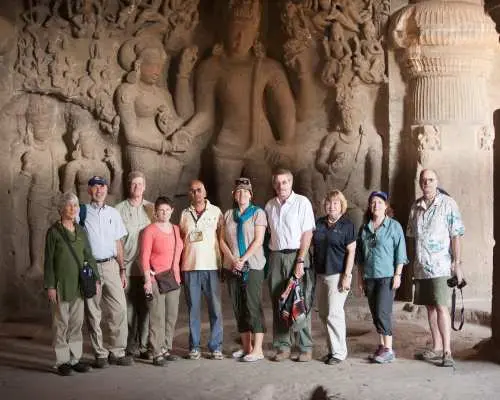

Most Popular 2 - Days Tour of Ajanta & Ellora Caves from Aurangabad
- Explore the UNESCO World Heritage Sites of Ajanta Caves and Ellora Caves with a private guided tour.
- Discover ancient Buddhist cave monasteries, murals and fresco paintings at Ajanta Caves.
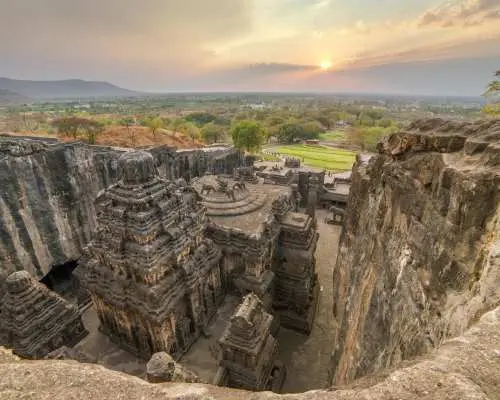
- Visit the world-famous Kailasa Temple, one of the largest monolithic rock-cut temples in the world.
- Learn about India’s ancient history, architecture and religious heritage through expert local guidance.
- Travel comfortably in a private air-conditioned vehicle with hotel pickup and drop-off from Aurangabad.
- Experience the artistic brilliance of Buddhist, Hindu and Jain cave architecture dating back centuries.
Product Info
FAQ
1. How can visitors reach Ajanta and Ellora Caves from Aurangabad?
Aurangabad serves as the primary base for visiting both sites. Ajanta Caves are approximately 100 kilometers northeast of Aurangabad, while Ellora Caves are about 30 kilometers northwest. The most convenient way to reach them is by private air-conditioned vehicle, which is often included in tours for comfortable hotel pickup and drop-off from Aurangabad, ensuring a hassle-free journey.
2. What is the recommended duration to thoroughly explore both Ajanta and Ellora Caves?
To fully appreciate the extensive rock-cut architecture, detailed carvings, and frescoes at both Ajanta and Ellora Caves, a two-day itinerary is highly recommended. This allows for ample time at each site: dedicating one full day to the Ajanta Caves to explore its ancient Buddhist monasteries, and another full day for Ellora Caves to delve into its Buddhist, Hindu, and Jain cave complexes, including the magnificent Kailasa Temple.
3. What unique artistic and historical features can be found at the Ajanta Caves?
The Ajanta Caves are renowned for their ancient Buddhist rock-cut cave monasteries and vibrant fresco paintings. These murals, dating from the 2nd century BCE to about 480 CE, depict the life of Buddha and Jataka tales, offering a rare glimpse into early Buddhist art and religious thought. The intricate details and expressive forms make them a unique archaeological treasure.
4. What are the key differences between Ajanta Caves and Ellora Caves that visitors should consider?
Ajanta Caves are exclusively Buddhist and famous for their exquisite wall paintings and sculptures depicting ancient life. Ellora Caves, on the other hand, showcase a unique blend of Buddhist, Hindu, and Jain monuments carved side-by-side, reflecting religious harmony. Ellora is also home to the monumental Kailasa Temple, a single monolithic structure carved from top down, which is a major architectural highlight distinguishing it from Ajanta.
5. What makes the Kailasa Temple at Ellora Caves a significant highlight?
The Kailasa Temple (Cave 16) at Ellora Caves is a colossal, monolithic structure entirely carved out of a single rock. It's dedicated to Lord Shiva and represents Mount Kailash, his abode. Its sheer scale, intricate carvings, and architectural precision, having been excavated vertically downwards, make it one of the most astonishing rock-cut temples in the world and a marvel of ancient Indian engineering and artistry.
6. What types of religious art and architecture are primarily featured at Ellora Caves?
Ellora Caves are unique for featuring a harmonious co-existence of Buddhist, Hindu, and Jain rock-cut architecture. The site comprises 12 Buddhist caves (Caves 1-12), 17 Hindu caves (Caves 13-29), and 5 Jain caves (Caves 30-34). This diversity offers a comprehensive overview of India's ancient religious heritage, allowing visitors to explore different spiritual traditions within one complex.
7. What kind of guidance is provided during a tour of Ajanta and Ellora Caves?
A comprehensive tour of Ajanta and Ellora Caves typically includes expert local guidance. This ensures visitors gain deep insights into India’s ancient history, the architectural styles, and the religious heritage represented by the Buddhist, Hindu, and Jain cave complexes. The expert will provide context and detailed explanations of the murals, carvings, and structures, enhancing the understanding and appreciation of these UNESCO World Heritage Sites.
8. Are there any specific shopping opportunities or local crafts available near Ellora Caves?
Near the Ellora Caves, visitors can find local vendors selling souvenirs, religious artifacts, and traditional handicrafts. Popular items include replicas of the cave sculptures, paintings, and stone carvings inspired by the region's rich heritage. It's an opportunity to acquire unique keepsakes that reflect the artistic and cultural essence of the area.


