
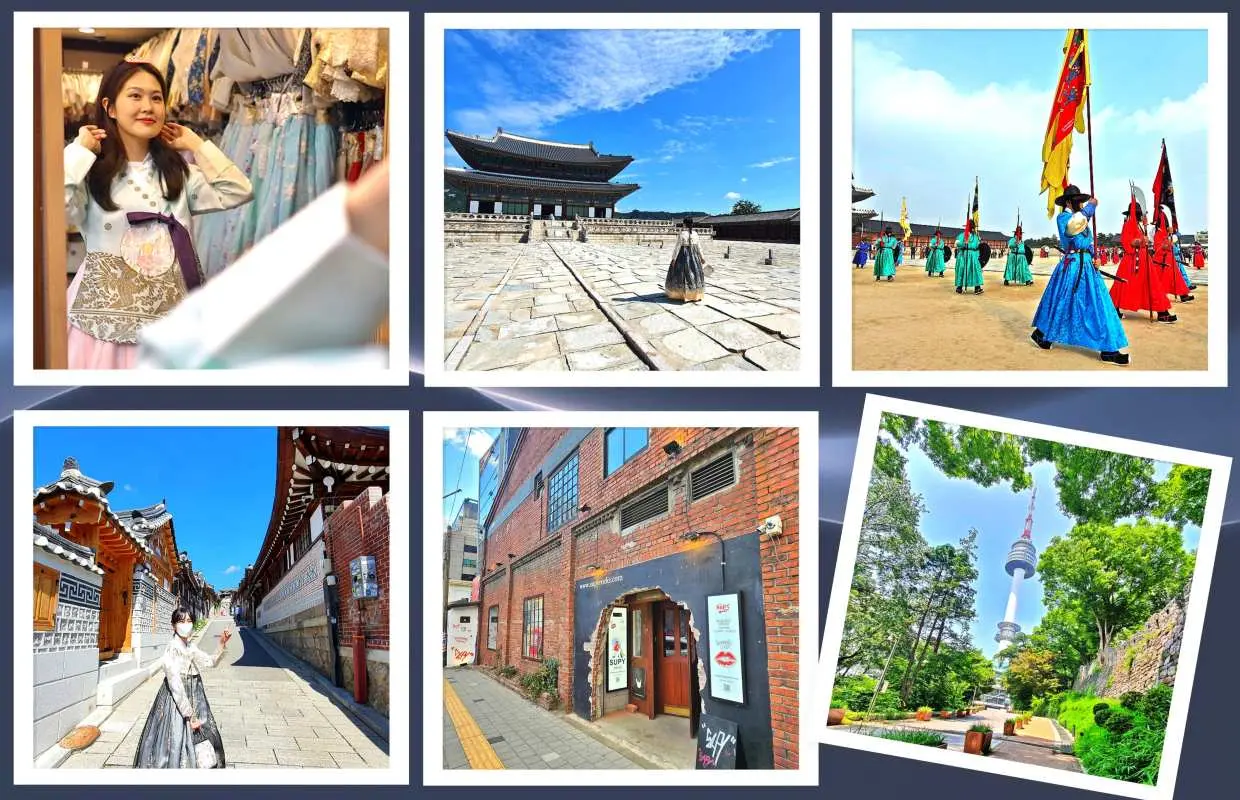


[Japanese Guide] Photogenic Sightseeing Tour: Stroll in a Hanbok! Gyeongbokgung Palace + Royal Guard Changing Ceremony + Bukchon + Seongsu-dong + N Seoul Tower Octagonal Pavilion <Morning/Full-Day>
- Experience the 'past and present' of Seoul in one day, from the traditional Gyeongbokgung Palace to the trendiest art spot, Seongsu-dong!
- Enjoy a fulfilling trip with a Hanbok experience, vibrant market street food, and the romantic panoramic view from N Seoul Tower!
Package options


Product Info
Purchase Notice
- *This tour will be conducted as a shared tour with other customers.
- Please be sure to arrive on time. The tour will depart 10 minutes after the scheduled departure time, and if you are unable to board, you will not be able to join the tour midway or receive a refund.
- Tour schedules may be changed or canceled due to weather, traffic conditions, etc.
- For group tours, if there are three or fewer participants, we may provide transportation by taxi.
- Due to traffic conditions, there may be slight variations in the travel time.
- We assume no responsibility whatsoever for accidents caused by natural disasters or other causes not provided on this tour.
- Please note that the tour lounge on the 2nd floor of the Lotte Hotel in Myeongdong, which is the meeting point, is not affiliated with the tour operator. Therefore, please refrain from contacting or calling the tour lounge.
- Children under 10 years old may not be able to try on a hanbok (traditional Korean dress). (However, it may be possible if a suitable size is available).
- Even if you decide not to participate in the hanbok try-on experience due to personal reasons, the fee for the hanbok try-on experience will not be refunded.
- At N Seoul Tower, you will only be able to visit the octagonal pavilion; you will not be admitted to the tower itself.
Reminders
A minimum of 2 traveler(s) are required for the tour to depart. If the number of participants does not reach the minimum requirement, the tour will be canceled. An email regarding tour cancellation will be sent 1 day(s) before the departure date
Please arrive at the designated location 10 minute(s) before the scheduled departure time, as the tour will depart on time
FAQs
1. What makes Gyeongbokgung Palace a significant historical site?
Gyeongbokgung Palace, constructed in 1395, holds profound historical significance as the principal royal palace of the Joseon Dynasty. It served as the heart of Korean sovereignty and culture for over 500 years. Its grand architecture, including notable structures like Geunjeongjeon Hall and Gyeonghoeru Pavilion, showcases traditional Korean palace design and reflects its central role in the nation's political and cultural life.
2. Has Gyeongbokgung Palace undergone significant restoration or reconstruction throughout its history?
Yes, Gyeongbokgung Palace has experienced several periods of extensive damage and subsequent restoration. It was largely destroyed during the Imjin War (Japanese invasions) in the late 16th century and later rebuilt. In the early 20th century, many of its buildings were again dismantled. Comprehensive restoration projects have been actively underway since the 1990s, aiming to meticulously restore the palace complex to its former glory and historical authenticity.
3. Are there any admission fees for foreign visitors at Gyeongbokgung Palace?
Yes, foreign visitors are generally required to purchase an admission ticket to enter Gyeongbokgung Palace. Tickets can be purchased directly at the palace's ticket booths located at the main entrance. For a more convenient and often more comprehensive experience, you can also pre-purchase your admission as part of a tour package through KKday, which offers the advantage of streamlined entry and often includes additional services like guided tours, enhancing your visit without hassle.
4. How much time is typically needed to explore Gyeongbokgung Palace?
To fully appreciate Gyeongbokgung Palace and its key attractions, including the main halls, courtyards, and the National Folk Museum of Korea (located within the palace grounds), most visitors typically allocate about 2 to 3 hours. This duration allows for a leisurely pace, ample time for photography, and the opportunity to witness the Changing of the Royal Guard Ceremony if your visit aligns with its schedule.
5. Which subway station exit is closest to Gyeongbokgung Palace?
The most convenient subway station for Gyeongbokgung Palace is Gyeongbokgung Station (경복궁역) on Seoul Subway Line 3 (Orange Line). The closest exit to the main entrance of the palace is Exit 5. Another nearby option is Anguk Station (안국역) on Line 3, which is particularly suitable if you plan to visit the eastern side of the palace or head towards Bukchon Hanok Village.
6. What are the best transportation options to reach Gyeongbokgung Palace from Myeongdong?
From Myeongdong, the most efficient way to reach Gyeongbokgung Palace is by subway. You can take Seoul Subway Line 4 (Light Blue Line) from Myeongdong Station towards Danggogae. At Chungmuro Station, transfer to Line 3 (Orange Line) towards Daehwa, and alight at Gyeongbokgung Station. Use Exit 5 for direct access to the palace. The estimated travel time for this route is approximately 15-20 minutes.
7. How long does it take to travel from Gyeongbokgung Palace to Gwangjang Market?
Traveling from Gyeongbokgung Palace to Gwangjang Market by subway is straightforward and quick, typically taking around 10-15 minutes. From Gyeongbokgung Station (Line 3), take the subway one stop to Jongno 3(sam)-ga Station. At Jongno 3(sam)-ga, transfer to Line 5 (Purple Line) and travel one stop to Euljiro 4(sa)-ga Station. Gwangjang Market is just a short walk from this station.
8. Can visitors rent traditional Korean hanbok for the Gyeongbokgung Palace experience?
Yes, many visitors choose to rent traditional Korean hanbok (traditional attire) to wear while exploring Gyeongbokgung Palace. There are numerous hanbok rental shops conveniently located in the vicinity of the palace, particularly around Anguk Station and the Insadong area. Wearing a hanbok not only enriches your cultural immersion but also provides the benefit of free admission to Gyeongbokgung Palace and several other major palaces in Seoul.


