

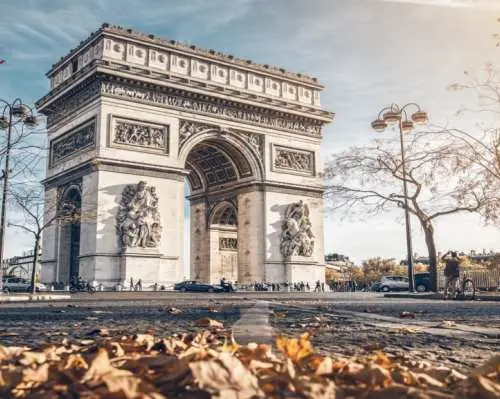


Explore France | Paris & Caen & Rennes & Amboise & Limoges & Rocamadour & Bordeaux & Lourdes & Marseille & Lyon & Dijon 15 days and 14 nights | Depart from Paris | Chinese tour guide
- Take a comfortable car and travel easily without worrying about traffic problems
- Professional Chinese tour guide to take you to learn more about France
- The itinerary visits many popular attractions, so allow enough time to carefully appreciate the beautiful scenery.
Package Options


Sightseeing Tours
| Tour Type | Shared tour |
| Transportation method | Transfer from meeting point |
| Tour types | Guided tour |
| Accommodation type | Hotel |
| Room type | Double room, Triple room |
| Additional service & facility | Transfer included |
| Sightseeing type | City walking tour, Historic site tour, Bus tour |
| Transport | Bus tour |
Important Info
Reminders
Each adult can only bring one child (for example, when one adult brings 2 children, he needs to book 2 adults + 1 child)
Each passenger can carry up to one 30kg suitcase. If your itinerary includes train travel, usually the train company requires that the weight of the luggage does not exceed 20 kilograms and the sum of the length, width and height is no more than 250 centimeters. The transportation fees due to overweight/oversized luggage will be paid directly by you. Train company (different train companies have different policies, please contact customer service for secondary verification).
On the first day of the trip, please read carefully the Europamundo information board posted in the hotel lobby. There will be itineraries to different destinations in the information board. Please read carefully and find the departure time of your trip tomorrow and the name of the tour guide. We will contact you via WeChat or WhatsApp before the trip starts.
Supplier emergency contact information: Office: 0034917589200 Emergency 24 hour.0034609007313 Whatsapp EMERGENCIES (Chat Only): 0034616841984
Cancellation Policy
- Cancellations 31 day(s) (inclusive) before the selected date are allowed. Unused orders can be canceled for free
- For cancellations made 21 to 30 days prior to selected date, a cancellation fee of 10% will apply
- For cancellations made 11 to 20 days prior to selected date, a cancellation fee of 20% will apply
- For cancellations made 5 to 10 days prior to selected date, a cancellation fee of 30% will apply
- For cancellations made 3 to 4 days prior to selected date, a cancellation fee of 50% will apply
- Cancellation is not allowed between 0–2 days from the selected date. Orders cannot be canceled or modified, and refunds will not be granted.
- Due to time zone differences, the confirmed cancellation date is based on the supplier’s local time. Please allow 2–5 business days to process your cancellation request, after which the cancellation fee will be charged according to the product’s cancellation policy. Once your refund request is confirmed, KKday will initiate the refund to your original payment method within 15 days. The actual refund timing depends on your card-issuing bank’s policy.
FAQ
1. What are some common local slang words or expressions one might hear when visiting Paris?
When exploring Paris, you might encounter local expressions that enrich your experience. For instance, "C'est la vie" (That's life) is a classic philosophical shrug. Locals often use "Apéro" to refer to pre-dinner drinks and snacks, a popular social ritual. You might also hear "Boulot" for work, or "Pot de départ" for a farewell party. These terms offer a glimpse into the relaxed yet structured rhythm of Parisian daily life.
2. What iconic quotes or cultural references are famously associated with Paris, often highlighted during visits?
Paris is rich in iconic quotes and cultural references that capture its essence. Phrases like "Paris is always a good idea" (Audrey Hepburn) and "The City of Lights" highlight its enduring allure and vibrant atmosphere. Culturally, references often include its status as a global center for art, fashion, and romance, with landmarks like the Eiffel Tower and Louvre Museum embodying these ideals.
3. How is the unique city identity of Paris typically described, and what terminology defines its character for travelers?
Paris's unique identity is often described through terms that evoke its distinct character. It's known as "La Ville Lumière" (The City of Lights) for its intellectual and artistic brilliance, alongside its literal illumination. "Paname" is a popular, informal nickname. Its character is defined by its elegant architecture, café culture, artistic heritage, and a certain je ne sais quoi that captivates visitors.
4. What does the concept of the 'Paris effect' entail, and how might it influence a visitor's experience in Paris?
The 'Paris effect' often refers to the romanticized image of Paris that shapes visitors' expectations, encompassing its elegance, charm, and cultural sophistication. This influence can lead travelers to seek out quintessential Parisian experiences, from strolling along the Seine to enjoying classic French cuisine. It shapes a visitor's perception, creating a desire to immerse themselves in the city's iconic atmosphere and lifestyle.
5. What is the origin and linguistic meaning of the city name 'Caen' in Normandy, France?
The city name 'Caen' originates from ancient Celtic words. It is believed to derive from "cato" meaning battle or combat, and "magos" meaning field or plain. Over time, these combined into a name suggesting a "battlefield" or "plain of combat." This etymology reflects the region's historical significance, including various conflicts throughout the centuries.
6. Is there a direct English translation or common linguistic interpretation for the French name 'Caen'?
While 'Caen' does not have a direct, single-word English translation, its linguistic interpretation points to its ancient origins. Based on Celtic roots, it's generally understood to signify a "battlefield" or "plain of combat." This interpretation comes from the historical evolution of the name and provides insight into the landscape's past uses rather than a literal translation.
7. What was the historical significance of Caen during World War II, particularly concerning key Allied military operations?
Caen held immense strategic importance during World War II, particularly after the D-Day landings in June 1944. Its location was crucial for controlling routes to Paris. The Battle of Caen became a prolonged and fierce engagement, vital for Allied efforts to break out of the Normandy bridgehead. The city endured extensive damage but its capture was a significant milestone in the liberation of France.
8. What artistic or literary references are commonly associated with Paris's cultural landscape and history?
Paris has profoundly inspired countless artists and writers. It's associated with literary giants like Victor Hugo ("Les Misérables") and Ernest Hemingway ("A Moveable Feast"). Artistically, Paris was the birthplace of Impressionism and home to major art movements, with artists such as Monet, Renoir, Picasso, and Van Gogh drawing inspiration from its streets and vibrant artistic scene. Its museums, like the Louvre and Musée d'Orsay, house vast collections reflecting this rich heritage.


