


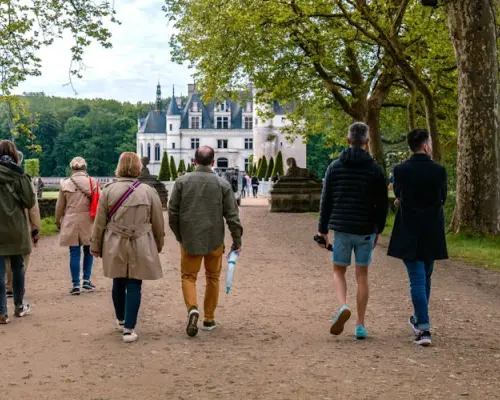


Full Day Tour of Chambord and Chenonceau from Amboise
- Discover two of the best castles of the Loire Valley and learn more about French history with this full day tour.
Package Options


Product Info
Purchase Notice
Reminders
Please refer to your voucher for final information regarding meeting points, pick-up locations, and pick-up time
Meeting point description: Present your voucher to your guide 10 minutes before departure time in front of Amboise Tourist Office.(Office de Tourisme Amboise Val de Loire, Quai du Général de Gaulle, Amboise, France)
Know in advance:It is strictly required to have a ticket in order to access our vans at the beginning of the tour, including children, infants, and pets. In the event of a child, infant or pet not being declared, the tour operator won’t be able to accept any additions on the day of the tour
Please note that for security and legal reasons, our tour is not accessible to children under 4 years old
FAQ
1. What are the unique architectural features of Chambord Castle, particularly its staircase?
Chambord Castle's most celebrated architectural feature is its double-helix staircase, attributed by some to Leonardo da Vinci's designs. This innovative staircase allows two people to ascend and descend simultaneously without ever meeting. Other unique elements include its massive scale, distinctive French Renaissance style with Italian influences, a rooftop littered with intricate chimneys, turrets, and cupolas resembling a miniature city, and symmetrical facades adorned with rich sculptural details.
2. Is visiting Chambord Castle recommended for travelers interested in French history and architecture?
Yes, Chambord Castle is highly recommended for those passionate about French history and architecture. Its sheer grandeur and unique design, particularly the iconic double-helix staircase and its rooftop 'skyline,' offer an unparalleled glimpse into the Renaissance era. Visitors can explore elaborately furnished rooms, extensive art collections, and learn about the ambitious vision of King Francis I, making it a profoundly enriching experience.
3. How long did it take to construct Chambord Castle and who initiated its building?
The construction of Chambord Castle began in 1519, initiated by King Francis I of France. Although precise completion dates are difficult to ascertain due to continuous work and modifications by subsequent monarchs, the main structure and significant portions were largely finished by the time of Francis I's death in 1547, taking approximately 28 years under his reign. Work continued sporadically over decades, contributing to its intricate design.
4. What are the transportation options to reach Château de Chambord from major cities like Paris?
To reach Chambord Castle from Paris, you can take a TGV train from Paris Montparnasse to Blois-Chambord station (about 1.5 hours). From Blois, a bus service (line 2, 'Châteaux') runs directly to Chambord. Alternatively, a regional train from Paris Austerlitz to Blois is an option, followed by the bus. Taxis are also available from Blois. Many travelers opt for organized day tours, which include convenient round-trip transportation directly to the castle.
5. How much time should be allocated for a comprehensive visit to Chambord Castle?
For a comprehensive visit to Chambord Castle, including exploring its interior, climbing the famous staircase, and strolling through its immediate grounds, it is recommended to allocate at least 2.5 to 3 hours. If you wish to fully experience the expansive Chambord Estate, which includes formal gardens and wildlife reserves, a half-day or more would be ideal, especially for walking or cycling.
6. Are there specific viewpoints or routes for observing Chambord Castle's exterior design?
Absolutely. The vast estate surrounding Chambord Castle offers numerous viewpoints for appreciating its exterior. Approaching the castle from various pathways within the park provides different perspectives of its grand scale and Renaissance architecture. The reflection of the castle in the Cosson River is a classic photographic spot. Driving along the D112 road allows glimpses, but for the best appreciation, explore the designated walking routes around the castle and its gardens.
7. What can visitors expect to see and experience inside Chambord Castle?
Inside Chambord Castle, visitors can explore over 400 rooms, many furnished to reflect Renaissance life. Key highlights include the iconic double-helix staircase, the Royal Apartments of Francis I and Louis XIV, and numerous grand halls adorned with tapestries and period decor. The rooftop terrace offers breathtaking panoramic views of the estate and allows a close-up look at the intricate chimneys and turrets. Various exhibitions on the castle's history and design are also often featured.


