



Package Options


Product Info
Purchase Notice
Reminders
Please refer to your voucher for final information regarding meeting points, pick-up locations, and pick-up time
Meeting point description: Calçada de Vandoma, Porto – right next to the Cathedral of Porto (Sé do Porto). Look for the friendly staff, dressed in red and clearly identified with Living Tours. The drop-off point is at R. de Alexandre Herculano, 4000-053 Porto, Portugal.(Meeting Point - Living Tours Porto, Calçada de Vandoma, Porto, Portugal)
Know in advance:This tour can be operated by a multilingual guide
FAQ
1. How do I get my Compostela certificate in Santiago de Compostela?
To obtain your Compostela certificate, you must present a 'credencial' (pilgrim passport) with sufficient stamps proving you have completed at least the last 100 kilometers on foot or 200 kilometers by bicycle of a Camino route. Head to the Pilgrim's Reception Office (Oficina de Acogida al Peregrino) near the cathedral, where staff will verify your credencial and issue the certificate. It's a meaningful symbol of your pilgrimage.
2. What are the best ways to get around Santiago de Compostela city center?
The historic center of Santiago de Compostela is predominantly pedestrianized, making walking the ideal way to explore its charming streets, squares, and key attractions. For slightly longer distances within the city, public buses operate a comprehensive network connecting various points. Taxis are also readily available at designated stands and can be hailed if needed, offering convenient door-to-door service.
3. Is ride-sharing services like Uber available for transportation in Santiago de Compostela?
Currently, major international ride-sharing services such as Uber or Bolt are not widely operational or commonly used in Santiago de Compostela. The city primarily relies on its well-regulated and efficient local taxi services for on-demand private transportation. You can easily find official taxis at designated ranks, outside major attractions, or by using a local taxi app or phone service. Public buses are also an excellent option.
4. Can I take a train to explore areas around Santiago de Compostela?
Yes, Santiago de Compostela is served by a train station (Santiago de Compostela-Estación de Tren) that provides good connectivity. You can take regional trains to explore other cities and towns within Galicia, such as A Coruña or Pontevedra, making for enjoyable day trips. The station also offers connections to major cities across Spain, serving as a gateway for broader regional and national travel.
5. What are the main historical and pilgrimage sites to visit in Santiago de Compostela?
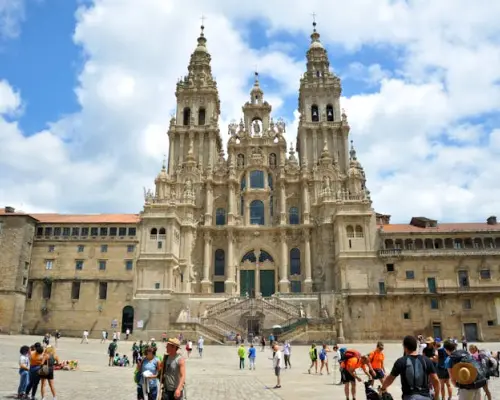
The undeniable highlight is the magnificent Cathedral of Santiago de Compostela, which enshrines the tomb of Saint James. Surrounding it, explore the grand Praza do Obradoiro, flanked by architectural marvels like the Hostal dos Reis Católicos and the Rajoy Palace. The entire historic old town, a UNESCO World Heritage site, is rich with ancient churches, charming squares like Praza da Quintana, and narrow medieval streets perfect for discovery.
6. What is the best time of year to visit Santiago de Compostela for a full-day tour?
The most pleasant times to visit Santiago de Compostela are typically spring (April to May) and autumn (September to October). During these seasons, the weather is generally mild and comfortable for walking and sightseeing, and the city is less crowded than during the peak summer months. Summer (July and August) can be warm and very busy, particularly with pilgrims arriving. Winters are cooler and often bring rain.
7. What kind of local experiences or cultural activities can I find in Santiago de Compostela?
Beyond its pilgrimage heritage, Santiago offers rich cultural experiences. Explore the vibrant Mercado de Abastos, a traditional food market, to sample local Galician produce and seafood. Indulge in authentic Galician cuisine at local restaurants, known for dishes like pulpo a feira (octopus). Enjoy live traditional music in the old town or stroll through Alameda Park for iconic views of the cathedral and city.
8. What should I know about local etiquette or customs when visiting Santiago de Compostela?
When visiting Santiago de Compostela, a polite 'Hola' (hello) and 'Gracias' (thank you) are always appreciated. Dress modestly, especially when entering religious sites like the Cathedral. Meal times are typically later than in many other countries, with lunch often served from 2 PM to 4 PM, and dinner from 9 PM onwards. Tipping is customary but not mandatory, and usually a small amount for good service is sufficient.


