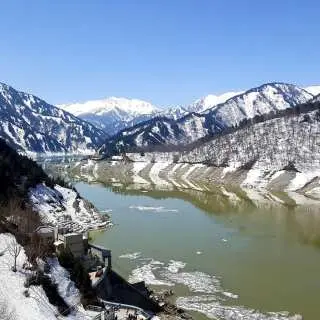
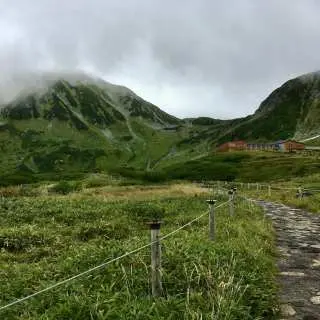
The scenery in Sangokuchi is absolutely stunning. The driver was very kind, there was almost no traffic, and 3.5 hours of free time was more than enough. Exploring Sangokuchi was a true pleasure.
My Two-Day Trip to Tateyama Kurobe and Kamikochi: Although my trip to Tateyama Kurobe and Kamikochi was only two days, it allowed me to deeply appreciate the charm of the Japanese Northern Alps and experience firsthand how a good guide can make a journey truly unforgettable. Day 1: Exploring the Nature of Kamikochi The journey began in Kamikochi. We met up early in the morning, and our guide, Liu Mei, had already thoughtfully arranged our seats on the tour bus, making us feel at ease. During the bus ride, Ms. Liu provided detailed introductions to the attractions along the way. Upon arriving at Kamikochi, she meticulously explained hiking safety precautions—including what to do if you encounter a black bear and how to use a bell to scare it away. These details made us feel safer while enjoying nature. Ms. Liu prepared two routes for us to choose from, patiently explaining the length, difficulty, and scenic features of each route—she was incredibly attentive. Along the way, she also recommended local delicacies and souvenirs, adding a touch of local enjoyment to the hike. After the hike, we returned to the hotel. Ms. Liu assigned us to our rooms and kindly reminded us of the clothing and equipment needed for the next day, allowing us to prepare in advance. The buffet dinner was plentiful, and the overall process went smoothly, ending the first day with satisfaction and anticipation. Day Two: Tateyama Kurobe – A Magnificent Journey with Six Modes of Transportation. The highlight of the second day was Tateyama Kurobe. We used six different modes of transportation to ascend from Ogisawa Station to Murodo, traversing valleys and mountain ranges. The changing of modes of transportation itself was a unique experience: • The Kanden Tunnel Electric Bus took us into the Kurobe Dam. • The Kurobe Ropeway and hiking allowed us to experience the dam's grandeur up close. • The Tateyama Ropeway and Tunnel Bus connected Daikanbo and Murodo. The most anticipated part was undoubtedly the snow-capped mountains and valleys of Murodo, and the Tateyama Kurobe Great Snow Wall. Unfortunately, the weather was poor that day; snow and dense fog prevented us from seeing the famous snow walls. Our guide, Mr. Liu, sincerely apologized and thanked us for our understanding. Although it was somewhat disappointing, the changes in nature are beyond human control, which only makes us cherish every opportunity for a clear, sunny encounter even more. On the highland bus from Murodo to Bijo-hei, I specifically chose a seat on the right. Just as the tour guide had said, I could capture stunning views of the waterfall and the enormous cedar trees; the scenery was breathtaking. Reflecting on these two days of travel, I truly appreciated the awe-inspiring nature of the landscape and witnessed the value of a professional tour guide. Our guide, Ms. Liu, not only arranged the itinerary smoothly and provided clear explanations, but more importantly, she was attentive and...
Although the overall travel time was long, the actual experience wasn't painful, with rest stops on both the outward and return journeys. Upon arriving at Kamikochi, we had nearly three and a half hours. Even the kids, who are usually indifferent to scenery, couldn't help but exclaim, "It's quite beautiful!" 😆 We walked, stopped frequently to take photos, let the kids touch the water, and had short breaks to eat our packed lunches. The walk from Taisho Pond to Kappa Bridge took about two and a half hours, a relaxed and pleasant pace. The scenery is beautiful, highly recommended!
The scenery was truly as beautiful as the legends said; the trip was definitely worthwhile.
Anonymous User
Family
Taisho Pond Weather, Climate and Best Time to Visit
Data source:Meteostat Update date:2025-09
Taisho Pond year round climate
Spring (March–May): Average 6.5–16.8°C, climate transitions from cold to warm, rainfall gradually increases, with more rain during March–May. Common activities: Flower viewing (e.g., mountain cherry blossoms, depending on actual blooming conditions), hiking. Recommended clothing: Light jacket, warm inner layers, rain gear.
Summer (June–August): Average 21.3–26.6°C, warm and humid climate, most rainfall in June, less rainfall in July and August. Common activities: Mountain climbing, riverside walks, enjoying summer scenery. Recommended clothing: Breathable clothing, sun hat, rain gear.
Autumn (September–November): Average 9.1–23.3°C, pleasant and comfortable climate, transitioning from warm to cool, rainfall gradually decreases. Common activities: Maple leaf viewing (depending on actual maple leaf conditions), hiking. Recommended clothing: Light jacket, long-sleeved clothing.
Winter (December–February): Average 0.2–2.9°C, cold and dry climate, least rainfall. Common activities: Snow viewing (depending on actual snowfall), onsen experience. Recommended clothing: Thick jacket, warm clothing, scarf, gloves, hat.
Taisho Pond climatological average
Annual average temperature: approx. 13.4°C / Annual rainfall: approx. 1207 mm / Summer humidity: 70%–80% / Rainiest month: June
Taisho Pond monthly average temperature and precipitation
Month
Air temperature (°C)
Precipitation (mm)
January
0.2°C
29.6
February
1.2°C
48.8
March
6.5°C
124.7
April
13.3°C
160.9
May
16.8°C
173.2
June
21.3°C
181.1
July
25.8°C
113.5
August
26.6°C
76.5
September
23.3°C
111.8
October
14.3°C
96.5
November
9.1°C
76.8
December
2.9°C
14.4
Taisho Pond weather for the next seven days
6/11
Thursday
Patchy rain nearby
23.1°C/5.3°C
6/12
Friday
Patchy rain nearby
22.7°C/7°C
6/13
Saturday
Patchy rain nearby
25°C/5.7°C
6/14
Sunday
Patchy rain nearby
24.5°C/8.1°C
6/15
Monday
Patchy rain nearby
21.5°C/10.1°C
6/16
Tuesday
Patchy rain nearby
24.7°C/10.4°C
6/17
Wednesday
Partly Cloudy
26.1°C/9.7°C
KKday App
Your Best Travel Buddy
Use the code APP5OFF to enjoy an exclusive in-app deal of 5% off (cap at USD$3) on your 1st orderScan here to download the app