



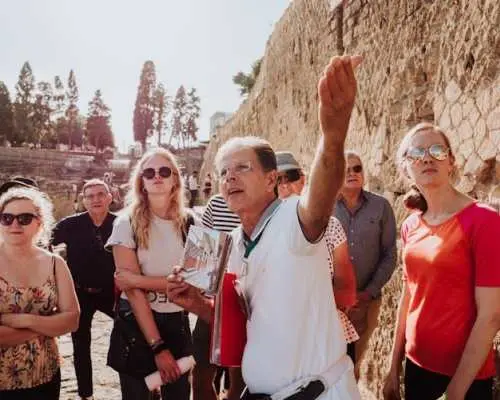

Package Options


Product Info
Purchase Notice
Duration: Lasts up to 2 hours
Reminders
Please refer to your voucher for final information regarding meeting points, pick-up locations, and pick-up time
Meeting point description: Meet your guide at the Herculaneum archaeological site ticket office.(Corso Resina, 80056 Ercolano NA)
Maximum group size of 15 people
The official admission ticket costs €16 per adult and €2 per reduced (EU Citizens aged 18–25), free below 18 years. The price difference is due to the additional services included in the offer. This can be paid both cash or card at the Herculaneum Ruins ticket office
Sunscreen and a hat is recommended for you to have
Bring plenty of water
Wear closed-toe shoes to walk through the ruins of Herculaneum
You can not bring handbags, backpacks, luggage or cases larger than 30x30x15 cm inside of Herculaneum
FAQ
1. How does Herculaneum compare to Pompeii in terms of preservation and visitor experience?
Herculaneum is notably better preserved than Pompeii due to the unique way it was buried. Unlike Pompeii, which was covered by ash and pumice, Herculaneum was inundated by superheated pyroclastic flows that solidified into a dense material, preserving organic elements like wooden structures, fabrics, and even carbonized food. This leads to an experience of intact multi-story buildings and a more intimate, detailed exploration of a smaller, less crowded site.
2. What unique historical conditions led to the different preservation of Herculaneum's remains compared to Pompeii?
Herculaneum was buried by a series of swift, extremely hot pyroclastic flows, which are fast-moving currents of volcanic gas and debris. This intense heat instantly carbonized organic materials such as wood, textiles, and even food, preserving them in exquisite detail. The subsequent cooling and hardening of these flows also encased victims, leading to the remarkable preservation of skeletal remains, unlike the ash-casts found in Pompeii.
3. How long should visitors allocate for a thorough walking tour of Herculaneum?
For a comprehensive exploration of Herculaneum, especially with an expert guide, visitors should typically allocate about two hours. This duration allows ample time to navigate the key areas of the ancient town, understand its unique history and preservation, and appreciate the intricate architectural details and preserved artifacts without feeling rushed. A guided experience enhances the depth of understanding significantly.
4. What kind of on-site experience can visitors expect during a walking tour of Herculaneum?
During a walking tour of Herculaneum, visitors can expect to explore well-preserved ancient Roman streets and enter multi-story houses, shops, and public buildings. The site offers a unique opportunity to see original wooden frameworks, vibrant frescoes, and intricate mosaics, often in their original settings. It provides an immersive glimpse into the daily life of a Roman town due to its compact size and exceptional state of preservation.
5. What are the benefits of exploring Herculaneum with an archaeologist-guide?
Exploring Herculaneum with an archaeologist-guide significantly enhances the visit. An expert guide can provide deep historical context, interpret complex archaeological findings, and highlight crucial details that might be easily missed. They offer insights into the unique preservation methods, the daily lives of the inhabitants, and the broader significance of the structures, enriching your understanding and appreciation of this ancient site.
6. What are the recommended public transportation options for reaching the Herculaneum archaeological site?
The most convenient public transportation to the Herculaneum archaeological site is the Circumvesuviana train line. From Naples, take the train heading towards Sorrento and alight at the 'Ercolano Scavi' station. The entrance to the archaeological park is a straightforward, downhill walk of approximately 10-15 minutes from the station, directly following the main street, Via IV Novembre.
7. Is the Herculaneum archaeological site still undergoing active excavations?
Yes, the Herculaneum archaeological site is still undergoing active excavations, though perhaps not on the same scale or continuity as Pompeii. New discoveries are occasionally made, continuing to reveal more about the ancient town, its inhabitants, and the impact of the Vesuvius eruption. Ongoing work contributes to a deeper and more nuanced understanding of Roman history and archaeology.
8. What are some key features and highlights visitors should look for at the Herculaneum ruins?
When exploring the Herculaneum ruins, be sure to look for the remarkably preserved multi-story buildings, such as the House of the Bicentenary with its detailed frescoes, and the House of the Deer. The Suburban Baths offer excellent insights into Roman bathing culture. Also, observe the unique carbonized wooden structures that provide a rare glimpse into ancient architecture, and the boat-houses where many human remains were found along the ancient shoreline.


