

South America Multi-Country eSIM | 5G/4G Network 3-30 Days | ChatGPT Supported | Argentina, Bolivia, Brazil, Chile, Peru, etc.
- Travel across multiple South American countries with one card, the best choice for your business trips and vacations.
- No need to swap cards, zero waste. Get your eSIM and use it instantly to enjoy fast 5G/4G internet, saving time and being eco-friendly.
- Various data plans available to suit your needs.
Package Options
Product Info
The 7 South American countries include: Costa Rica, El Salvador, Guatemala, Honduras, Nicaragua, Paraguay, and the Dominican Republic.
The 8 South American countries include: Argentina, Bolivia, Brazil, Chile, Ecuador, Peru, Uruguay, and Venezuela.
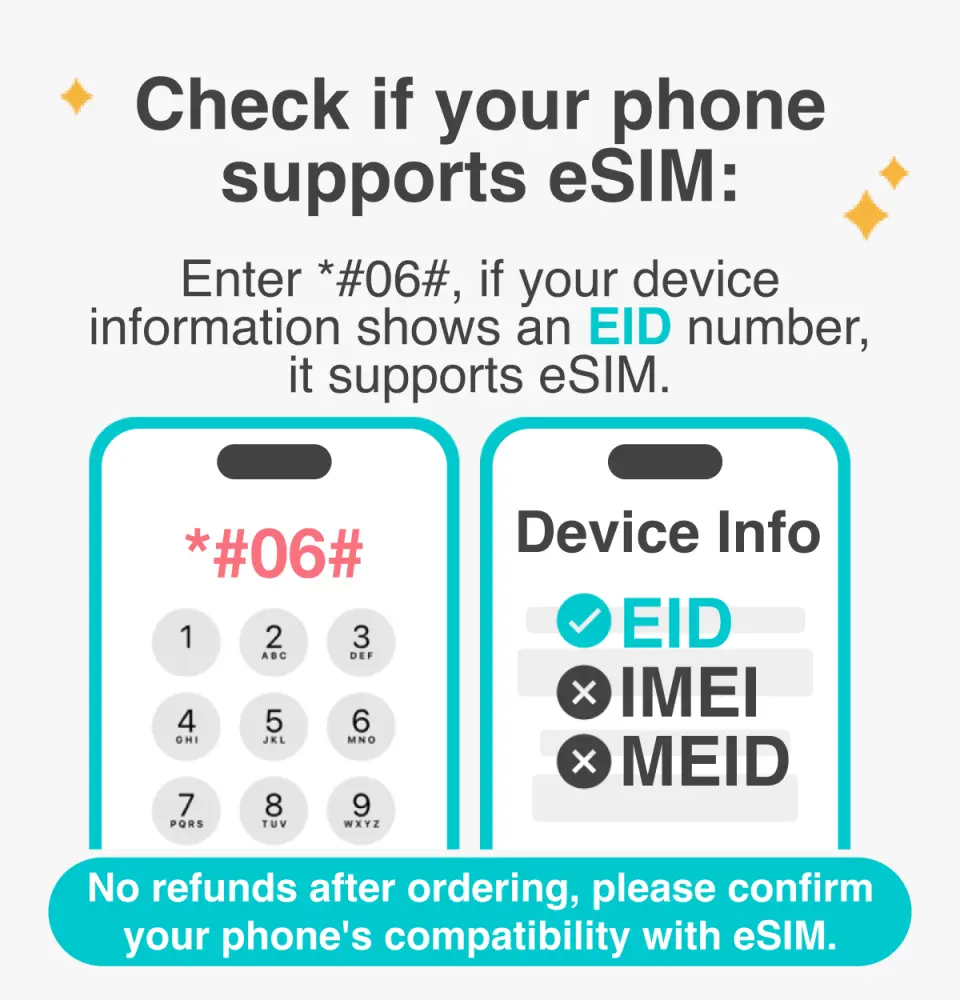
Please confirm whether your device is eSIM compatible before purchasing.

iOS Installation Instructions

Android Installation Instructions
Purchase Notice
- Mobile data only; voice calls and SMS functionality are not supported.
- Please enter *#06# on your phone's dial pad to check if eSIM is supported. If EID is displayed, it means eSIM is supported; if not, eSIM is not supported.
- Please be aware that signal quality may be affected by factors such as location, terrain, building obstruction, number of users, and weather.
- If your location or mobile phone does not support 5G, it will automatically switch to 4G/3G signal. The actual network speed depends on the local signal.
- To maintain network connection quality and uphold the Fair Usage Policy (FUP), telecommunications companies worldwide sometimes impose data rationing on users who consume large amounts of data in a short period, which may result in internet access disruptions or slower speeds. To ensure a stable internet connection, please avoid prolonged periods of watching or downloading videos, updating software, sharing your hotspot with others, or engaging in other activities that consume excessive data.
Reminders
Once the QR code is scanned and the order is successfully downloaded, cancellation and refunds are not possible.
Installing an eSIM requires an internet connection. Please install it when you have a stable Wi-Fi or mobile data connection (installation may fail due to Wi-Fi at some airports).
Each QR code can be scanned once. It can be scanned repeatedly on the same device. Once bound, it cannot be changed to another device or deleted.
Please use the eSIM within 60 days of receiving it; it will expire after that period.
It is recommended to scan and install the eSIM after arriving at your destination to avoid starting the validity period calculation prematurely.
Before using an eSIM, please be sure to disable data roaming on your domestic SIM card to avoid accidentally using your domestic SIM card's mobile data network and incurring high international roaming charges. You will be responsible for all related costs; no additional subsidies will be provided, including roaming fees, overseas SIM card/eSIM purchase costs, and transportation expenses.
Please enter *#06# on your phone's dial pad to check if eSIM is supported. If EID is displayed, it means eSIM is supported; if not, eSIM is not supported.
iOS version 12.1 or later is required. Please note that iPhones sold in mainland China do not support eSIM. In Hong Kong and Macau, only the iPhone 13 mini, iPhone 12 mini, iPhone SE 2020, and iPhone XS have eSIM functionality.
Samsung phones vary by country. Samsung phones purchased in Taiwan do not support eSIM. For other regions, please check with the Samsung website first.
To maintain network connection quality and uphold the Fair Usage Policy (FUP), telecommunications companies worldwide sometimes impose data rationing on users who consume large amounts of data in a short period, which may result in internet access disruptions or slower speeds. To ensure a stable internet connection, please avoid prolonged periods of watching or downloading videos, updating software, sharing your hotspot with others, or engaging in other activities that consume excessive data.
How to Use
Activation steps:
1. After arriving at your destination, turn off all other SIM cards and only enable eSIM and its data roaming.
2. Configure the eSIM's APN (usually the APN is automatically recognized; if it cannot be automatically recognized, you need to set it manually).
Cancellation Policy
- Once the order has been completed, it cannot be canceled, modified, or refunded
- Due to time zone differences, the confirmed cancellation date is based on the supplier’s local time. Please allow 2–5 business days to process your cancellation request, after which the cancellation fee will be charged according to the product’s cancellation policy. Once your refund request is confirmed, KKday will initiate the refund to your original payment method within 15 days. The actual refund timing depends on your card-issuing bank’s policy.
FAQ
1. What are the potential disadvantages of using a South America eSIM for travel?
While convenient, a South America eSIM requires a compatible device. Not all older smartphone models support eSIM functionality. Additionally, the initial setup process involves scanning a QR code, which might require a stable internet connection or an alternative device to display the code. Users should also ensure they purchase the correct data plan for their travel duration and data needs, as exceeding limits may result in slower speeds or additional costs.
2. Can I use a South America eSIM simultaneously with my existing physical SIM card?
Yes, most modern smartphones that support eSIM functionality also offer Dual SIM Dual Standby (DSDS). This allows you to use your existing physical SIM for calls and texts (e.g., your home number) while using the South America eSIM for mobile data when traveling. You can easily switch between your physical SIM and eSIM for data usage in your phone settings, offering flexibility for managing connectivity abroad.
3. What is the process for installing and activating a South America eSIM?
Installing a South America eSIM is straightforward. After purchase, you will typically receive a QR code via email. Simply scan this QR code using your compatible smartphone's settings to add the eSIM profile. Once installed, activate the eSIM by enabling data roaming in your phone settings upon arrival in any of the covered South American countries. This allows immediate connection to the local 5G/4G network without needing a physical card.
4. What are the key advantages of using a South America eSIM over a traditional physical SIM card for multi-country travel?
The main advantages of a South America eSIM include unparalleled convenience for multi-country travel. You don't need to physically swap SIM cards or search for local providers upon arrival, saving time and hassle. It supports seamless connectivity across multiple South American nations with a single plan. Being digital, it's also eco-friendly, as it eliminates plastic waste from physical SIM cards, and you can enjoy quick 5G/4G internet access.
5. What device requirements are necessary to use a South America eSIM?
To use a South America eSIM, your smartphone must be eSIM-compatible and unlocked by your carrier. Most recent iPhone models (XR/XS and newer), Google Pixel phones (3 and newer), and some Samsung Galaxy devices (S20 and newer, Flip/Fold series) support eSIM. Ensure your device's operating system is updated to the latest version for optimal performance and compatibility with eSIM features.
6. Which South American countries does the multi-country eSIM service cover?
The South America multi-country eSIM offers coverage across several nations. You can travel and stay connected in Argentina, Bolivia, Brazil, Chile, Ecuador, Peru, Uruguay, and Venezuela. This extensive coverage makes it an ideal solution for travelers visiting multiple destinations within the region, ensuring consistent 5G/4G internet access throughout your journey.
7. What types of data plans are available with the South America eSIM?
The South America eSIM offers various data plans to suit different travel needs. Options typically include plans ranging from 3 to 30 days in duration, with different data allowances. You can select a plan that aligns with your specific trip length and expected data consumption, ensuring you have sufficient 5G/4G internet access for navigation, communication, and other online activities, including supporting services like ChatGPT.
8. How does the South America eSIM provide 5G/4G internet and support services like ChatGPT?
The South America eSIM utilizes local 5G/4G networks in the covered countries, providing fast and reliable internet access. Once activated, your device connects to the strongest available signal. This robust connectivity supports all standard online services, including browsing, social media, video streaming, and sophisticated AI applications like ChatGPT, allowing you to access information and communicate efficiently throughout your travels.


